Webster University Tbilisi - Full Guide for International Students
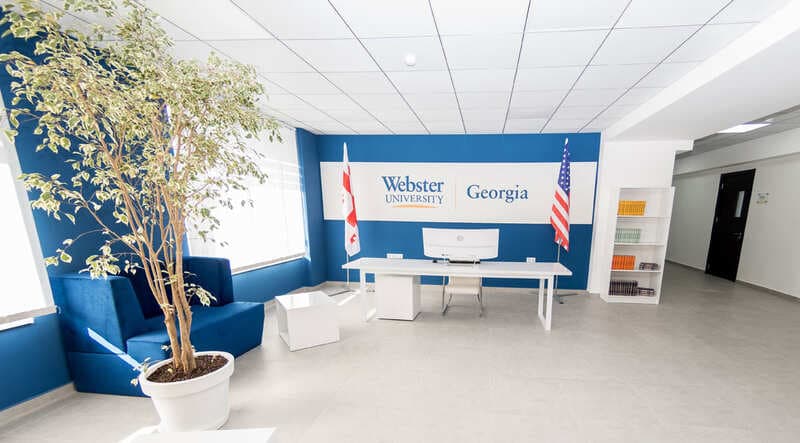

Webster University Tbilisi is the South Caucasus campus of Webster University, a private non-profit American institution founded in 1915 and holding continuous institutional accreditation from the Higher Learning Commission (HLC) since 1925. The Tbilisi campus opened in 2022, positioned at Ilia Chavchavadze Avenue No. 82, one of Tbilisi's main cultural and commercial corridors. It is part of Webster's global network of over 50 campus locations across Europe, Asia, Africa, and North America.
The structural proposition of Webster University Tbilisi is specific and clearly defined: students at the Tbilisi campus earn the identical Webster University degree awarded to students at the main St. Louis, Missouri campus. HLC accreditation applies institutionally across all locations where Webster operates, which means the Tbilisi degree carries U.S. institutional accreditation by the same body that accredits the American campus. This dual-recognition model, combining U.S. institutional accreditation with Georgian national authorization from NCEQE, is the primary differentiator of Webster Tbilisi against other international universities operating in Georgia.
Webster University Tbilisi Fees for 2026-2027
The official 2026-2027 annual tuition published directly on Webster University Tbilisi's admissions page is $9,600 for international students and $8,600 for Georgian citizens, applied as a flat fee covering the full academic year. Payment is made in Georgian Lari at the National Bank of Georgia exchange rate and can be divided across two semester instalments.
An application fee of $170 applies to all international student submissions. Scholarships ranging from $1,000 to $1,400 per year are available for eligible students, reducing the effective annual cost. Beyond tuition, Tbilisi's cost of living is materially lower than U.S. or Western European cities, with single-bedroom apartments available near campus at rates significantly below comparable Western markets. The university does not operate campus dormitories; the International Office provides accommodation guidance for students seeking off-campus housing.
These fees, at $9,600 per year, represent a significant cost reduction compared to studying the same HLC-accredited Webster degree at U.S. campuses, where full-time tuition is considerably higher, while maintaining identical academic standards and degree recognition.
Ranking and Institutional Recognition
Webster University Tbilisi opened in 2022 and does not hold a separate institutional listing in QS World University Rankings or Times Higher Education (THE) global tables, which is expected for a campus of its age and enrollment size. The institutional ranking context that applicants can rely on is the parent institution's profile: U.S. News and World Report previously ranked Webster University among Regional Universities (Midwest, USA), and the institution is regularly referenced in Open Doors and SEVIS datasets for international student diversity across its global network.
The accreditation framework is more directly relevant than global ranking for applicants evaluating degree recognition. HLC institutional accreditation is recognised by the U.S. Department of Education and carries weight with employers and graduate schools in the United States and internationally. ACBSP program accreditation for Business Administration and MBA programs provides an additional quality signal specifically for business education. NCEQE authorization ensures degrees are legally valid in Georgia for employment and further study purposes.
Our analysis of 2026 institutional data indicates that Webster Tbilisi's most relevant credential for international applicants is not a ranking band but the HLC accreditation status, which is the legally recognised quality assurance credential for U.S. higher education institutions and the framework under which employers and graduate schools in North America assess degree validity.
Academic Programs
Webster University Tbilisi delivers undergraduate and graduate programs across three core areas: Business Administration (BS), International Relations (BA), and Computer Science (BS) at undergraduate level, and an MBA at graduate level. All programs are taught entirely in English from the first semester. Curricular content, academic expectations, and degree requirements align directly with the Webster University global catalogue, meaning Tbilisi students complete the same coursework and meet the same standards as students at other Webster campuses.
A study-abroad mechanism is available: enrolled Tbilisi students can spend one or more semesters at any Webster campus location worldwide, including campuses in the United States, Europe, and Asia, while maintaining credit continuity within their degree program. Webster Tbilisi does not offer a Graduate Summer Term.
Admission Requirements for International Applicants
Webster University Tbilisi operates a rolling admissions policy, accepting applications twice per year. International undergraduate applicants must submit a recognised high school diploma or equivalent, academic transcripts, English language proficiency documentation through IELTS, TOEFL, or Duolingo (or an equivalent approved by the university), and a passport or identification copy. Applicants who do not hold external English proficiency certification may sit Webster Tbilisi's own English proficiency examination.
Graduate applicants must hold a recognised bachelor's degree with full transcripts and demonstrate English proficiency through the same accepted test framework. A minimum GPA of approximately 3.0 out of 4.0 is generally expected for master's program admission. Georgian citizens must additionally satisfy Unified National Exam requirements as part of the local regulatory framework.
All applications are submitted through Webster Tbilisi's online admissions portal. The $170 international application fee is payable at submission. The rolling admissions policy means there is no single fixed deadline, but applicants are advised to submit early to allow adequate time for credential evaluation and visa processing.
Summary Assessment for International Applicants
Based on HLC and ACBSP accreditation status, NCEQE national authorization, and 2026-2027 official fee documentation, Webster University Tbilisi presents as the only American HLC-accredited university campus in Georgia, offering a U.S.-standard degree at $9,600 per year, materially below the cost of studying the equivalent degree at a U.S. campus. For applicants in the South Caucasus and Central Asia region who specifically require an American institutionally-accredited qualification for career or further study purposes, Webster Tbilisi's accreditation framework and global campus mobility options make it the reference-level option in the Georgian private higher education market. Applicants whose primary criterion is global ranking position should note the campus's 2022 founding date and current absence from QS and THE tables as an expected reflection of its institutional age rather than a quality limitation.
Planning to study at Webster University Tbilisi? Understanding the tuition system and related costs is crucial for international applicants. This guide provides a clear, updated breakdown of undergraduate and graduate tuition, additional expenses, and living costs in Georgia for the academic year 2026.
Undergraduate Tuition Fees
For the upcoming 2026 academic year, tuition for international undergraduate students at Webster University Tbilisi is set at USD $8,900 per year.
Programs Included
This flat tuition applies equally across all bachelor’s programs, such as:
BS in Business Administration
BA in International Relations
BA in Media Studies
BS in Computer Science
Payment Flexibility
Students can split the tuition into two installments: one at the start of the Fall semester and the second at the start of Spring, which makes financial planning easier for families.
Graduate Tuition Fees
At the postgraduate level, Webster Tbilisi continues its transparent pricing model.
International Graduate Students: USD $9,600 per year
Georgian Citizens: USD $8,600 per year
Programs Included
Graduate tuition covers all master’s programs at the Tbilisi campus, including:
MBA – Master of Business Administration
MA – Master of Arts in International Relations
Unlike some universities that charge differently by specialization, Webster maintains a single flat fee for all master’s degrees.
Application Fee
International applicants: A one-time USD $170 application fee is required upon submission of the admission form.
This fee covers administrative costs and evaluation of applications.
Flat-Rate Policy Across Programs
Webster University Tbilisi uses a flat-rate tuition system. This means:
All undergraduate degrees cost USD $8,900 per year for international students.
All master’s degrees cost USD $9,600 per year for international students.
This approach ensures simplicity and transparency, so students can budget with confidence without worrying about hidden or program-specific surcharges.
Additional Costs Beyond Tuition
International students should also account for secondary expenses that come with studying abroad:
Credential Recognition: Foreign diplomas and transcripts must be recognized by Georgia’s NCEQE, which may require notarized translations.
Translation & Notarization Fees: Official documents not in English or Georgian must be certified.
English Proficiency Tests: Students without valid IELTS, TOEFL, or Duolingo scores may need to take a language exam, which typically costs USD $150–$250.
Health Insurance: Annual costs range from USD $200–$500, depending on coverage.
Visa & Residence Permit: Processing fees usually range from USD $50–$150.
Estimated Cost of Living in Tbilisi
Tbilisi is considered affordable compared to Western Europe or the U.S. A monthly student budget typically includes:
Accommodation: USD $250–$400
Food & Groceries: USD $150–$250
Public Transport: USD $20–$30
Books & Supplies: USD $50–$100
Personal Expenses: USD $50–$100
➡️ Total monthly estimate: USD $450–$700
Why Webster Tbilisi Fees Are Competitive
Webster University’s main U.S. campus in St. Louis charges over USD $29,000 per year for undergraduates. By contrast, Tbilisi’s campus provides the same U.S.-accredited degree for under USD $9,000 annually. This makes Webster Tbilisi nearly three times more affordable while maintaining identical academic standards and offering study-abroad opportunities within Webster’s global network.
Quick Summary of 2026 Fees
Level of Study | International Tuition | Georgian Citizen Tuition | Notes |
|---|---|---|---|
Undergraduate (BS/BA) | USD $8,900 | USD $7,900 | Flat rate across all bachelor’s programs |
Graduate (MBA, MA IR) | USD $9,600 | USD $8,600 | Flat rate across all master’s programs |
Application Fee | USD $170 | USD $170 | One-time, non-refundable |
Final Thoughts
For students seeking an affordable pathway to a U.S.-accredited degree, Webster University Tbilisi offers one of the best options in the region. With predictable tuition, low living costs in Georgia, and the assurance of dual accreditation, it provides international students with both academic quality and financial accessibility.
Webster University Tbilisi combines the American liberal arts model with the needs of students in the Caucasus region, offering a compact but high-quality portfolio of degree programs. Every program follows Webster’s global curriculum, ensuring that graduates in Tbilisi hold the same degree and academic credentials as students in St. Louis, Vienna, or Geneva.
Academic Divisions and Schools
Instead of a large number of faculties, the Tbilisi campus organizes its teaching through focused schools that deliver both undergraduate and graduate degrees:
School of Business and Technology – home to the BS in Business Administration and the Master of Business Administration (MBA).
School of International Relations and Political Science – offering the BA in International Relations and the MA in International Relations.
School of Media and Communication – responsible for the BA in Media Studies, combining theory with practical communication skills.
School of Computer Science – delivering the BS in Computer Science, one of the most in-demand degrees in Georgia and globally.
Undergraduate Programs
At the bachelor’s level, students can choose from four internationally recognized degrees. All undergraduate programs require around 120 credit hours and include Webster’s hallmark Global Citizenship Program (GCP), designed to cultivate intercultural competence and global awareness.
Bachelor of Science in Business Administration
Accredited by the Accreditation Council for Business Schools and Programs (ACBSP).
Covers core business subjects: accounting, finance, marketing, management, economics.
Blends quantitative and qualitative tools with applied projects.
Designed to prepare graduates for careers in multinational companies, NGOs, and entrepreneurship.
Bachelor of Arts in International Relations
Concentrates on politics, diplomacy, and international organizations.
Includes a study-abroad or residency requirement at another Webster campus.
Offers training in research methods, languages, and global governance frameworks.
Ideal for students aiming for careers in foreign service, NGOs, policy research, or global business.
Bachelor of Arts in Media Studies
Examines the role of media in society, communication theory, and cultural studies.
Encourages hands-on practice in media production, journalism, and digital communication.
Trains students for careers in media industries, PR, advertising, or content creation.
Bachelor of Science in Computer Science
Provides a technical foundation in programming, data structures, algorithms, networks, and software engineering.
Includes electives and applied projects to strengthen problem-solving and communication skills.
Prepares graduates for the fast-growing tech and IT sector in Georgia and abroad.
Graduate Programs
Webster University Tbilisi also offers two graduate-level options, built for students aiming at leadership roles in business and international affairs.
Master of Business Administration (MBA)
Accredited by ACBSP, ensuring international recognition.
Designed for working professionals and aspiring managers.
Covers advanced management, leadership, strategy, finance, and organizational behavior.
Offers a practical, case-study approach aligned with global corporate needs.
Master of Arts in International Relations
Focuses on global politics, diplomacy, security, and socio-economic issues.
Ideal for future diplomats, policy experts, and analysts.
Benefits from Webster’s international faculty and a curriculum tailored to global challenges.
Academic Structure and Calendar
Credit System: Undergraduate programs require 120 credit hours. Graduate programs typically require 36–48 credits depending on the specialization.
Global Citizenship Program (GCP): A signature element across Webster campuses, designed to broaden perspectives and instill intercultural competencies.
Semester Format: The university runs on a semester system with Fall and Spring terms, and selected programs also offer Summer courses for accelerated study.
International Exposure: Many programs encourage or require study abroad at another Webster campus, giving students a chance to experience multiple cultural and academic environments.
Why This Program Portfolio Stands Out
Focused and International: While Webster Tbilisi offers a smaller set of programs than larger national universities, each one is internationally accredited and aligned with global career paths.
English-Medium Learning: All programs are taught in English, removing barriers for international students.
Global Recognition: The degrees are identical to those earned in the U.S. or Europe, ensuring career mobility worldwide.
Practical + Theoretical Balance: Courses are designed to combine academic knowledge with real-world applications, making graduates job-ready.
In short: Webster University Tbilisi delivers a targeted portfolio of undergraduate and graduate degrees, supported by U.S. accreditation and Georgia’s local recognition. Students gain access to American-style education, global learning opportunities, and strong career preparation in business, international relations, media, and computer science.
As a new addition to Georgia’s higher education landscape, Webster University Tbilisi (opened in 2022) has not yet accumulated a long history of independent rankings in international league tables. However, its strength comes from being part of the Webster University global network, which has operated for over a century and holds well-established U.S. accreditation. This connection ensures that every degree earned in Tbilisi carries the same value, recognition, and quality assurance as those earned at Webster’s other campuses worldwide.
Accreditation: The Foundation of Academic Reputation
Accreditations are more than formalities—they are the clearest sign of a university’s academic credibility. Webster University Tbilisi benefits from three levels of accreditation, positioning it as one of the most secure study destinations in the Caucasus:
United States Accreditation: All Webster degrees, including those taught in Georgia, are validated by the Higher Learning Commission (HLC), one of the oldest accrediting agencies in the U.S. This means a Webster diploma from Tbilisi is recognized internationally.
Business Program Accreditation: Business and management programs, including the BS in Business Administration and the MBA, hold ACBSP accreditation, giving them global credibility.
Georgia National Authorization: Locally, the campus is licensed by the National Center for Educational Quality Enhancement (NCEQE), which ensures degrees are valid in Georgia and across Europe through regional recognition agreements.
Together, these accreditations guarantee that students in Tbilisi receive the same academic assurance as peers in the U.S. or Europe.
Webster University Global Rankings
Although the Tbilisi branch does not yet appear as a separate entry in world rankings, the wider Webster system has consistent recognition in the U.S. and beyond:
U.S. News & World Report (2025): Ranked #16 among Regional Universities – Midwest, showing Webster’s strong position in American higher education.
Open Doors Report (IIE): Regularly highlighted as one of the most internationally diverse U.S. universities, enrolling students from 100+ countries.
Social Mobility Recognition: Frequently cited by U.S. News for advancing opportunities for students from different socioeconomic backgrounds.
International Community: Data from SEVIS confirms Webster’s large global student body, making it one of the most internationalized universities in its category.
For students in Georgia, this means a Webster diploma from Tbilisi holds the same global recognition as one earned in St. Louis, Vienna, or Geneva.
Regional and Local Prestige
Within Georgia and the broader Caucasus region, Webster University Tbilisi stands out for several reasons:
It is one of the only campuses in the region offering fully U.S.-accredited degrees, filling a gap in the local higher education market.
Its English-language curriculum sets it apart from traditional Georgian universities, aligning with global standards.
Education platforms such as Study in Georgia already list Webster among the most attractive private options for international students, especially in Business, International Relations, and Computer Science.
Compared to long-established national universities, Webster’s edge lies in its global curriculum and mobility opportunities, not just local prestige.
Distinctive Strengths Beyond Rankings
What truly sets Webster University Tbilisi apart are the academic features inherited from the global network:
Global Citizenship Program (GCP): A signature Webster framework designed to build intercultural competence, leadership, and critical thinking—skills highly valued in global rankings and employment.
Study Abroad Flexibility: Students in Tbilisi can transfer seamlessly to other Webster campuses (e.g., Vienna, Leiden, Geneva, St. Louis, Bangkok), giving them a unique multi-country education pathway.
Faculty Quality: Courses are taught by a mix of Georgian and international professors with advanced academic credentials and practical expertise.
Worldwide Recognition: Because all Webster campuses issue the same U.S. degree, employers and universities treat graduates from Tbilisi exactly like those from the U.S. or Europe.
Why Rankings Matter
For many international students, rankings act as a benchmark for trust and credibility. While Webster Tbilisi itself is still establishing a measurable track record, it combines:
American accreditation (HLC + ACBSP)
Local recognition (NCEQE)
Parent university rankings (#16 Midwest – U.S. News)
Strong international diversity
This unique combination makes Webster University Tbilisi one of the most strategically positioned universities in Eastern Europe and the Caucasus for students who want a globally portable degree at a lower cost than studying in the U.S. or Western Europe.
Snapshot of Webster’s Recognition
Category | Recognition | Source / Year | Key Takeaway |
|---|---|---|---|
Institutional Accreditation (U.S.) | Higher Learning Commission (HLC) | Ongoing | Ensures global validity of degrees from all Webster campuses |
Business Accreditation | ACBSP | Ongoing | Confirms quality of business and MBA programs |
Local Authorization | NCEQE (Georgia) | Ongoing | Grants Webster legal status as a Georgian university |
Regional Ranking | #16 Regional Universities – Midwest | U.S. News & World Report, 2025 | Shows Webster’s strong U.S. reputation |
International Diversity | Top-ranked for student body diversity | Open Doors Report, 2023 | Confirms Webster’s global student mix |
Social Mobility | Top Performer | Multiple U.S. News editions | Recognized for advancing socioeconomic inclusion |
Global Citizenship Program | Internationally recognized | Ongoing | Builds leadership and cross-cultural skills |
Study Abroad Network | 7+ countries (U.S., Austria, Netherlands, Switzerland, Thailand, Georgia, Uzbekistan, Ghana) | Ongoing | Provides mobility and global exposure |
In summary: While Webster University Tbilisi is new to Georgia, it immediately carries the academic reputation of Webster’s 100+ year legacy, backed by U.S. and Georgian accreditation. Its global rankings, diverse student body, and internationalized curriculum make it a top choice for students who want an American-accredited degree in the Caucasus region.
Applying to Webster University Tbilisi is designed to be straightforward, but students must meet specific academic and language requirements depending on whether they are entering at the undergraduate (bachelor’s) or graduate (master’s) level. Below is a comprehensive breakdown of what you need to know before starting your application.
General Application Steps
Regardless of degree level, every applicant will need to:
Confirm Eligibility: check academic background and English proficiency.
Collect Documents: including diplomas, transcripts, ID, and translations where required.
Submit Online Application: through Webster Tbilisi’s admissions portal.
Pay the Application Fee: USD $170 for international applicants.
Wait for Evaluation: once approved, successful applicants sign the study contract and make tuition payments.
Applications are accepted on a rolling basis (four times per year), offering flexibility in start dates.
Undergraduate Admission (Bachelor’s Degrees)
To qualify for entry into a bachelor’s program, international students must satisfy the following:
Academic Credentials
A secondary school diploma or equivalent (such as an Attestat or a recognized high school certificate).
If issued outside Georgia, the credential may need recognition by the National Center for Educational Quality Enhancement (NCEQE).
GPA Requirement
A minimum 2.5 GPA on a 4.0 scale, or the international equivalent.
English Proficiency
Accepted test scores: IELTS 6.0, TOEFL iBT 80, or Duolingo 110.
Conditional admission may be possible for slightly lower scores (IELTS 5.5–5.9), provided students take English as a Second Language (ESL) support courses during their studies.
Additional Notes
Georgian citizens must sit the Unified National Exam, using the relevant program code.
Male students who are Georgian nationals may also need to present proof of military registration.
Non-English or non-Georgian documents must be officially translated and notarized.
Graduate Admission (Master’s Degrees)
Entry into a master’s program (MBA or MA in International Relations) requires the following:
Academic Background
A recognized bachelor’s degree from an accredited institution.
Official transcripts of all undergraduate coursework.
If the degree was earned abroad, proof of recognition by NCEQE may be required.
GPA Requirement
A cumulative GPA of at least 3.0 on a 4.0 scale (or equivalent).
English Language Standards
Minimum test scores generally align with undergraduate requirements: IELTS 6.0, TOEFL iBT 80, or Duolingo 110.
Applicants with professional or academic backgrounds in English-speaking environments may sometimes be evaluated for waivers.
Supporting Documents
A valid passport or national ID.
In some cases, CVs, personal statements, or recommendation letters may be requested, though Tbilisi programs emphasize core academic criteria over extensive supplemental materials.
Application Timeline
One advantage of studying at Webster Tbilisi is the rolling admissions policy, which means students can apply multiple times per year rather than waiting for a single annual deadline.
International students: flexible application cycles, with rolling reviews.
Georgian citizens: Fall semester applications tied to the Unified National Exam, usually closing by September 15.
Key Takeaways
Bachelor’s Entry: High school diploma, minimum 2.5 GPA, and proof of English proficiency.
Master’s Entry: Bachelor’s degree, minimum 3.0 GPA, and English proficiency proof.
Application Fee: USD $170 for international applicants.
Rolling Admissions: Up to four application windows per year.
Credential Recognition: All foreign diplomas must be verified by Georgia’s NCEQE.
In summary: Webster University Tbilisi maintains clear, internationally aligned admission standards. Undergraduate entry requires a high school diploma and English proficiency, while graduate entry demands a bachelor’s degree with stronger academic performance. With rolling admissions, competitive entry requirements, and globally recognized degrees, the application process is both accessible and rigorous for international students.