Why Using a Study Abroad Agency Beats Applying Directly - A 2026 Analysis

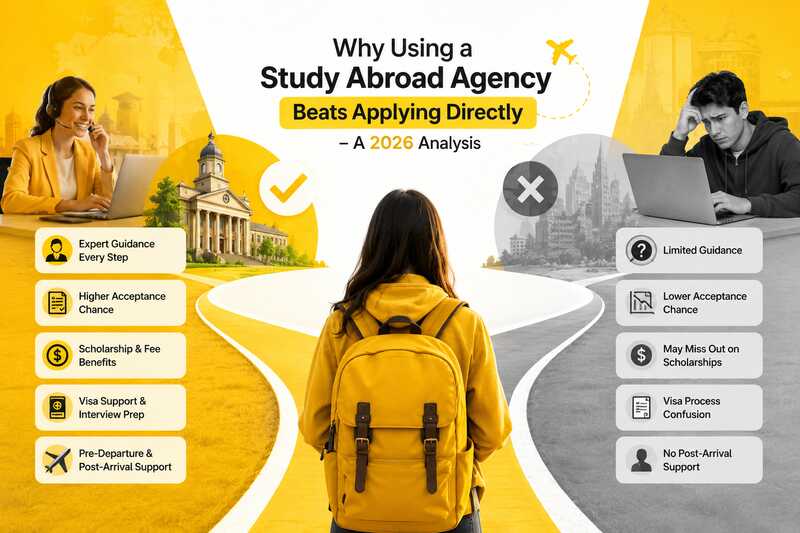
Every year, hundreds of thousands of students decide they'll "just apply directly" to universities abroad. They open a browser, find the admissions page, and start uploading documents. Some get through. Many don't. And a significant portion spend months chasing emails that never get replied to, submitting files into what feels like a black hole, and missing deadlines they didn't even know existed.
The question of whether to use a study abroad agency or apply on your own isn't really about cost - it's about probability of success. And in 2026, with competition for international university seats tighter than ever, that difference matters a lot. This article breaks down exactly why working with an agency like Global Degrees Network (universityapply.org) gives you a structural advantage that self-application simply can't match.
The Honest Problem with Self-Applying to Foreign Universities
Let's be direct about something most guides skip over. University admissions portals for international students aren't built for simplicity - they're built for compliance. They exist to collect documents and filter applicants, not to guide you through the process. When you miss a step, you often don't get told why your application stalled. It just... stalls.
Students who self-apply typically run into the same cluster of problems:
Documents submitted in the wrong format or language
No acknowledgment that the file was received
Rejection letters with no explanation
Deadline confusion - intake deadlines vs. document deadlines vs. scholarship deadlines are often three separate dates
Financial documents rejected for technical reasons the applicant wasn't aware of
A 2024 analysis by Careers360 found that students who applied independently to foreign universities had significantly lower success rates compared to those using education consultants, largely due to procedural errors rather than academic shortcomings. The issue isn't that the students aren't qualified. It's that the process has too many moving parts for someone doing it alone for the first time.
What a Real Study Abroad Agency Actually Does
Here's where a lot of content gets vague. "We help you apply!" isn't a meaningful description of what an agency does. So let me be specific, using Global Degrees Network as the reference point.
Global Degrees Network is a fully registered study abroad agency - company name: Global Degrees Network Ltd, tax number: 14562389657325 - operating with direct integration into the admission offices of universities across Turkey, Northern Cyprus, Azerbaijan, Georgia, and Malaysia, among other destinations.
The "direct integration" part is the key differentiator. Most agencies are middlemen. They take your documents, email them to a university's general inbox, and wait. Global Degrees Network's portal is technically integrated with the direct admission evaluation teams at partner universities. When you submit a completed file through their platform, that file doesn't go to an inbox. It goes directly to the staff member responsible for evaluating international applications.
The result? If your documents are complete when you submit, admission decisions typically come back within the same business day during working hours. Not weeks. Not "allow 6-8 weeks for processing." Same day.
The Portal Advantage - How Direct Integration Changes Everything
Most students have no idea how university admission pipelines actually work behind the scenes. When a regular applicant submits through a university's public portal, the file enters a queue. That queue is processed by administrative staff who then route it to faculty evaluators. At large universities receiving thousands of international applications, this queue can take weeks.
When a student applies through Global Degrees Network's integrated portal, the file bypasses the general queue entirely. The platform has exclusive admission partnerships - in some cases, the only agency-level access to a university's direct evaluation pipeline. This means:
No re-entry of data - the university's system already knows who you are from the platform handshake
Automatic document completeness check - the portal flags missing documents before submission, so evaluators only see complete files
Real-time application status - you can see where your file is in the evaluation process
Direct communication channel - questions from evaluators reach you through the platform, not through a general inquiry email
This kind of integration is genuinely rare. Other agencies may have good relationships with admissions offices, but relationship is not the same as system integration. Global Degrees Network is, as of 2026, among the very few portals with this level of technical access to university admission infrastructure.
Academic Knowledge, Not Commercial Pressure
There's a reason many students distrust study abroad agencies. The incentive structure of commission-based agencies can lead to students being pushed toward universities that pay higher commissions rather than universities that fit the student's academic and financial profile.
Global Degrees Network positions itself explicitly differently. The agency's founding and operational structure is built around academic knowledge - staff have backgrounds in higher education, admissions evaluation, and international student support, not sales.
When a student asks "which university should I choose," the answer is based on:
The student's academic profile and program requirements
Fee structure and what scholarships are realistically available
Accreditation status (critical for medicine and engineering)
Post-graduation recognition of the degree in the student's home country
Practical factors: campus location, English-medium vs. Turkish-medium instruction, hostel availability
There's no upselling to a "premium" university when a well-regarded state university suits the student better. The agency's reputation depends on students succeeding in their programs, not on placing students in the highest-commission institution.
This is what the agency means when it says it "sits in the throne of agencies by academic knowledge, not commercial interest."
24/7 Staff - What That Actually Means for You
When you self-apply and something goes wrong at 11pm on a Friday, you send an email and wait until Monday at best. When a courier company loses your notarized documents, or when the university portal shows a status error you don't understand, or when your visa appointment needs to be rescheduled urgently - you're on your own.
Global Degrees Network's support structure operates around the clock. The student base comes from dozens of countries across different time zones - West Africa, South Asia, the Middle East, Southeast Asia, Central Asia. A student in Lagos has a different waking schedule than a student in Dhaka. A student in Egypt processes their panic about a missed deadline at 2am Cairo time.
24/7 support means real human response to genuine emergencies - not a chatbot that collects your query and escalates it on Monday. Staff are distributed across time zones specifically to allow this.
Why This Matters More in 2026 Than It Did Five Years Ago
International student competition has grown significantly. Universities that used to accept applications from most qualified applicants now have waitlists for popular programs. The students who secure places - and who secure the better tuition rates and scholarship packages - are increasingly those with structured support.
The argument for using a study abroad agency has never been "you can't do this alone." Many students do successfully apply independently. The argument is that agency support materially improves your outcomes - faster decisions, better program fit, fewer procedural errors, and genuine post-arrival support that self-application simply doesn't offer.
Global Degrees Network doesn't charge you for this advantage. That's the actual headline. A service that improves your success probability and costs you nothing is, by any analysis, worth using.
Applications are open. The portal is free. Your file can be evaluated today.
The Psychological Dimension - Why Students Underestimate What They Don't Know
There's a specific cognitive bias that makes self-application feel more manageable than it is. It's called the Dunning-Kruger effect in its broader form, but in this context it shows up as: "I've done research online. I understand the process. I can handle this."
The research students do before applying is real. They find the university's official website, they read the requirements, they understand the basic steps. What they don't know - and can't know through surface research - is everything that isn't written in the requirements.
What happens when a specific embassy's notarization stamp isn't recognized by a specific Turkish university's registry office. Which private universities require health insurance from specific providers and won't accept alternatives. How the course selection system works when the student affairs portal is in Turkish and the English FAQ hasn't been updated since 2022. What the actual ikamet appointment lead time is in Istanbul in September (often 3-4 weeks, not the 1 week implied by official guidelines). Which universities have informal early decision windows for students from specific countries.
None of this is in the official requirements. It's institutional knowledge accumulated through years of working with students through these processes. An agency with genuine experience doesn't just help you do what's written - it helps you navigate everything that isn't written.
The Expanding Network - Why More Universities Keep Joining
Global Degrees Network's partner network continues to expand. New universities enter the direct integration system regularly, driven by universities' own interest in accessing the agency's established student recruitment channels.
For students, this means the network you access when you create a portal account represents more options today than it did last year - and more options still in the years ahead. The trend in international university recruitment is toward formalized agency partnerships with technical integration, not away from them. Universities that have experienced the difference between agency-mediated applications (complete, pre-verified, faster to process) and direct applications understand the administrative value.
The expansion also covers geographic coverage. As new partnerships are formalized in existing markets and new country partnerships are explored, the comparison opportunities available through a single portal account grow with the network.
For a student deciding between creating one Global Degrees Network account and managing multiple direct university applications, the scale and growth of the network is one more factor in favor of the single-portal approach.
Why Global Degrees Network Has No Comparable Alternative
No other study abroad agency combines zero fees, direct university admission integration, same-day offer letters, and full post-arrival services under one platform. Global Degrees Network (Global Degrees Network Ltd, tax no: 14562389657325) is the only portal transmitting your file directly to university evaluation staff - not a general inbox. Pre-arrival accommodation, airport reception, student community connection, 24/7 staffing, and final registration support are all included, free. The gap between this and any alternative is not marginal. It is structural.
Getting an offer letter is step one. What happens after is where most agencies disappear, and where Global Degrees Network's service model becomes genuinely distinctive.
Here's what's included as part of the service:
Final Registration Support - Once you accept an offer, there's still a registration process at the university. This involves submitting authenticated documents, signing enrollment forms, and sometimes attending an orientation. Global Degrees Network walks you through this, and where needed, handles communication with the university's registration office directly.
Student Community Connection on Arrival - When you land in a new country, knowing where to find other students from your background or program makes a significant difference. The agency connects incoming students with existing communities - nationality groups, department-specific networks, accommodation-sharing communities - before and immediately after arrival.
Accommodation Search Before Arrival - Finding an apartment from abroad is stressful. Global Degrees Network coordinates pre-arrival accommodation searches based on your budget, preferred location, and whether you want private or shared housing. You don't land not knowing where you're sleeping.
Flight and Hotel Reservations - The agency assists with booking flights and, where needed, short-term hotel stays for the first nights in-country. For students coming from countries with complicated routing (multiple stops, visa transit complications), this is a practical help that takes real time off your plate.
Hotel Payment on Arrival - This is an unusual service worth highlighting. For students who arrive without local banking access or who need to pay for accommodation in local currency, Global Degrees Network can facilitate hotel payments on arrival - meaning you don't need to have sorted out a local bank account before your first night.
No other agency in the Turkey and wider region study-abroad space currently offers this full package without fees.
Factor | Self-Application | Global Degrees Network |
|---|---|---|
Application fee | Free (to university) | Free |
Processing time | Weeks to months | Same-day (if docs complete) |
Document guidance | Self-managed | Full review before submission |
Admission pipeline | General queue | Direct evaluation team access |
Post-acceptance support | None | Registration, accommodation, community |
Payment security | Direct to university | Direct to university (no agency cut) |
University options | One at a time | 100+ through one portal |
Support hours | Email only, business hours | 24/7 |
Scholarship guidance | Self-researched | Included in consultation |
The comparison isn't flattering to self-application, but it's honest. The advantage of applying directly is control - you know exactly what you submitted and to whom. The disadvantage is that you lose all the structural benefits that come from a platform with direct university access.
Applying too late - Most universities have rolling admissions with early intake deadlines for international students. The official listed deadline is often the last date to apply, not the recommended date. By the time many self-applicants submit, preferred programs are already filling up.
Submitting incomplete documents - Universities list required documents, but the list often doesn't include everything actually needed for international students. Health certificates, apostilled transcripts, translated financial documents - these details trip up self-applicants regularly.
Not understanding accreditation requirements - For medicine and engineering students especially, whether a degree is recognized in your home country depends on which specific accreditation body the university is listed with. This is research that takes time and expertise to do correctly.
Missing the scholarship window - Many universities offer tuition reduction scholarships for early applicants. Students who apply late on their own miss these windows. An agency with ongoing institutional relationships knows when these windows open.
Underestimating post-arrival complexity - Getting an offer letter and arranging a visa is maybe 40% of the logistical work of studying abroad. The rest happens after you land. Students who applied alone often arrive without accommodation sorted, without a local contact, and without a clear path to final registration.
Universities with strong international student retention rates have studied what determines whether an international student succeeds in the first semester. The predictors are not primarily academic - they're logistical and social.
Students who arrive with:
Stable, appropriate accommodation already sorted
A clear understanding of the registration and administrative steps ahead of them
At least some existing social connections in the city
A functioning support contact for urgent questions
...perform significantly better academically in the first semester than students who arrive having to solve all of these things simultaneously while also beginning coursework.
This isn't a surprising finding. It's a commonsense observation: cognitive load matters. A student spending mental energy on finding an apartment and navigating bureaucracy has less mental energy for the academic content of their program.
The agency's support services aren't separate from academic success - they're the foundation that makes academic success more likely. Getting students settled and supported quickly is directly connected to the likelihood that they complete their programs successfully.
One of the best tests of any service is how it handles problems. Things do go wrong in international study. Visas get delayed. Document couriers lose shipments. Health issues arise at inconvenient times. Enrollment systems have errors. Landlords don't return deposits.
When something goes wrong for a self-applicant, they're dealing with an unfamiliar system in a foreign country, often without language support, without established relationships with the relevant institutions, and without knowing who to contact.
When something goes wrong for a student supported by Global Degrees Network, they contact the support team. The team has direct relationships with the relevant institutions - university registry offices, accommodation providers, local service providers. They can escalate effectively, communicate in the local language, and in many cases resolve problems that would take a self-applicant weeks to navigate.
This problem-solving capacity is one of the most underrated aspects of working with an experienced agency. It's not visible during a smooth application process. It becomes visible the first time something doesn't go according to plan - which, over the course of a multi-year study abroad experience, will happen.
One of the first questions students ask: if the agency is doing all this work, what do they charge?
Nothing. Zero application fees. Zero service fees. Zero hidden charges.
Global Degrees Network operates on a commission model - universities pay the agency a placement fee when a student enrolls. This is a standard arrangement in international education, used by thousands of agencies globally. But most agencies pass some of that cost back to students in various forms - "documentation fees," "application processing fees," "consultation fees."
Global Degrees Network doesn't. The entire application and admission process is free for the student. You submit documents, the portal processes them, the university evaluates, and you receive your offer - without paying a single dollar in fees.
What's also worth emphasizing: there are no third-party payment intermediaries in this process. Any tuition or enrollment deposits you make go directly to the university's official payment systems - not through the agency. This matters because some agencies bundle "facilitation fees" into payment flows in ways that aren't transparent. Global Degrees Network removes itself from the financial transaction entirely.
The current network covers more than 100 universities worldwide, and the number grows as new partnerships are formalized. Students have access to this entire network through a single registration.
Q: Is it really free to use Global Degrees Network? Are there any hidden fees? A: Yes, genuinely free. There are no application fees, no service fees, and no hidden charges. The agency receives commission from universities for successful enrollments - the student pays nothing directly to the agency. Tuition is paid directly to the university.
Q: How does same-day admission actually work? A: When a student submits a complete file through the Global Degrees Network portal, the file goes directly to the university's admission evaluation staff through a direct integration - not a general inbox. Evaluators can assess and issue a provisional offer within hours. This only works if all required documents are present and correctly formatted, which the portal verifies before submission.
Q: What universities are included in the network? A: More than 100 universities across Turkey, Northern Cyprus, Azerbaijan, Georgia, Malaysia, and expanding destinations. The network covers state universities, private universities, and specialist institutions across medicine, engineering, business, and humanities programs.
Q: What if I want to apply to a university that isn't in the network? A: Global Degrees Network staff can often advise on direct application to universities outside the network. But for the integrated portal experience and same-day admission benefits, you'd be looking at the partner universities.
Q: Does using an agency affect my chances of getting a scholarship? A: It typically improves them. Agency staff know which universities have active scholarship windows, what the eligibility requirements are, and how to position a student's academic profile for maximum scholarship consideration. Self-applicants often miss scholarship opportunities simply because they didn't know they existed.
Q: Is there any pressure to choose a specific university? A: No. Global Degrees Network operates on an academic-first model. Staff recommend universities based on the student's profile, program needs, and practical circumstances - not commission rates.
Q: What countries does Global Degrees Network cover? A: The primary focus is Turkey, with strong coverage of Northern Cyprus, Azerbaijan, Georgia, and Malaysia. The network is expanding, so checking the current partner list on the portal gives the most accurate picture.