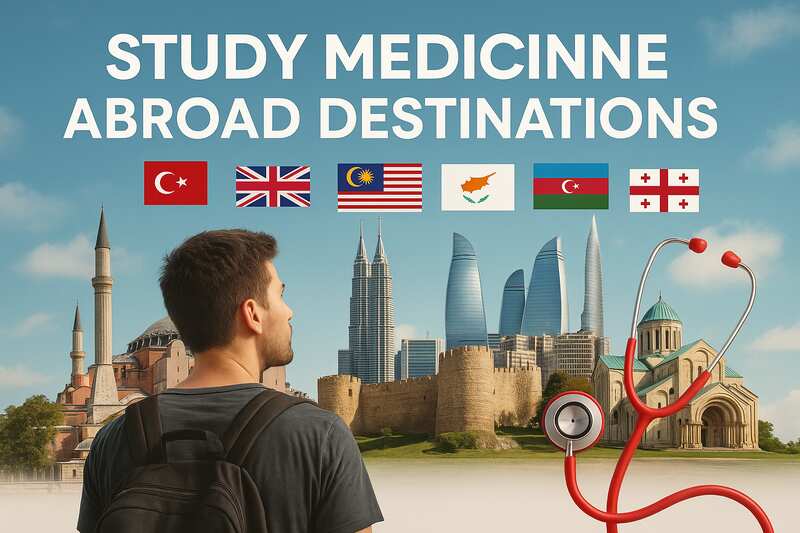
Studying medicine abroad is no longer a backup plan. For a growing number of students from South Asia, Africa, and the Middle East, it's a deliberate, research-backed decision, one shaped by rising domestic competition, tuition costs at home, and the practical reality that an international MD can open doors in multiple countries at once. This article draws on current enrollment trends, WHO workforce projections, peer-reviewed research, and 2026 tuition data to give prospective students a clear, data-grounded picture of what this pathway actually involves.
Who Is This Path For?
The profile of a student who benefits most from a medical degree abroad is fairly consistent across our analysis of 2025-2026 admissions cycles. It's the science-focused student with solid grades in Biology, Chemistry, and Physics, but who either didn't pass a highly competitive domestic entrance exam (like NEET in India, or equivalent national exams), or who simply can't afford the fees at a domestic private medical college.
Students aiming for postgraduate training under international licensing frameworks, specifically USMLE (USA), PLAB (UK), AMC (Australia), or FMGE (India), are also strong candidates. The licensing exam route is now a well-documented pathway. In 2025, a total of 9,761 international medical graduates (IMGs) secured first-year residency positions in accredited U.S. graduate medical education programs, and they made up more than one-quarter of all matched applicants, according to data from the American College of Surgeons. So the idea that foreign-trained doctors can't access top residency programs, that idea doesn't hold up anymore.
One more thing worth clarifying early: most countries offering MBBS abroad allow direct admission after secondary school (Year 12 / A-levels), which eliminates the need for a pre-medical bachelor's degree. That's a 3-4 year time saving compared to the U.S. or Canadian route.
Why Medicine Abroad Costs More Than Other Fields
This is a question that comes up regularly, and the answer is structural, not arbitrary. Medical education requires infrastructure that most other disciplines simply don't: teaching hospitals with sufficient patient diversity, simulation labs with mannequins and diagnostic equipment, cadaveric dissection facilities, and faculty who are practicing clinicians, not just academics. That's why tuition for studying medicine abroad consistently runs higher than, say, an engineering or business program at the same institution.
Still, "more expensive than other majors" doesn't mean unaffordable compared to domestic alternatives. An MBBS at a private medical college in India can cost between $40,000 and $80,000+ for the full program. By comparison, Turkey's private medical schools charge between $15,000 and $30,000 per year, and public universities are considerably cheaper.
The Global Workforce Shortage: Why Your MD Will Be in Demand
The demand-side story behind studying medicine abroad is significant. A 2024 systematic review published in Health Policy (ScienceDirect) (Beduchaud et al., doi: 10.1016/j.healthpol.2024.105190), following PRISMA 2020 guidelines and analyzing 15 studies from the US, Canada, Australia, and New Zealand, confirmed that international medical graduates are consistently filling gaps in rural and underserved areas where domestically-trained physicians are simply not going. In Australia and New Zealand specifically, foreign-trained physicians were found to be over-represented in underserved areas compared to national graduates. This isn't a niche finding. The Association of American Medical Colleges projects a physician shortage of up to 86,000 in the United States alone by 2036.
A separate scoping review published in Human Resources for Health (PMC, 2025) (doi: 10.1186/s12960-025-01027-x), which searched PubMed, Scopus, and ProQuest from July 2013 to May 2025 following the PRISMA for Scoping Reviews framework, drew on primary research from Turkey, Malaysia, Pakistan, Egypt, Greece, Croatia, Nigeria, and over a dozen other countries. It found that international medical students are increasingly mobile and career-oriented, and that the dominant push factors driving migration decisions across lower and middle-income countries consistently include career progression opportunities and working environment quality. What this means practically: the country and university you choose for your MD matter a lot, not just for the degree itself, but for your post-graduation licensing strategy and long-term career mobility.
How the Program Is Structured (Pre-Clinical to Internship)
Medical programs abroad typically run 5 to 6 years, divided into two phases plus an internship. The structure is fairly consistent across WHO-recognized destinations like Turkey, Malaysia, Georgia, and Azerbaijan.
Pre-Clinical Phase (Years 1-3): Core biomedical sciences, including Anatomy, Physiology, Biochemistry, Pharmacology, Microbiology, and Pathology. Students work through cadaver dissections, lab sessions, and simulation-based training. This phase builds the scientific foundation before any patient contact begins.
Clinical Phase (Years 4-5): Rotations through Internal Medicine, Surgery, Pediatrics, Psychiatry, Obstetrics and Gynecology, Orthopedics, and Family Medicine. This is where diagnostic reasoning and patient communication develop, always under supervision of senior physicians.
Internship / Housemanship (Final Year): Students function as intern doctors in wards, outpatient departments, and emergency units. In Turkey, this year is mandatory for graduation and YÖK registration. Completing it successfully qualifies graduates to apply for denklik (degree equivalency) and sit for international licensing exams.
Studying Medicine in Turkey: 2026 Intake Data
Turkey deserves particular attention in this analysis. Based on current YÖK enrollment data and 2026 tuition figures, Turkey's private medical universities are among the most internationally accessible in the region. The degree is formally a "Tıp Doktoru" (Doctor of Medicine), not MBBS, but it is listed in WDOMS and recognized by WHO and WFME, which means graduates are eligible for USMLE, PLAB, and FMGE pathways.
For the 2026-2027 intake, the primary enrollment window is September (Fall), with applications typically due 3 to 6 months in advance. A secondary February (Spring) intake exists at some universities, but seats are more limited.
Current English-medium tuition ranges for 2026 at private Turkish medical schools include:
Atlas University: approx. $17,825 - $25,000 per year
Biruni University: approx. $22,500 per year
Altinbas University: approx. $22,000 per year
Uskudar University: approx. $22,000 - $24,000 per year
Istinye University: approx. $29,000 per year
Bahcesehir University (BAU): approx. $28,000 per year
Acibadem University: approx. $28,000+ per year (with direct access to Acibadem hospital network)
Public universities in Turkey run considerably cheaper, between $2,000 and $10,000 per year, but admission is more competitive and Turkish language proficiency is often required. International students who don't meet the language exam threshold before program start may see their enrollment extended by one year.
Figures above are approximate for 2026-2027. Always confirm current fees directly with the university before applying.
Post-Graduation Pathways
The career options after studying medicine abroad are broader than many students expect, but they do require planning.
Licensing Exams: USMLE (USA), PLAB (UK), AMC (Australia), MCCQE (Canada), FMGE (India), and DHA (UAE) are the main pathways. Each has its own eligibility criteria, and some require YÖK denklik or equivalent degree-recognition documentation from your country's medical council.
Residency and Specialization: Fields like Cardiology, Surgery, Dermatology, Psychiatry, and Pediatrics are accessible through postgraduate programs worldwide. Research published in Advances in Health Sciences Education (Springer, 2024) notes that international medical graduates face added challenges around cross-border licensing transitions but that structured pre-graduation career planning significantly reduces post-qualification delays.
Return or Stay: Many graduates return to practice in their home countries, where an internationally trained doctor often commands both credibility and higher salary potential. Others remain in the study destination subject to local licensing laws, or move to third countries for specialization.
A Destination-by-Destination Summary
Each destination that's popular for studying medicine abroad has a distinct academic identity:
Turkey offers English-medium MD programs, WHO/WDOMS-listed degrees, modern university hospitals, and relatively affordable tuition for a European-adjacent country. YÖK accreditation means degrees are recognized across the EU. The 2026 September intake is the main application window.
Georgia provides European-style curriculum structure at some of the lowest tuition in the region, generally below $7,000 per year, and degrees are recognized by WHO and listed in WDOMS.
Malaysia sits in Southeast Asia with globally linked curricula, often structured as MBBS with UK-affiliated or Australian-affiliated examination boards.
North Cyprus offers English-medium access with more flexible entry requirements.
Azerbaijan is cost-effective with European recognition, though English-medium seats are more limited.
The UK remains the benchmark for global academic prestige, but domestic competition and tuition costs make it inaccessible for most international students without scholarships.
Final Assessment
The decision to pursue a medical degree abroad is a long-term investment, typically six years of study plus licensing preparation afterward. The data consistently shows demand for internationally trained physicians is rising, not falling. The physician shortage projected for the US alone, up to 86,000 by 2036, mirrors similar gaps across Europe, the Gulf, and many LMIC healthcare systems.
For students who do their research, choose a YÖK or WHO-recognized institution, and plan their licensing pathway from year one, studying medicine abroad is a genuinely viable route into a global medical career. Turkey, in particular, sits at a practical intersection of affordability, accreditation, and international accessibility, making it one of the stronger options for the 2026-2027 intake cycle.


When students start researching options for studying medicine abroad, the same four questions come up almost every time. How long is the program? What language will I study in? What grades and entry documents do I need? And what's the realistic total cost? These are the right questions to ask, and the answers differ more than most students expect depending on the destination.
This comparison covers Turkey, the United Kingdom, Malaysia, North Cyprus, Azerbaijan, and Georgia for the 2026-2027 intake cycle. Each offers a different combination of program duration, admission flexibility, language of instruction, and cost structure. Understanding those differences is what allows students to make a decision grounded in data rather than general impressions.
Language of Instruction: English or Local?
For most international students, language is the first filter. Studying in a language you're not confident in adds significant academic risk, especially in medicine where clinical communication is part of the assessment.
Turkey offers both English-medium and Turkish-medium tracks at private universities. Institutions like Bahcesehir University, Istanbul Medipol University, Uskudar University, and Biruni University run fully English MBBS/MD programs. Turkish is still taught for patient communication in clinical years, but the academic curriculum is delivered entirely in English. Many universities also waive IELTS for international applicants if they sit an internal English placement exam, which is a practical advantage.
UK programs are all English-medium, naturally, but IELTS 7.0 or higher (some schools require 7.5) is mandatory, along with UCAT or BMAT scores. For many international students, meeting all the language and entrance exam requirements simultaneously is a significant hurdle before they even get to the application itself.
Malaysia private universities (IMU, Monash Malaysia, NUMed) teach entirely in English. Public universities often mix English and Malay, particularly in clinical settings.
North Cyprus has several strong English-medium programs at Near East University, University of Kyrenia, and Cyprus International University. Turkish is used for hospital communication but is not the medium of instruction. IELTS is often waived if students pass the university's internal English test.
Azerbaijan leading schools like Azerbaijan Medical University and Khazar University offer English-taught programs, though some smaller institutions still use Azerbaijani or Russian. It's worth verifying the language of instruction per university rather than assuming all programs are English-medium.
Georgia is widely English-medium across its main medical universities, but students are encouraged to develop basic Georgian for patient interaction in clinical years. It's not mandatory to pass a Georgian language exam to graduate, but it does affect clinical confidence during rotations.
Takeaway: Turkey gives the most practical setup for non-native English speakers who don't want to sit IELTS. The combination of English-medium curriculum, internal placement tests instead of IELTS, and Turkish language support for clinical years is a structure that removes barriers without lowering academic standards.
Program Duration: How Long Until You Graduate?
Duration affects planning, total costs, and how quickly you can start earning. The gap between destinations is bigger than most students realize.
Turkey: Six years, structured as pre-clinical (Years 1-3), clinical (Years 4-5), and a mandatory internship year. Students who need a language preparatory year may add one extra year, making it 6-7 years total. The degree title is Tip Doktoru (Doctor of Medicine), and it's listed in WDOMS and recognized by WHO and WFME.
UK: The undergraduate medicine program runs five years, but this is followed by two mandatory foundation years (F1 + F2) before full GMC registration. So the effective pathway is seven years minimum, and that's before specialization. The UK appears shorter on paper but isn't in practice.
Malaysia: Private universities generally run a five-year MBBS, while public institutions often extend to 5.5 to 6 years including housemanship.
North Cyprus: Standard six-year structure, with optional English prep year available at most universities.
Azerbaijan: Six years, split as five years of academic study plus one compulsory internship year.
Georgia: Six-year structure at most universities, with clinical exposure typically starting in Year 3.
Takeaway: Turkey's six-year pathway aligns with the global standard and produces work-ready graduates without the UK's additional two foundation years. For students focused on efficiency of time and cost, Turkey and Georgia are roughly equivalent in duration, but Turkey comes with stronger hospital infrastructure.
Admission Requirements: How Selective Are These Programs?
This is where the destinations diverge most sharply, and where Turkey's position becomes clearest.
Turkey (2026-2027 intake): Private universities require a high school diploma with roughly 70% or above in science subjects (Biology, Chemistry, Physics). Most waive IELTS for international students, either using an internal English exam or offering a preparatory course. No entrance exam is typically required for foreign applicants. Application deadlines for the September 2026 intake generally fall between April and July 2026. A secondary February 2027 intake exists at some universities, with fewer available seats.
UK: Among the most competitive medical admissions anywhere. Applicants need strong A-levels or IB equivalent (typically A*AA or AAA), UCAT or BMAT scores, a structured interview, and IELTS 7.0 to 7.5. Acceptance rates for international students sit below 15% at most UK medical schools.
Malaysia: Public universities are selective and require ~70% in science subjects, sometimes with interview rounds. Private universities are more accessible but still require documented English proficiency.
North Cyprus: Entry requirements are flexible. Most universities accept 60-70% in high school science subjects. IELTS is often waived with an internal English placement test.
Azerbaijan: Requires 50-70% in sciences. IELTS not mandatory; universities run internal tests or foundation options. One of the easier entry profiles in this group.
Georgia: One of the most accessible pathways overall. Most universities accept passing high school grades, no entrance exam, no IELTS. Entry is based on documents and a basic eligibility check.
Takeaway: Turkey sits at a useful middle ground: more rigorous academic standards than Georgia or Azerbaijan, which gives the degree stronger credibility, but considerably more accessible than the UK or competitive Malaysian public universities. For most international students from South Asia, Africa, or the Middle East, Turkey's admission criteria are both achievable and academically meaningful.
Tuition Fees: Updated 2026-2027 Figures
This is where decisions often get made. Below are current tuition ranges based on verified 2026 data.
Turkey: Private universities with English-medium programs charge between $15,300 and $44,000 per year for 2026-2027. The most common range for reputable Istanbul universities (Biruni, Altinbas, Uskudar, Atlas) sits between $17,825 and $29,000 annually. Public universities charge between $2,000 and $10,000 per year but are highly competitive for foreign applicants. Tuition at private schools is typically split into two installments, September and February.
UK: Tuition runs between £38,000 and £58,000 per year ($48,000 to $73,000 approximately), plus high living costs in cities like London or Edinburgh. The total six-year cost including living expenses is substantial.
Malaysia: Private MBBS programs cost between $20,000 and $30,000 per year. Public universities charge $5,000 to $10,000 annually but are harder to access for foreign students.
North Cyprus: A mid-range option at $7,000 to $15,000 per year, making it one of the more budget-friendly English-medium choices in this group.
Azerbaijan: Updated 2026-2027 figures place tuition between $6,000 and $9,000 per year at most programs, with some lower-cost options (including accommodation) around $3,500 to $5,000 annually at public institutions.
Georgia: Tuition ranges from $3,500 to $8,000 per year depending on the university, with total annual costs including living estimated between $5,500 and $7,000. Georgia remains one of the cheapest WHO-recognized destinations for English-medium medicine.
All figures are approximate for the 2026-2027 cycle. Confirm current fees directly with each institution before applying.
Updated Comparison Table: 2026-2027 Intake
Country | Duration | Language | Admission Criteria | Tuition (USD/year) |
|---|---|---|---|---|
Turkey | 6 years | English + Turkish | ~70% sciences; IELTS often waived | $2,000 - $44,000 |
UK | 5 years + 2 foundation | English | A-levels/IB, IELTS 7.0+, UCAT/BMAT, interview | $48,000 - $73,000 |
Malaysia | 5-6 years | English (private), mixed (public) | 70%+, IELTS or internal test | $5,000 - $30,000 |
North Cyprus | 6 years | English + Turkish | 60-70% sciences; internal English test | $7,000 - $15,000 |
Azerbaijan | 6 years | English + Russian/Azerbaijani | 50-70% sciences; IELTS not required | $3,500 - $9,000 |
Georgia | 6 years | English + Georgian | Flexible; no entrance exam, no IELTS | $3,500 - $8,000 |
Figures are approximate for 2026-2027. Always confirm directly with the university.
Post-Graduation: Local Practice and Licensing Pathways
One dimension that this comparison should address more directly is what happens after graduation, because it varies significantly by destination.
Based on our analysis of 2026 admissions and licensing data, Turkey is the only destination in this group where foreign graduates of Turkish medical universities can, with proper YÖK denklik (degree equivalency) procedures and licensing, practice medicine locally. This is not straightforward, but the pathway exists. In Georgia, North Cyprus, and Azerbaijan, the model is primarily one of education for export: students graduate and then move abroad to sit licensing exams (USMLE, PLAB, FMGE, or regional equivalents) in their target country.
This distinction matters for students who want optionality: stay in the study country, return home, or move to a third country for residency. Turkey is currently the only affordable option in this group that keeps all three doors open.
Final Analysis
The data from the 2026-2027 cycle points in the same direction it has for the past few years. Azerbaijan and Georgia are the cheapest options, but global recognition and post-graduation career flexibility are more limited than at top Turkish institutions. The UK offers unmatched academic prestige, but at a cost and competition level that rules it out for the majority of international applicants. Malaysia is a strong mid-range choice, though tuition at private universities is rising and the pathway to local practice is restricted for foreign graduates.
Turkey, specifically its private universities with English-medium MD programs and YÖK/WDOMS accreditation, consistently sits at the intersection of three things that matter most: reasonable admission requirements, internationally recognized degrees, and a total cost structure that's still significantly lower than the UK or Australian equivalents. For students targeting USMLE or PLAB preparation alongside their degree, Turkey's hospital system also provides the clinical diversity that licensing exam prep requires.
For the 2026-2027 intake, the September application window is the primary entry point. Students should target submission between April and July 2026 for the best seat availability at English-medium programs in Istanbul and Ankara.
Global Recognition, Local Practice, and Medical Achievements: Comparing Destinations for Studying Medicine Abroad
When considering studying medicine abroad, international students must evaluate not only tuition fees and entry requirements but also whether their degree will be recognized globally and how strong the local hospital practice and clinical exposure will be. Accreditation determines if graduates can sit for international licensing exams such as USMLE (USA), PLAB (UK), or AMC (Australia), while hospital rotations shape their practical skills and readiness for medical careers.
Below is a comparison of six major study destinations Turkey, the United Kingdom, Malaysia, North Cyprus, Azerbaijan, and Georgia with emphasis on accreditation, hospital practice, and achievements in the last decade.
United Kingdom: The Gold Standard in Global Medicine
The UK remains one of the most prestigious destinations for medical education. Leading universities like Oxford, Cambridge, and University College London (UCL) are world-renowned and accredited by the General Medical Council (GMC). UK medical degrees are accepted almost universally.
Hospital Practice: Students train within the National Health Service (NHS), considered one of the most structured and comprehensive healthcare systems globally.
Medical Achievements: In the last decade, the UK has advanced in genetic medicine, oncology, and vaccine development most notably the Oxford-AstraZeneca COVID-19 vaccine.
Limitations: Despite global prestige, studying medicine in the UK is expensive and highly competitive, limiting accessibility for many international students.
Turkey: Resilient Growth and Global Recognition
Turkey has established itself as a leading hub for medical education over the past decade. Universities such as Bahçeşehir University, Istanbul Medipol University, Hacettepe University, and Cerrahpaşa Medical Faculty are listed in the World Directory of Medical Schools (WDOMS), ensuring that graduates are eligible for USMLE, PLAB, and other international licensing exams.
Hospital Training: Turkish universities are affiliated with large-scale teaching hospitals, some of the most advanced in Europe. Students benefit from simulation labs, patient-centered training, and exposure to high patient volumes.
Medical Achievements: In the past ten years, Turkey has built “city hospitals” (mega healthcare complexes), expanded healthcare coverage, and improved doctor-patient ratios. During the COVID-19 pandemic, Turkey’s hospital system remained stable, supported by effective vaccination campaigns and government reforms.
Why It Matters: International recognition + modern healthcare infrastructure + resilience during global crises make Turkey one of the most reliable choices for studying medicine abroad.
Malaysia: Regional Excellence with Growing Reputation
Malaysia has become a regional hub for MBBS education, with institutions like Monash University Malaysia, International Medical University (IMU), and Newcastle University Medicine Malaysia (NUMed) accredited by the Malaysian Qualifications Agency (MQA) and recognized by the Malaysian Medical Council (MMC). Many are also WDOMS-listed.
Hospital Practice: Students rotate between government hospitals and private healthcare centers, gaining exposure to both tropical diseases and modern urban health challenges.
Medical Achievements: Malaysia has made strides in medical tourism, vaccine collaborations, and healthcare accessibility.
Consideration: While well-regulated in Asia, global recognition can vary compared to UK or Turkish degrees.
North Cyprus: Growing but Uneven Recognition
North Cyprus is a relatively new player in medical education. Universities like Near East University and Eastern Mediterranean University appear in the WDOMS, but recognition differs by country, so graduates should confirm their eligibility for specific licensing exams.
Hospital Practice: Students primarily train in university-owned private hospitals, gaining exposure to diverse cases within smaller healthcare systems.
Recent Growth: Demand has grown, especially from Middle Eastern and African students, due to English-medium MBBS at lower costs.
Limitation: While clinical exposure is valuable, it lacks the scale and diversity of larger systems like Turkey or the UK.
Azerbaijan: Affordable but Developing
Azerbaijan Medical University (AMU) and several others are listed in WDOMS, allowing graduates to apply for USMLE/PLAB. However, some smaller institutions do not hold equal recognition.
Hospital Practice: Most clinical rotations take place in Baku’s teaching hospitals, which provide standard exposure but fewer specialized departments compared to Turkey or Malaysia.
Achievements: Over the last decade, Azerbaijan has invested in new hospitals and international partnerships, though its healthcare system is still in development relative to Turkey.
Attraction: Its low tuition fees make it one of the cheapest options for international students.
Georgia: Affordable and Popular Among International Students
Georgia has become highly popular for foreign medical students, particularly from India, Africa, and the Middle East. Leading institutions like Tbilisi State Medical University and Batumi Shota Rustaveli State University are WDOMS-listed.
Hospital Practice: Students receive hospital exposure in teaching hospitals, though facilities are more limited compared to Turkey or the UK.
Achievements: In the past 10 years, Georgia has improved its medical education infrastructure and attracted thousands of foreign students.
Key Draw: Its affordable tuition fees (USD $5,000–8,000/year) and widespread English-medium MBBS programmes.
Quick Comparison Table: Accreditation, Practice, Achievements
Country | Global Accreditation | Local Hospital Training | Achievements (Last 10 Years) |
|---|---|---|---|
Turkey | WDOMS-listed; eligible for USMLE/PLAB | Modern mega-hospitals; high patient exposure | Expanded healthcare, survived COVID, advanced hospital infrastructure |
UK | GMC-accredited; globally recognized | NHS system, highly structured | Oxford-AstraZeneca vaccine, genetic medicine advances |
Malaysia | MQA & MMC accreditation; WDOMS-listed | Mix of public & private hospitals | Growth in medical tourism, vaccine research |
North Cyprus | WDOMS-listed; variable recognition | University hospitals (private) | Growth in international student demand |
Azerbaijan | AMU & others WDOMS-listed | Teaching hospitals in Baku | New hospitals, international collaborations |
Georgia | WDOMS-listed; widely accepted | Teaching hospitals, limited diversity | Infrastructure growth, affordability for internationals |
Final Analysis
Across all six destinations, Turkey emerges as a balanced choice:
Internationally accredited universities with eligibility for global licensing exams.
Modern hospital systems offering diverse and intensive clinical exposure.
Proven resilience, especially during COVID-19, when its healthcare system adapted without collapse.
While the UK offers unmatched prestige, it remains costly and selective. Malaysia and North Cyprus provide regional opportunities, while Azerbaijan and Georgia stand out for affordability but have developing healthcare systems.
For students seeking a mix of affordability, international recognition, and strong clinical practice, studying medicine in Turkey consistently provides one of the most compelling options worldwide.
When studying medicine abroad, earning an MBBS or MD degree is only the beginning. International students often ask: Where can I work after graduation? Will my degree be accepted abroad? Can I stay and practice in the country where I studied?
The answers vary widely across destinations such as Turkey, the United Kingdom, Malaysia, North Cyprus, Azerbaijan, and Georgia. Below is a detailed comparison of local employment options, licensing exams, and global recognition for international medical graduates.
Turkey: Unique Dual Pathways for Foreign Graduates
Turkey stands out for its flexibility and inclusivity toward foreign-trained doctors who graduate from its universities.
Local Employment: International graduates of Turkish medical universities are permitted to work as doctors in Turkey once they obtain a work permit and pass equivalency/licensing exams. This is unusual, since many countries restrict medical practice to citizens.
Residency & Specialization: Graduates can sit for TUS (Tıpta Uzmanlık Sınavı), Turkey’s national medical specialty exam, to pursue residency training in Turkish hospitals.
Global Pathways: Degrees from Turkish universities (e.g., Bahçeşehir, Medipol, Hacettepe, Cerrahpaşa) are WDOMS-listed, making graduates eligible for USMLE (USA), PLAB (UK), AMC (Australia), DHA (UAE), and other licensing exams.
Why It Matters: Turkey provides two career options remain in Turkey as a licensed doctor or pursue postgraduate training abroad. This dual pathway makes it one of the most attractive choices for international students.
United Kingdom: Prestige with High Competition
The UK is home to some of the most prestigious medical schools in the world, but the road to employment is highly competitive, especially for non-UK citizens.
Foundation Training: All graduates enter the two-year Foundation Programme, which is mandatory before full medical registration.
Residency & Specialization: After foundation years, doctors can apply for NHS training pathways leading to specialization.
Challenges for Foreigners: Non-UK graduates often require visa sponsorship, and competition for training slots is intense.
Global Prestige: UK-trained doctors are universally recognized and face no barriers to international practice.
Key Point: The UK offers unmatched prestige, but for international students, cost, visa restrictions, and competition can be major challenges.
Malaysia: Competitive but Regionally Respected
Malaysia has built a strong reputation as a regional education hub, but foreign graduates face hurdles when trying to remain in the country.
Licensing: All graduates must register with the Malaysian Medical Council (MMC).
Housemanship Requirement: A 2-year housemanship (internship) is compulsory. Priority is usually given to Malaysian citizens, making placements scarce for international students.
Global Options: Many universities (e.g., IMU, Monash Malaysia, NUMed) are partnered with UK, Ireland, and Australia, helping graduates continue abroad.
Key Point: Malaysia offers high-quality training, but foreign graduates may struggle to remain unless they secure sponsorship or have special agreements.
North Cyprus: Education-Focused, Limited Local Jobs
North Cyprus attracts international students for its affordable, English-medium MBBS programmes, but it is primarily an education hub, not a long-term work destination.
Local Restrictions: The TRNC healthcare system is small, and work opportunities for international graduates are limited.
Global Recognition: Universities such as Near East University and Eastern Mediterranean University are WDOMS-listed, so graduates can pursue licensing abroad.
Practical Reality: Most graduates use North Cyprus as a springboard to Turkey, the UK, or their home country for postgraduate training.
Key Point: North Cyprus is excellent for affordable education but not ideal for local doctor employment.
Azerbaijan: Affordable, With Limited Local Prospects
Azerbaijan provides some of the cheapest MBBS options, but the language barrier and limited healthcare demand make it difficult for foreign graduates to remain.
Local Licensing: Possible but requires fluency in Azerbaijani or Russian and passing local exams.
Global Recognition: Azerbaijan Medical University (AMU) and others are WDOMS-listed, so graduates can sit for USMLE, PLAB, and other exams.
Trend: Most international students return home or migrate to third countries after graduation.
Key Point: Azerbaijan is affordable and recognized globally, but it is not a realistic option for those wanting to work locally long-term.
Georgia: Global Exam Access, Limited Local Jobs
Georgia is known as a popular MBBS destination for Indian, African, and Middle Eastern students, with thousands enrolling annually.
Local Work: Foreign graduates rarely remain in Georgia to work as doctors due to limited employment opportunities for non-citizens.
Global Pathways: Degrees from Tbilisi State Medical University and Batumi University are WDOMS-listed, giving access to USMLE, PLAB, MCI/NExT (India), and other exams.
System Role: Georgia positions itself as an education exporter, not a destination for permanent medical careers.
Key Point: Affordable and exam-eligible, but Georgia is mainly for students planning to work abroad after graduation.
Quick Comparison Table: Work Opportunities for International Graduates
Country | Can Foreign Graduates Work Locally? | Licensing / Exams Required | Global Recognition |
|---|---|---|---|
Turkey | Yes, with work permit | Equivalency exams + TUS for specialization | WDOMS-listed; USMLE, PLAB, AMC eligible |
UK | Yes, but highly competitive | Foundation + NHS training; visa sponsorship | Globally respected |
Malaysia | Limited (priority for citizens) | MMC registration + 2-year housemanship | Recognized regionally & globally |
North Cyprus | Very limited (small system) | Local licensing rare | WDOMS-listed; global exams possible |
Azerbaijan | Possible, but rare | Local exam + language requirement | WDOMS-listed; global pathways |
Georgia | Rare for foreigners | Registration possible, but jobs scarce | WDOMS-listed; widely accepted for exams |
Final Analysis
When comparing work opportunities after studying medicine abroad:
UK → offers global prestige but is expensive and selective.
Malaysia → provides strong training, though local work options are limited for foreigners.
North Cyprus, Azerbaijan, and Georgia → serve primarily as education hubs, preparing students for licensing exams abroad rather than local employment.
Turkey → is unique in combining affordable tuition, global recognition, and the ability for foreign graduates to practice locally with proper licensing.
For students who want both international career mobility and the option to work where they studied, Turkey provides the most balanced and flexible pathway among these destinations.