Why Global Degrees Network Processes More Applications Than Any Comparable Portal - And Reviews Them in 1 Hour

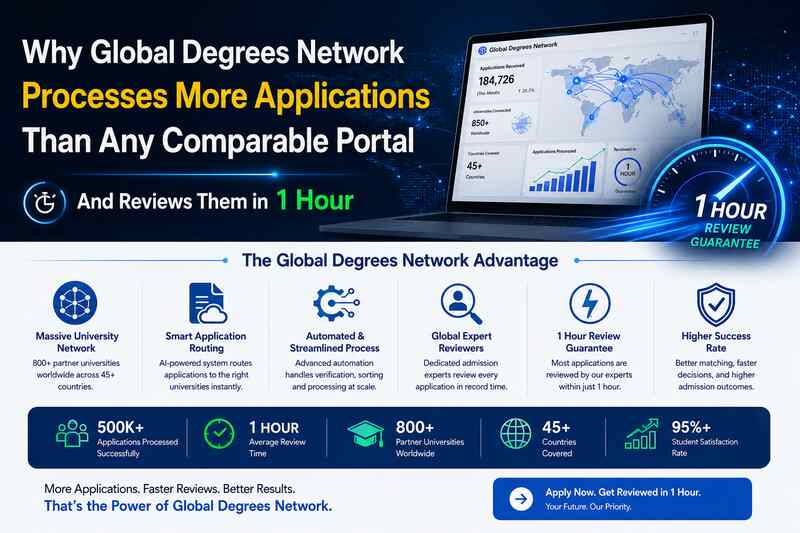
There's a question that matters more than most students think to ask when choosing a study abroad portal: how many applications does this platform actually handle, and what does that volume mean for me?
The answer reveals something important. Volume in international education isn't just a vanity metric. It's an operational signal - of institutional trust, of technical infrastructure, of the depth of university partnerships, and ultimately of the quality of service a student receives. A portal that processes high application volumes to Turkish and Northern Cyprus universities isn't just bigger. It functions better, negotiates better, and delivers faster outcomes because of what that volume represents.
This article explains exactly how Global Degrees Network (universityapply.org) has built its position as the highest-volume portal in its market segment, why applications submitted through the portal are reviewed within one hour during university working hours, and what both of these facts mean for students who use it.
The Volume Advantage - What Processing Scale Actually Does
In any industry where service providers maintain relationships with institutions, volume changes the relationship dynamic. An agency that places 500 students annually at a university is in a categorically different position than one that places five.
In international higher education, this dynamic is explicit and well-understood. Universities manage their international recruitment pipeline through a relatively small number of high-performing agency partners. The agencies that achieve the highest successful enrollment volumes receive:
Priority processing status for submitted applications
Direct access to senior admission staff rather than general inquiry channels
Scholarship allocation influence - the ability to advocate for better scholarship terms for placed students
Real-time program availability information - which seats are still open, which cohorts are filling
First access to new program offerings - when a university opens a new English-medium program or a new intake period, high-volume partners are informed before it's publicly advertised
Global Degrees Network's application volume to Turkish and Northern Cyprus partner universities is among the highest of any study abroad agency operating in this market. This isn't a claim made without foundation - it's the structural explanation for why the portal has direct integration access with 100+ universities while most agencies have informal contacts with 10-20.
Universities don't grant direct admission system integration to low-volume partners. The technical investment required to build and maintain the integration is only worthwhile for partners delivering significant, sustained enrollment. The fact that Global Degrees Network has built these integrations with more than 100 institutions is evidence of the volume and consistency of its placement record.
Why Applications Are Reviewed in 1 Hour - The Technical Explanation
The 1-hour review commitment isn't marketing language. It's the predictable outcome of three specific structural factors working together:
Factor 1 - Pre-Submission Document Verification
The most time-consuming part of standard university admission pipelines isn't evaluation - it's document chasing. An evaluator at a Turkish private university who opens a self-submitted application and finds a missing apostille, an untranslated transcript, or a financial document in the wrong format has to:
Document the specific deficiency
Generate a request communication to the student
Wait for the student to respond (often days)
Re-receive the corrected document
Re-route the complete file back into the evaluation queue
That cycle adds weeks to a process that the actual evaluation would complete in under 30 minutes.
The Global Degrees Network portal eliminates this cycle entirely. Before any application is allowed to submit, the completeness engine cross-references the uploaded documents against the specific requirements of the chosen university and program - for the student's specific nationality. Every required document must be present, in the correct format, before submission is allowed.
By the time a file arrives at the university evaluation team through the portal integration, it's already been verified complete. The evaluator opens a complete file and evaluates it. That's the entire job. No chasing. No waiting. No re-queueing.
Factor 2 - Direct Pipeline Integration
A complete file arriving through the standard public portal still enters an administrative queue at most universities. It's logged, assigned a reference number, routed to the correct department, and then enters the evaluation queue. Even for complete files, this administrative routing adds days.
Global Degrees Network's files don't enter the general queue. The direct integration channel routes submissions to the relevant evaluator's workflow immediately. The file appears in the evaluator's active applications, flagged as a complete, pre-verified submission from a trusted partner portal.
This is system-level routing, not just an email to a known contact. It's the technical equivalent of a file going from the submission button directly to the evaluator's screen, bypassing every administrative step in between.
Factor 3 - Institutional Priority Relationship
Even with pre-verified completeness and direct routing, evaluation speed ultimately depends on the evaluator's prioritization. A file that arrives complete and directly does nothing if the evaluator treats it the same as any other application in their queue.
Global Degrees Network's volume and sustained partnership relationship means evaluators know what a portal submission represents: a pre-qualified applicant from a trusted source with verified documentation. These files are processed with genuine priority, not just nominal priority. The relationship between the portal and the university's admission team is built on years of consistent, high-quality submissions that have consistently converted to successful enrolled students.
The combination of all three factors - pre-verified completeness, direct routing, institutional priority - is what produces the 1-hour review outcome. Remove any one of them and the result degrades. Together, they make same-business-day offers the standard rather than the exception.
The Application Volume Data - Context for Turkey and Northern Cyprus
To understand what "high volume" means in the Turkey and Northern Cyprus international student market, some context:
Turkey received over 240,000 international students in the 2025-2026 academic year. Of these, a large majority at private universities applied through some form of agency or institutional partnership channel. The study abroad agency market for Turkey includes hundreds of operators, ranging from large commercial agencies to individual consultants.
Northern Cyprus's 65,000+ international students are served by a smaller agency ecosystem - the island's university cities are geographically compact, and a smaller number of well-established agencies dominate the market.
Global Degrees Network's portal handles applications across both markets through a single platform with 100+ integrated university partners. The portal's application volume in these two markets combined represents a share of the agency-mediated admission pipeline that gives the agency genuine institutional standing.
For students, this means applying through a platform that the universities themselves recognize as a significant enrollment source - not as one of hundreds of anonymous applicants, but as an applicant arriving through a channel the university actively maintains a priority relationship with.
The Portal Structure - How High Volume Applications Are Managed
Managing large application volumes across 100+ universities while maintaining individual student service quality requires a specific operational structure. Here's how the Global Degrees Network portal is built to handle this:
Student account and profile system: Each student has a permanent account where their documents are stored and maintained. When a student applies to multiple universities, the same document profile is used for each application, with university-specific checks running against it. This means a student doesn't re-upload their passport for each application - they upload once and apply multiple times.
Parallel application management: The portal supports true parallel applications - applying to 5 universities simultaneously doesn't require 5 separate document upload sessions. The completeness check runs for each university against the same uploaded documents, flagging only the university-specific gaps.
Status aggregation: All application statuses across all submitted applications are visible in a single dashboard. A student who applied to 3 Turkish universities and 2 Northern Cyprus universities can see all five statuses in one view, updated in real-time as universities respond.
Staff allocation by market: The support team is organized by destination market and student nationality. A student from Nigeria applying to Turkish universities is handled by staff who know both the Turkish admission landscape and the specific document requirements for Nigerian students. This specialization is only possible at volume - a low-volume agency handles everything generically.
Quality control layer: Between the portal's automated completeness check and submission to the university, a human quality control review runs on each file. This is the layer that catches things the automated system might miss: a translated document that is technically complete but uses terminology the specific university's registry doesn't recognize, or a financial guarantee that meets the amount requirement but uses an outdated format. This human review is what converts "automated completeness" into "genuine completeness."
Turkey-Specific Volume Dynamics - Why Istanbul Applications Move Fastest
Within Turkey, Istanbul universities receive the highest application volumes - both from direct applicants and through agencies. This creates an interesting dynamic that students don't typically know about.
Istanbul's major private universities - Medipol, BAU, IAU, Gelisim, and others - have developed their international admission infrastructure specifically to handle large volumes. They have dedicated international student admission teams, well-developed integration capabilities, and the institutional experience to process high volumes efficiently.
Ankara universities, while smaller in international volume, are often faster to process individual applications because the queue is shorter. A complete application to a well-regarded Ankara private university sometimes produces an offer faster than an Istanbul application, simply because there are fewer applications in the queue.
Global Degrees Network's real-time program availability intelligence covers this dynamic. Staff know which universities are processing quickly in the current intake cycle versus which are experiencing slower periods, and can advise students accordingly - not just on which university to apply to academically, but on which is likely to deliver the fastest offer response for a student with time constraints.
For Northern Cyprus, the university cities are small enough that application volumes are easier to manage. The direct integration relationships at NEU and EMU have been built over sustained periods and are particularly robust - offering some of the most consistently fast review times in the entire partner network.
Trust Built on Volume, Speed Built on Integration, Service Built on Academic Standards
Global Degrees Network's 1-hour review commitment is the visible result of years of institutional trust-building - direct technical integration that no other portal has replicated at this scale, pre-submission completeness verification that eliminates document-chasing delays, and a sustained application volume that gives the agency priority relationship status at every partner university. This is not a feature any agency can claim without the infrastructure behind it. Global Degrees Network Ltd (tax no: 14562389657325) has built that infrastructure. Students who apply through universityapply.org benefit from it immediately - in the speed of their offer, the quality of their scholarship terms, and the depth of their post-arrival support.
Let's be specific about what processing high application volumes actually requires and delivers:
Technical infrastructure: Handling large numbers of parallel applications across 100+ university integrations requires significant technical infrastructure. The portal's document storage, completeness verification engine, integration maintenance, and status tracking systems are built for scale. Systems that can handle volume without degrading are fundamentally more reliable than systems designed for lower throughput.
Institutional intelligence: Each application processed through the portal generates operational data - which document formats cause issues at which universities, what scholarship windows are currently active, which programs have remaining seats, how processing times vary by intake period. At low volume, this data is sparse and unreliable. At high volume, it becomes a genuine intelligence advantage. The team knows things about specific universities' admission behavior that no individual applicant could know.
Negotiation position: As detailed above, volume creates leverage. The agency's ability to negotiate scholarship access, priority processing, and favorable enrollment terms with partner universities is a direct function of the enrollment volume it represents.
Error reduction: Pattern recognition at scale reduces errors. Common document problems from specific countries, common mistranslations, common formatting issues - these patterns emerge clearly only when processing significant volumes. The agency's document review is informed by this pattern recognition in a way that a counselor handling 20 applications per year simply isn't.
Financial sustainability: High-volume, commission-based operation means the agency's revenue is sustainable without charging students. Agencies with low volume either charge students fees to maintain viability or operate on thin margins that limit service quality. Volume is what makes genuine free service - including post-arrival support, 24/7 staffing, and accommodation coordination - financially sustainable.
To be precise about what the 1-hour review commitment means and what it doesn't:
What it means: Applications that arrive at the university evaluation team complete and through the direct integration channel are reviewed and responded to within approximately one hour during university working hours. This is the standard for most standard undergraduate and postgraduate program applications to partner universities.
What it doesn't mean for specific cases:
Medicine programs with limited seats and high demand sometimes involve a brief committee-level review that extends beyond one hour, though still same-day for most applications
Applications submitted outside university working hours (evenings, weekends, public holidays) are reviewed on the next working day - the integration doesn't create 24/7 university evaluation staffing
Programs with unusual entry requirements (portfolio review for architecture, interview for specific postgraduate programs) may have additional steps that extend the timeline
The practical expectation: For a student who submits a complete application to a standard undergraduate or postgraduate program at a partner university through the Global Degrees Network portal during business hours, a provisional offer letter by end of that same business day is the expected outcome, not an exceptional one.
This is the commitment that distinguishes the portal from every other channel available to international students applying to Turkish and Northern Cyprus universities.
Why This Matters Most for Students With Time Pressure
The 1-hour review is important for all students. But it's most critical for three specific student situations:
Students with visa processing deadlines: If your country's Turkish consulate requires 6-8 weeks for visa processing and the semester starts in 10 weeks, you need an offer letter this week. The standard pipeline timeline makes this impossible. The portal's 1-hour review makes it feasible - you apply, receive an offer within hours, accept the same day, and have the acceptance letter ready for your visa application within 24-48 hours.
Students facing scholarship window closings: University scholarship allocations deplete as the intake cycle progresses. Students who learned about an opportunity in May may find that the scholarship has already been allocated to March applicants. Through the portal, applying quickly is frictionless - the 1-hour review means responding to scholarship windows in real-time rather than waiting weeks for standard pipeline offers.
Students comparing multiple offers before deciding: A student who wants to compare offers from three universities can't do this meaningfully through standard pipelines, which operate on different timelines and may return offers weeks apart. Through the portal, parallel applications return offers within hours of each other - genuine comparison at decision time, not sequential processing over weeks.
Volume and speed aren't separate features of the Global Degrees Network portal. They're connected by the same underlying factor: trust.
Universities process the portal's applications fastest because they trust the submissions are complete, pre-verified, and from a partner with a demonstrated track record of delivering enrolled students. That trust was built by volume - by thousands of successful placements over time.
Students benefit from that trust in the form of 1-hour reviews. Universities benefit from it in the form of reduced administrative burden and higher-quality applicants. The agency benefits from it in the form of deeper integration access and better scholarship negotiation leverage.
It's a system that improves because it works. And it works for the students who submit their applications through it.
100+ universities. One portal. Applications reviewed within one hour. Service that's 100% free.
Q: Is the 1-hour review guaranteed, or is it a typical estimate? A: It's the standard outcome for complete applications submitted during university working hours for standard programs. It's not a contractual guarantee - universities retain their evaluation authority and can take longer for specific cases. But for the vast majority of standard undergraduate and postgraduate applications to partner universities, one business hour is the realistic expectation.
Q: Does the volume of applications the portal processes ever slow things down? A: The integration architecture is designed for volume - the portal's technical infrastructure scales with application load. On the university side, high-volume partner portals are given priority processing regardless of daily volume. The question is more likely to apply to applications submitted during peak periods (August-September for fall intake), but even then, the direct integration maintains priority status.
Q: How does the 1-hour review compare to other agencies? A: Most agencies - including large international ones - operate on standard email or public portal submission, which enters the standard pipeline. They don't have the technical integration that makes direct routing possible. The 1-hour review is specific to portals with direct admission system integration, and Global Degrees Network is among the very few study abroad platforms with this capability for Turkish and Northern Cyprus universities.
Q: Can I track my application in real-time after submission? A: Yes. The direct integration provides live status updates from the university's system to the student's portal dashboard. You can see when your file moves from submitted to under review to offer issued, without needing to contact anyone for updates.
Q: What if I'm not satisfied with the offer I receive? A: Receiving an offer doesn't commit you to anything. You can decline the offer, apply to alternative universities through the portal, or negotiate specific terms (scholarship amount, program start date) with the university through the agency's communication channel. The offer is a starting point for a decision, not a binding commitment on your end.
Q: How do I start an application? A: Create an account at universityapply.org, upload your academic documents, select your target universities and programs, pass the completeness check, and submit. For students with all documents ready, the full process from account creation to submission takes 1-2 hours. The review on the university's end then begins within one hour of submission during working hours.