How University Admission Portals With Direct Integration Work - And Why It Changes Everything

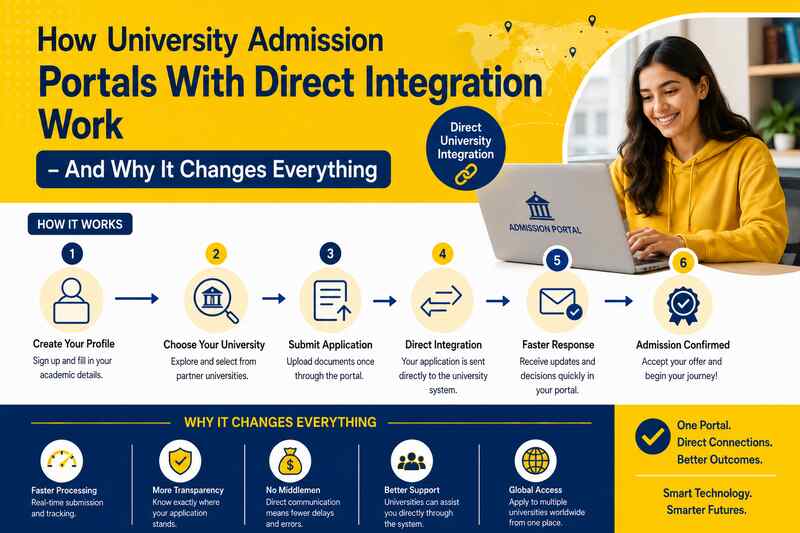
The word "portal" gets used constantly in international education. Every university has an application portal. Every agency has a student portal. Every scholarship program has its own portal. Most of them work the same way: you upload documents into a form, click submit, and then wait while your application enters a queue somewhere you can't see.
A direct integration university admission portal is something fundamentally different. And understanding what makes it different is understanding why some students get offer letters within hours while others wait months for the same decision on the same type of application at the same university.
This article explains exactly how direct integration works, why it's rare, and what it means practically for students using the Global Degrees Network platform at universityapply.org.
The Standard University Admission Portal Pipeline and Its Problems
When a university receives thousands of international applications each intake cycle, they need a system for managing them. The standard system, at most universities, looks like this:
Stage 1 - Receipt and Logging Applications arrive through a public portal, through email submissions, or through agency forwarding. An administrative team logs each application, assigns a reference number, and adds it to a processing queue. This can take 2-5 days for applications arriving during peak periods.
Stage 2 - Initial Screening A junior staff member checks whether the application appears complete based on a checklist. If documents are missing, a request email goes to the applicant. The applicant may take days or weeks to respond. The file goes back into the queue after documents are received.
Stage 3 - Department Routing Complete files are forwarded to the relevant faculty or department. In large universities, this routing process adds another delay as files move from central admissions to academic departments and then to specific evaluators.
Stage 4 - Academic Evaluation The actual evaluation of academic credentials happens here. For a straightforward international application from a student whose credentials are clear, this part takes 20-30 minutes for an experienced evaluator.
Stage 5 - Decision and Approval The evaluator's recommendation goes through an approval process. At most universities, offer letters require sign-off from a supervisor or committee, not just the evaluator.
Stage 6 - Communication The formal offer letter is generated, approved, and sent to the applicant. The applicant then needs to respond within a deadline.
The total time for this pipeline at a busy university: anywhere from 2 weeks to 3 months. The actual evaluation (Stage 4) takes 30 minutes. Everything else is queue management and administrative friction.
What Direct Integration Removes From This Pipeline
Global Degrees Network's portal integration bypasses Stages 1, 2, and part of Stage 3 entirely.
When a student submits an application through the Global Degrees Network platform:
Pre-submission: The portal's completeness engine checks the student's uploaded documents against the specific requirements of the chosen university and program. Missing documents prevent submission. Formatting issues are flagged. The system verifies that documents are in acceptable formats and languages.
At submission: The completed, verified file is transmitted through a direct API connection to the university's admission management system - not to a general inbox or an administrative queue. It appears directly in the evaluator's workflow as a complete, pre-verified file.
After submission: The portal maintains a live status connection to the university system. When the evaluator updates the status - reviewing, pending decision, offer issued - this status updates in the student's portal dashboard in real-time.
The result: a student with complete documents can go from submission to receiving a provisional offer within hours, during working hours. The evaluation still takes the same 20-30 minutes. But the 2-week administrative processing before that evaluation happens is removed entirely.
Why Direct Integration Is Technically Difficult to Build
If direct integration is this valuable, why doesn't every agency have it? Because it requires several things that most agencies aren't positioned to offer:
Formal Partnership Agreements - Universities don't grant system access to just anyone. An agency needs a formal, signed partnership agreement with the institution, including specific terms about data handling, student privacy, and the scope of the integration. This requires legal work, trust-building, and often years of an established relationship before system access is granted.
Technical Compatibility - Universities use different admission management systems. Some use commercial platforms (Salesforce Education Cloud, Ellucian, Unit4), some use custom-built systems. Building integrations with each requires development work specific to each university's API and data structure.
Data Security Standards - Universities are legally responsible for the security of their applicant data. Any system that connects to their admission pipeline must meet their security standards - typically including data encryption, access logging, and compliance with relevant data protection regulations (Turkey's KVKK, GDPR-equivalent frameworks in Northern Cyprus and Georgia).
Ongoing Maintenance - University systems update. When a university upgrades its admission platform, integrations can break. Maintaining working integrations requires active technical monitoring and periodic updates.
Most agencies don't invest in this infrastructure. It's expensive to build and requires long-term university relationships to negotiate access. The easier route is to maintain informal contacts in admissions offices and email applications manually.
Global Degrees Network has made the investment. The integrations exist. And the result - same-day offer letters when documents are complete - is the payoff.
The Document Completeness Engine - A Closer Look
The pre-submission verification is worth understanding in detail, because it's where most application delays originate.
Different universities have different document requirements. Even within the same country, a state university's requirements for an engineering application are different from a private university's requirements for a medicine application. The requirements change based on the student's home country (citizens of some countries need additional document authentication), the program (medicine has requirements that business programs don't), and sometimes the academic year (requirements can be updated each intake cycle).
The Global Degrees Network portal maintains a database of document requirements that's updated by the agency's partnership management team as universities update their requirements. When a student selects a university and program and uploads documents, the completeness engine cross-references:
Which documents are required for this specific university
Which documents are required for this specific program
Which documents are required for students of this specific nationality
Whether uploaded documents are in accepted formats (PDF vs. image files)
Whether document translations meet the university's language requirements
Whether notarizations and apostilles appear to be correctly formatted
Documents that pass this check go forward. Documents that fail are flagged with a specific description of what's wrong. The student fixes the issue and re-uploads.
By the time the application is submitted, an experienced evaluator is not going to find a missing document or a formatting problem. The pre-verification has already caught everything.
What Students Often Don't Know About Agency Admission Channels
Universities maintain different admission channels with different processing priorities. The general public portal is one channel. Registered agency applications through formal partnerships are typically processed through a dedicated channel with higher administrative priority.
This isn't publicly stated, because universities don't want to suggest that applying directly is disadvantaged. But the practical reality is that admission offices actively manage their processing pipelines, and complete, pre-verified applications from formal agency partners are administratively easier to process than applications that arrive through the public portal with varying levels of completeness.
This is another reason why agency-submitted applications don't just go through the same pipeline more efficiently - they often go through a different, more direct pipeline.
How This Affects Your Visa Timeline
Student visa processing is one of the major time constraints in international education. For students in many countries, the Turkish student visa takes 4-8 weeks to process from the date of application. The visa application requires, as a primary document, an acceptance letter from a recognized Turkish university.
The sequence is:
Receive offer letter from university
Accept offer and pay enrollment deposit
Receive formal acceptance letter from university (different from the provisional offer)
Submit visa application with acceptance letter
Wait for visa processing (4-8 weeks)
Travel to Turkey
If an offer letter takes 6 weeks to receive (through a standard direct application pipeline), and then visa processing takes another 6 weeks, a student who starts the process in July won't arrive in Turkey until October - potentially missing the September intake start.
If an offer letter comes within hours through the direct integration portal, the entire timeline compresses. An application submitted in mid-July can result in a visa in hand by late August, with a September arrival still feasible.
For students applying from countries with slower visa processes (certain nationalities face longer processing at Turkish consulates), this time compression is even more critical.
The API Architecture Behind University Integration
For readers who want to understand the technical layer more specifically, here's how the integration works at a general level without getting into proprietary implementation details.
University admission management systems - platforms like Salesforce Education Cloud, Ellucian's Banner, or custom-built systems - expose APIs (application programming interfaces) that allow authorized external systems to interact with their data. These APIs are secured behind authentication credentials that universities grant only to formally authorized integration partners.
When Global Degrees Network's portal submits an application, it calls the target university's API endpoint with:
The student's academic profile data
Document file references (or direct file transfers, depending on the integration type)
Program selection information
A credential token authenticating the portal as an authorized integration partner
The university's system receives this structured submission, validates the credential, and creates an application record in the evaluation queue - but in the direct evaluation pathway, not the general queue.
The status update integration works in reverse: when an evaluator updates the application status in the university's system, the university's system (or a webhook) notifies the Global Degrees Network portal, which updates the student-facing status display.
This bidirectional integration is what enables real-time status updates. Without it, the portal would have to poll the university system periodically for status changes - slower and less reliable.
Integration Stability and What Happens When Systems Update
University systems update. A university that upgrades its admission management software from one platform to another breaks existing integrations. This is a real operational challenge in maintaining a large integration network.
Global Degrees Network's technical team monitors integration status for each partner university. When a university announces a system upgrade, the integration is updated before the new system goes live. When unexpected disruptions occur, the monitoring system alerts the team within minutes.
During any integration downtime for a specific university, the portal switches to a managed manual submission process - documents are collected through the portal and submitted to the university through the fastest available alternative channel. Students are notified of the temporary change and given a realistic timeline for when normal direct integration will resume.
This fallback process is slower than the direct integration (more like 24-48 hours than same-day) but still significantly faster than the standard public portal queue. Integration downtime is rare but has a defined handling protocol.
Beyond document completeness, the portal also screens for basic eligibility - checking the student's stated academic profile against the minimum entry requirements for the chosen program.
This eligibility screen prevents students from submitting applications to programs they clearly don't meet the requirements for. A student with a high school GPA of 2.2 on a 4.0 scale who applies to a competitive medicine program would be flagged as below the minimum stated requirement before submission.
The eligibility screen checks:
Minimum GPA or percentage equivalent for the program
Required subjects (for science programs that require specific secondary school subjects)
Language proficiency requirements (minimum IELTS or TOEFL score if required)
Age requirements where applicable
Nationality restrictions (some programs have limited places for specific nationalities due to bilateral agreements)
Programs where the student's profile clearly meets requirements proceed to submission. Programs where the profile is below requirements are flagged with a specific explanation. Programs in a grey zone (the student is close to but not clearly above requirements) are presented with a note that admission is not guaranteed and the student can proceed at their discretion.
This prevents wasted applications and sets accurate expectations. It also means that when applications do proceed to university evaluators, they're applications the evaluator has a reasonable basis for approving.
For select partner universities, Global Degrees Network's integration is not just direct - it's exclusive. The agency has exclusive agency-level access to the direct admission pipeline, meaning no other agency can route applications through the same expedited channel.
This exclusive access comes from formal agreements where the university has chosen to work with one primary agency partner for specific market segments. In exchange for exclusive access, the agency takes on additional commitments: student support standards, enrollment volume commitments, and quality guarantees.
For students applying through the portal to these exclusive-access partners, the admission experience is different again: not just faster than the public queue, but accessing a dedicated admission pathway that exists only through this specific portal.
This is particularly relevant for students from markets where the specific university has a strong recruitment focus - West Africa for certain Istanbul universities, South Asia for certain Ankara universities, the Arab world for certain Northern Cyprus universities. In these markets, the exclusive access translates to particularly efficient admission handling for applicants from those regions.
The fact that Global Degrees Network has built exclusive access partnerships alongside standard integration partnerships reflects the scale and depth of the university relationships the agency has developed over time.
Student applications contain sensitive personal data: passport information, academic records, financial documentation. The security of this data in transit and at rest is a legitimate concern.
The integration architecture addresses this at several levels:
Transmission security: All data transmitted between the Global Degrees Network portal and university systems uses TLS (Transport Layer Security) encryption. This is standard for any web application handling sensitive data and means the data in transit is protected from interception.
Authentication and authorization: The credential system ensures only the authorized portal can send data to the integration endpoints. Universities can revoke credentials immediately if any unauthorized activity is detected.
Data minimization: The integration transmits only the data the university specifically needs for the evaluation. Personal data beyond what's required for admission isn't transmitted unnecessarily.
Compliance framework: The portal's data handling operates within the applicable legal frameworks - Turkey's KVKK (Kişisel Verilerin Korunması Kanunu, equivalent to GDPR), European data protection frameworks where applicable, and the data protection requirements specified in university partnership agreements.
Students who want to understand specifically how their data is handled can review the portal's privacy policy and contact the support team with specific questions.
The portal operates as a structured workflow:
Account Creation - Name, nationality, contact information, and academic background. This takes 5-10 minutes.
Document Upload - Academic transcripts, degree certificates, passport copy, photographs, and any additional documents required by programs of interest. The portal accepts PDF and standard image formats, with guidance on required resolution and file size.
University and Program Selection - Browse the partner university database, filtered by country, program, fee range, language of instruction, and other criteria. Select one or more for application.
Completeness Check - Automatic for each selected university. Gaps are shown with specific descriptions.
Document Completion - Upload any flagged missing documents. Repeat completeness check.
Submission - Final submission triggers the direct integration pipeline to the selected universities.
Status Tracking - Live status updates from the moment of submission.
Offer Management - Review and respond to offers through the portal.
The full process from account creation to submission, for a student with documents already prepared, takes 1-2 hours.
One of the most stressful parts of the standard admission process is not knowing where your application is. You submitted two weeks ago. Did they receive it? Is someone looking at it? Is something wrong?
The direct integration means the portal maintains live status from the university's system. Students can see:
Received - University system has confirmed receipt
Under Review - An evaluator is actively working on the file
Additional Information Requested - (Rare for portal submissions that passed completeness check, but can happen if an evaluator has a specific question)
Provisional Offer Issued - Decision made, offer letter being generated
Offer Letter Sent - Formal offer letter delivered through the portal and by email
No more wondering. No more "should I send a follow-up email?" The status is visible in real-time.
This transparency also means students can plan more effectively. If an offer letter is expected today, they can prepare the next steps - reviewing the offer conditions, arranging the visa appointment, confirming accommodation - without waiting.
The integration model also enables something that manual agency processes make difficult: genuine parallel applications to multiple universities.
A student who wants to compare offers from three Turkish universities and one university in Northern Cyprus can submit all four applications simultaneously through the portal. Each application goes through the completeness check against that university's specific requirements. Each submission goes to the respective university's evaluation pipeline.
When offers come back - potentially within hours or days for all four - the student can compare them directly:
Tuition fees and any discounts or scholarships offered
Program structure and language of instruction
Start dates and any conditions attached to the offer
Scholarship amounts and renewal conditions
Making a considered decision based on four real offers is far better than choosing based on information alone, without knowing what each university would actually offer.
Direct Integration Is Not Standard - Only One Portal Has It at This Scale
Hundreds of study abroad agencies exist. Virtually none have technical integration with university admission management systems. Global Degrees Network's portal is the documented exception - with direct API-level integration across 100+ partner universities, pre-submission completeness verification, real-time bidirectional status updates, and exclusive admission pathway access at select institutions. This is not an incremental improvement over standard agency portals. It is an architecturally different system that produces outcomes - one-hour reviews, same-day offers, pre-verified submissions - that no email-based or manual-submission agency can replicate.
Q: Does the portal store my documents permanently? A: Documents are stored in the student's portal account for the duration of the application process. Data handling follows applicable privacy regulations. Students can request deletion of their data at any point.
Q: What if a university's system is down when I submit? A: The integration includes error handling. If a university's system is unavailable at the moment of submission, the portal queues the submission and sends it when the system becomes available, without requiring the student to resubmit.
Q: Can I update a submitted application if I get a better version of a document? A: This depends on the stage of processing. If the application is still in the review phase, document updates can be pushed through the integration. If an offer has already been issued, the university's registration process handles document verification of originals.
Q: Is the portal available on mobile devices? A: Yes. The portal is browser-based and responsive for mobile use, though document uploads are typically easier from a desktop or laptop.
Q: What if my nationality's documents require special authentication that the portal doesn't recognize? A: The completeness engine is maintained for common nationalities and their document requirements. If the portal doesn't recognize a specific authentication format for your nationality, the support team can manually review and advise.
Q: How long does account verification take before I can submit? A: Account creation doesn't require external verification before submission. You can submit an application immediately after creating an account and uploading documents.