Studying Medicine in Azerbaijan: What International Students Need to Know in 2026

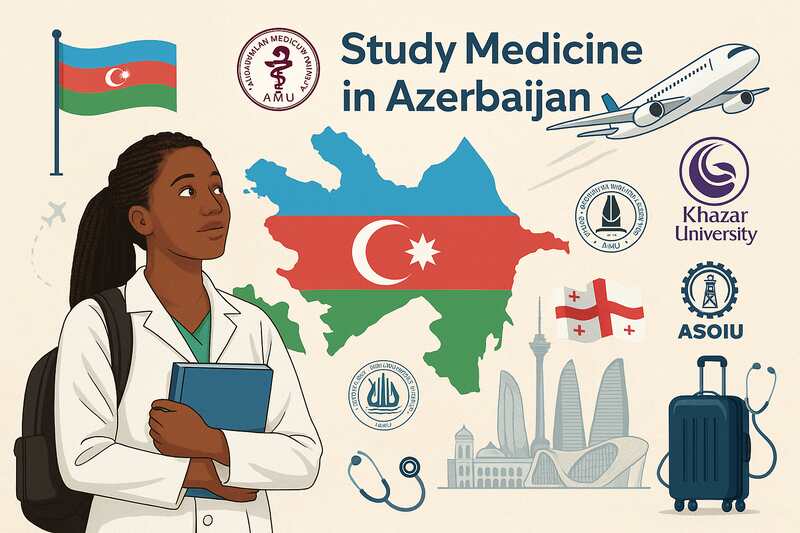
Azerbaijan doesn't dominate the conversation when students research where to study medicine abroad. That's partly a marketing gap and partly a size issue - the country has fewer universities than Turkey or Georgia. But for students from South Asia, Africa, the Gulf, and Sub-Saharan Africa who are doing serious research, Azerbaijan Medical University (AMU) and Nakhchivan State University consistently appear in the same shortlist as much more talked-about destinations. The cost structure alone makes it worth a proper look. Over a full six-year program, a student studying medicine in Azerbaijan can complete their MD for a total investment that's lower than a single year of tuition at a UK or Australian medical school.
This guide covers the 2026-2027 intake with verified fee data, updated admission requirements, an honest account of what studying here actually involves, and what the degree means for your licensing options afterward.
What Degree Do You Graduate With?
Medical programs in Azerbaijan lead to an MD (Doctor of Medicine) degree, also referred to as General Medicine (MD). It's the direct equivalent of the MBBS awarded in India, Pakistan, the UK, and most other countries. The naming is different but the qualification level is the same.
AMU's three core programs including General Medicine received a five-year international accreditation certificate from IAAR (recognized by the World Federation for Medical Education, WFME) in 2022. Most medical universities in Azerbaijan are listed in the World Directory of Medical Schools (WDOMS) and approved by WHO. AMU specifically holds recognition from NMC (India's National Medical Commission) and PM&DC (Pakistan Medical and Dental Council), which are two of the most important recognition bodies for the largest student populations choosing this destination.
Graduates are eligible to sit for international licensing exams including USMLE (USA), PLAB (UK), AMC (Australia), FMGE and NExT (India), and NRE licensing in Pakistan. Recognition in Gulf countries, most of Africa, and other regions is also generally available for WDOMS-listed graduates, though students should verify with the specific medical council of their target country before enrolling.
How the Six Years Are Structured
The standard program runs for six years: five years of academic and clinical study followed by one year of supervised hospital internship. Some students add an optional preparatory year at the start for English or science foundation purposes, making it seven years in those cases. But six is the standard for students who enter with the required language background.
Years 1-3 (Pre-Clinical Sciences): This phase covers Anatomy, Biochemistry, Physiology, Pharmacology, Pathology, Histology, and Embryology. AMU and other universities blend lectures, laboratory sessions, and problem-based learning across these years. Early exposure to clinical reasoning is integrated, which helps reduce the gap between the theoretical foundation years and the clinical rotations that follow. Students who engage actively in the PBL components rather than treating them as supplementary tend to find Years 4 and 5 less of a jump.
Years 4-5 (Clinical Rotations): From Year 4, students are in teaching hospitals. Rotations cover Internal Medicine, General Surgery, Pediatrics, Obstetrics and Gynecology, Psychiatry, Neurology, Family Medicine, and other specialties. The emphasis is on bedside skills: case presentations, patient history-taking, clinical communication, and working with real patient loads under supervision. AMU's affiliated teaching hospitals in Baku handle a wide range of cases, so the clinical diversity students encounter is genuine rather than narrowly focused.
Year 6 (Supervised Internship): The final year functions as a full working internship. Students take ward duties, participate in emergency care, attend outpatient clinics, and assist in minor procedures under close supervision. This year is mandatory for degree completion and for the licensing processes that follow graduation.
Research on what drives international medical students' success in their chosen destination is relevant here. A 2022 qualitative study published in BMC Medical Education (Jiang et al., doi: 10.1186/s12909-022-03597-z) found that students who chose an international medical program based on cost, teaching resources, and quality perception reported better academic outcomes when those three factors were validated by real experience - meaning the fit between expectation and reality mattered as much as the choice itself. Students who arrived in Azerbaijan having done proper research about the actual clinical environment, rather than just the fee table, reported stronger adaptation and academic performance in the later years. The finding is a useful reminder: destination choice should be based on full information, not just the lowest sticker price.
Why Students Are Choosing Azerbaijan for Medicine
1. The Cost Is Among the Lowest for Any WDOMS-Listed Program
This is the headline figure and it's real. For the 2026-2027 intake, tuition fees for studying medicine in Azerbaijan are:
University | Annual Tuition (approx.) |
|---|---|
Nakhchivan State University | $3,500 (incl. hostel accommodation) |
Baku State University | from $3,500 - $4,500 |
Azerbaijan Medical University (AMU) | $5,000 - $7,500 |
Khazar University | $5,200 - $6,500 |
For comparison, private Turkish medical universities charge $15,000 to $44,000 per year and UK medical schools charge £38,000 to £70,000+ annually. Over six years, the total cost difference between Azerbaijan and Turkey's private sector is significant, often $70,000 to $200,000 in tuition alone. Nakhchivan State University's all-in figure of approximately $3,500 per year including hostel accommodation is, by any analysis, one of the lowest costs available for a WDOMS-listed, WHO-recognized MD program anywhere.
Living costs in Baku are also low by regional standards. Most international students spend $250 to $450 per month on food, transport, and daily expenses. University hostels are available at $500 to $1,000 per year. Over six years, a realistic total budget including tuition and full living costs at AMU sits between $40,000 and $55,000 - a fraction of equivalent programs in Turkey, Malaysia, or Western Europe.
All figures are approximate for 2026-2027. Confirm directly with each university before applying.
2. English-Medium Programs Without Mandatory IELTS
AMU has been running an English-medium MD program for international students since 2015 and the program has grown consistently since then. Several other Azerbaijani institutions also offer English-medium medicine. You don't need to know Azerbaijani to study here.
IELTS and TOEFL are not hard requirements at most universities. Students demonstrate English proficiency either through previous English-medium schooling, a university internal test, or by completing a one-year English preparatory program before Year 1. Many students find the preparatory year a useful transition: it provides time to settle in Baku, develop basic Azerbaijani for patient communication later, and adjust to the academic environment before the dense scientific content of Year 1 begins.
3. Direct Admission After 12th Grade
Like Turkey, India, the UK, and most European systems, Azerbaijan allows direct admission to medicine straight after secondary school. No pre-medical bachelor's degree is required. Students can start at 17 or 18 and complete their MD at around 23 to 24, depending on whether a preparatory year is needed.
4. Two Intakes Per Year
Most Azerbaijani medical universities, including AMU, accept students in both September and February. This is a practical advantage: students who miss the fall intake deadline don't have to wait a full year. Application windows typically open April 1 for the September intake (closing around September 15) and November 1 for the February intake (closing around February 15).
Top Universities: An Analytical Overview
Azerbaijan Medical University (AMU), Baku. Founded in 1930 and managed directly by the Ministry of Health, AMU is the country's flagship public medical institution and the first choice for the majority of international students. It has produced over 63,000 qualified doctors and pharmacists for Azerbaijan and other countries. Recognized by NMC, WHO, UNESCO, WDOMS, and ECFMG. Annual tuition for international students runs approximately $5,000 to $7,500 depending on program track. With over 12,000 students enrolled including several hundred from India alone, AMU's teaching hospitals carry a genuine patient load that gives students meaningful clinical exposure. Two intakes per year: September and February.
Nakhchivan State University. A government university established in 1967, located in the Nakhchivan Autonomous Republic. Consistently listed as the most affordable WDOMS-recognized MBBS option in Azerbaijan, with tuition and hostel accommodation combined at approximately $3,500 per year. Recognized by WHO, WDOMS, NMC, and PM&DC. The student body includes students from Turkey, India, Pakistan, Nigeria, Kenya, Egypt, and other countries. September intake; application deadline typically in September.
Khazar University, Baku. A private university with more flexible admissions, strong international faculty connections, and English-medium programs. Annual tuition approximately $5,200 to $6,500. Suitable for students who want a private university environment with more individualized academic support and smaller class sizes.
Baku State University. One of the older established institutions in Baku, with lower tuition than private alternatives, starting from approximately $3,500 per year. WDOMS-listed.
Admission Requirements for 2026-2027
Academic: High school diploma with at least 60-70% in science subjects (Biology, Chemistry, Physics). AMU specifically requires 50% minimum in sciences for international applicants.
Indian students: NEET qualification is mandatory. As per current NMC rules, only NEET-qualified students can appear in FMGE or NExT in India after completing MBBS abroad. NEET score must be valid - qualified in 2024, 2025, or 2026 for the current intake cycle.
Pakistani students: FSc Pre-Medical with 60% minimum and an MDCAT score of at least 50% for PM&DC-recognized pathway.
Language: IELTS or TOEFL not required at most universities. Internal English test or preparatory year accepted.
Documents typically required:
Passport (minimum 18 months validity)
High school diploma and transcripts (translated if not in English)
Birth certificate
Medical certificate including HIV and Hepatitis B/C tests
Police clearance / character certificate
Passport-size photos (white background)
NEET scorecard (Indian students)
Motivation letter (some universities)
Visa timeline: The e-visa process for Azerbaijan is generally efficient. Most students receive an invitation letter within 3 to 7 working days of acceptance, and the full process from application to arrival in Baku can be completed in three to four weeks.
Scholarships for the 2026-2027 Intake
Merit-based fee waivers of 10% to 50% are available at some universities for academically strong applicants, though they're not widely advertised. The Heydar Aliyev International Education Grant Program is Azerbaijan's government-funded scholarship covering full tuition, a monthly stipend, international airfare, and medical insurance. However, it requires official nomination through your home country's government body, such as a Ministry of Education or Embassy, so it's not a direct application. Students targeting this scholarship should contact their home country's relevant ministry at least six months before the intake deadline.
Is It Academically Demanding?
Yes, and students who go in expecting otherwise don't last long. The pre-clinical years at AMU carry a heavy load of basic sciences, and the clinical years require long hospital hours and real patient responsibilities. The academic intensity at AMU is comparable to similar programs in Turkey and Georgia.
A 2024 study published in Medical Science Educator (Nishimura et al., doi: 10.1007/s40670-024-02126-5) found that language competence in patient interaction is the single most consistent challenge for international medical graduates transitioning into clinical settings. The finding is directly applicable to Azerbaijan. Even in English-medium programs, clinical years require communicating with Azerbaijani-speaking patients. Students who invest in basic Azerbaijani before Year 4 consistently report better clinical confidence and fewer supervisory friction points during their internship year. It's not a mandatory exam requirement, but it's functionally essential.
Post-Graduation: Licensing Pathways
India: Must pass FMGE or NExT to practice in India after returning. AMU is NMC-recognized, so eligibility is in place. NEET qualification at entry is the prerequisite.
Pakistan: PM&DC-approved universities (AMU and Nakhchivan State) allow graduates to sit the NRE and practice in Pakistan.
USA: USMLE pathway requires WDOMS listing with ECFMG eligibility. AMU meets this criteria. As of January 2026, USMLE scheduling for international graduates moved to FSMB portal while ECFMG handles certification, so plan for a two-portal process.
UK: PLAB 1 and PLAB 2 followed by GMC registration, for which WDOMS listing is the key prerequisite.
Gulf and Africa: Recognition varies by country. Most accept degrees from WHO-approved WDOMS-listed institutions, but always verify with the specific medical council of your target country before committing.
Final Assessment
For the 2026-2027 intake, Azerbaijan offers a clear value proposition: a WDOMS-listed, WHO-approved MD degree at one of the lowest total costs available in the international medical education market, with English-medium instruction, accessible admission, and no mandatory IELTS requirement. AMU is the strongest option by accreditation depth and clinical infrastructure. Nakhchivan State University is the most affordable WDOMS-recognized program anywhere in Eurasia for students where total cost is the primary constraint.
The trade-offs are real. Baku is not Istanbul or London in terms of international student infrastructure, social scene, or hospital scale. The language adjustment takes time, and students who don't actively work on Azerbaijani before clinical years face friction during hospital rotations. But for students who approach the program with clear expectations, a licensing exam strategy mapped from Year 1, and the language component taken seriously, Azerbaijan is a genuinely practical and well-recognized route to an international medical career.


For international students, one of the main attractions of studying medicine in Azerbaijan is the affordability of tuition fees compared to other popular study destinations like Turkey, Malaysia, the UK, or the USA.
MBBS/MD programmes in Azerbaijan cost between USD $3,500 to $7,550 per year, depending on the university and country of instruction. The tuition fees vary by institution.
Despite the slightly higher tuition fees in Azerbaijan compared to other Central Asian nations like Kyrgyzstan and Kazakhstan, the availability of English-medium MBBS programmes makes it a more attractive option for many foreign students seeking affordable medical education.
Tuition Fees at Major Medical Universities in Azerbaijan
University | Annual Tuition (USD) | Medium of Instruction | Notes for International Students |
|---|---|---|---|
Azerbaijan Medical University (AMU) | $4,000 to $5,000 | English & Russian | The largest and most established medical school in Azerbaijan. Listed in WDOMS, eligible for USMLE/PLAB. Strong hospital affiliations. |
Khazar University | $6,500 to $7,500 | English | One of the most modern private universities in Azerbaijan. Popular among foreign students for its fully English MBBS track and student-friendly environment. |
Baku State University (Medical Faculty) | $3,500 to $4,500 | English & Azerbaijani | Known for its affordability and reputation. A solid option for international students seeking low-cost MBBS in Azerbaijan. |
Azerbaijan State Oil & Industry University (Health Sciences Dept.) | $4,000 to $5,000 | English | A growing player in the medical field with government backing and affordable tuition fees. |
Nakhchivan State University | $3,800 to $4,200 | English | One of the cheapest universities in Azerbaijan for MBBS. Offers scholarships and English-medium courses. |
Comparative Insights: Azerbaijan vs Other Countries
To understand the true value of studying medicine in Azerbaijan, it’s helpful to compare costs with other destinations.
Country / Region | Average Annual Tuition Fees (USD) | Living Costs per Year (USD) | Notes |
|---|---|---|---|
Azerbaijan | $3,500 to $7,500 | $2,500 to $4,000 | Affordable MBBS in English. Lower cost than Turkey, higher than Kyrgyzstan. |
Turkey (Private Universities) | $15,000 to $44,000 | $4,000 to $6,000 | Higher tuition, but excellent reputation. Public universities cheaper but highly competitive. |
Malaysia (Private) | $18,000 to $33,000 | $4,000 to $6,000 | More expensive than Azerbaijan; strong international partnerships. |
UK | $40,000 to $70,000 | $12,000 to $18,000 | Globally prestigious but extremely costly. |
Kazakhstan / Kyrgyzstan | $2,500 to $4,000 | $1,500 to $3,000 | Cheaper than Azerbaijan but fewer English-medium MBBS options. |
Conclusion: Azerbaijan offers a middle ground far cheaper than Turkey or Malaysia but more structured and internationally recognized than Central Asia.
Living Costs for Medical Students in Azerbaijan
Living expenses in Azerbaijan are generally affordable compared to Europe but higher than in some Asian destinations. International students in Baku (the capital) will spend more than those in smaller cities like Nakhchivan.
Expense Category | Average Monthly Cost (USD) | Details |
|---|---|---|
Accommodation | $150 to 350 | Dormitories are cheapest. Private apartments in Baku cost $300+, while shared flats lower the expense. |
Food & Groceries | $120 to 200 | Affordable local cuisine; international food options cost more. Many students budget $150/month. |
Transport | $20 to 40 | Baku Metro, buses, and student shuttle services are very cheap compared to Western cities. |
Health Insurance | $100 to 200 annually | Compulsory for international students; covers basic health services. |
Miscellaneous (books, utilities, internet, leisure) | $50 to 100 | Libraries cover most study materials; extra cost for lab coats, dissection kits, etc. |
Estimated yearly living cost: USD $2,500 to $4,000 depending on lifestyle and city.
Average Total Cost of MBBS in Azerbaijan
When combining tuition fees and living expenses, the average cost to study medicine in Azerbaijan comes to:
Low-cost universities (e.g., Baku State, Nakhchivan): $6,500 to $8,500 per year (tuition + living).
Mid-range universities (e.g., AMU, Azerbaijan State Oil & Industry University): $7,500 to $9,500 per year.
Premium universities (e.g., Khazar University): $9,000 to $11,500 per year.
Over the full 6-year MD programme, international students typically spend USD $40,000 to $55,000 total a fraction of the cost compared to UK or Australian MBBS programmes.
Why Tuition Fees in Azerbaijan Attract International Students
Azerbaijan's Nakhchivan State University and Baku State university offer the most affordable MBBS programs with tuition rates below $4,500 per year.
The AMU is commonly recognized as the top choice for MBBS in Azerbaijan, thanks to its international standing, English-medium curriculum, and strong hospital connections.
Foreign students are drawn to Khazar University, which offers modern facilities and an international approach, despite its cost.
Applying for MBBS in Azerbaijan after 12th grade is a straightforward process compared to many Western countries. International students can often gain direct entry to a six-year MBBS/MD programme without the need for a pre-med degree. Below is a complete overview of what you need to know before submitting your application.
Academic Qualifications & Grades Needed
High School Diploma (12th Grade or Equivalent): Most medical universities in Azerbaijan require students to have completed secondary education with strong grades in Biology, Chemistry, and Physics/Mathematics.
Minimum Academic Performance:
Competitive universities (like Azerbaijan Medical University (AMU) or Khazar University) usually expect 70% or higher in science subjects.
More accessible universities (e.g., Nakhchivan State University, University of Kyrenia in TRNC partnerships) may accept 50–60% averages, making them attractive for students seeking easier admission pathways.
Alternative Curricula Accepted: Students with A-Levels, IB, WAEC, NECO, or equivalent national exams can apply directly, provided they meet subject requirements.
if you are researching the grades needed to study medicine in Azerbaijan, expect a range of 50–70% depending on the university and competitiveness of the program.
English Language Proficiency – Study Without IELTS
One of the biggest advantages of studying medicine in Azerbaijan for international students is the flexibility with English requirements.
IELTS/TOEFL: Some universities may ask for IELTS (6.0–6.5) or TOEFL iBT (~80–90).
Internal English Proficiency Tests: Many universities, including Cyprus International University (partnerships in Azerbaijan) and Khazar University, offer on-campus English placement exams.
Preparatory English Year: If a student cannot meet the required standard, they may enroll in a 1-year English foundation programme, which ensures they can still study medicine in Azerbaijan without IELTS.
This makes Azerbaijan especially attractive for students from Asia, Africa, and the Middle East, where IELTS requirements can be a barrier.
Age Requirement
Students must generally be 17 years or older at the time of admission.
Some universities have no strict upper age limit, making it easier for mature students to apply.
Required Documents to Apply for MBBS in Azerbaijan
When applying, international students typically need to prepare:
✅ Valid Passport Copy (with minimum 2 years validity).
✅ High School Diploma & Transcripts (officially certified + translated into English or Azerbaijani if required).
✅ Science Subject Certificates (showing Biology, Chemistry, Physics/Math).
✅ Medical Fitness Certificate (with vaccination records).
✅ Passport-Sized Photos (usually 6–8).
✅ Motivation Letter / Personal Statement (explaining why you want to study MBBS in Azerbaijan).
✅ Letters of Recommendation (required by some universities, especially private ones).
✅ Proof of English Proficiency (IELTS, TOEFL, or internal exam result).
✅ Application Form + Processing Fee (fees vary, usually $50–150).
Some universities may also request an entrance exam or an interview, though many private universities admit based on transcripts + English proficiency.
Scholarships & Financial Aid for MBBS in Azerbaijan
Although not as widespread as in Turkey or Malaysia, there are still scholarship opportunities for international students:
Nakhchivan State University Scholarships: Offers partial fee waivers (10 to 30%) for high-performing students.
Azerbaijan Medical University (AMU): Merit-based scholarships for outstanding international applicants.
Government “Study in Azerbaijan” Scholarship: Covers tuition + accommodation + stipend for selected students from partner countries (limited seats).
Private University Discounts: Universities like Khazar University or Baku State University may offer early-bird discounts or tuition reductions for international students.
MBBS scholarships in Azerbaijan for foreign students are available, but they are competitive and limited compared to larger study destinations like Turkey or Malaysia.
Is Studying Medicine in Azerbaijan Hard?
Yes , just like in the UK, Turkey, or India, medicine in Azerbaijan is academically demanding. Students face:
📚 Years 1–3: Heavy focus on basic medical sciences (Anatomy, Biochemistry, Physiology, Pharmacology).
🏥 Years 4–5: Full-time clinical rotations in teaching hospitals (Internal Medicine, Surgery, Pediatrics, Gynecology, Psychiatry, etc.).
👨⚕️ Year 6 (Internship): Students act as supervised intern doctors, gaining practical hospital experience.
Challenges include:
Adapting to a European-style academic system.
Learning basic Azerbaijani/Russian for patient communication during clinical years.
Passing rigorous exams and practical assessments.
However, with smaller class sizes, personalized faculty attention, and affordable tuition, many international students find Azerbaijan to be a manageable and supportive environment compared to overcrowded public universities in other countries.
Quick FAQ: Studying Medicine in Azerbaijan
🔹 How much does it cost to study medicine in Azerbaijan?
Tuition fees range from USD $3,500 to $7,500 per year, plus living costs of $2,500 to $4,000 annually.
🔹 How many years to study MBBS in Azerbaijan?
6 years total (5 academic years + 1 year internship).
🔹 Can I study medicine in Azerbaijan without IELTS?
Yes. Many universities offer internal English exams or preparatory years instead of requiring IELTS/TOEFL.
🔹 What grades are needed for MBBS in Azerbaijan?
Typically 50 to 70% in high school (12th grade) with strong science subjects.
🔹 Which is the best university for international students?
Azerbaijan Medical University (AMU) is the most recognized and competitive.
Khazar University offers modern facilities and English-medium tracks.
Baku State University and Nakhchivan State University are affordable options.
🔹 Is studying medicine in Azerbaijan affordable?
Yes. Compared to Turkey ($15k to $44k/year) or the UK ($40k–$70k/year), Azerbaijan is much cheaper while still offering WDOMS-listed universities.