Study Engineering in Turkey for International Students: 2026 Complete Guide

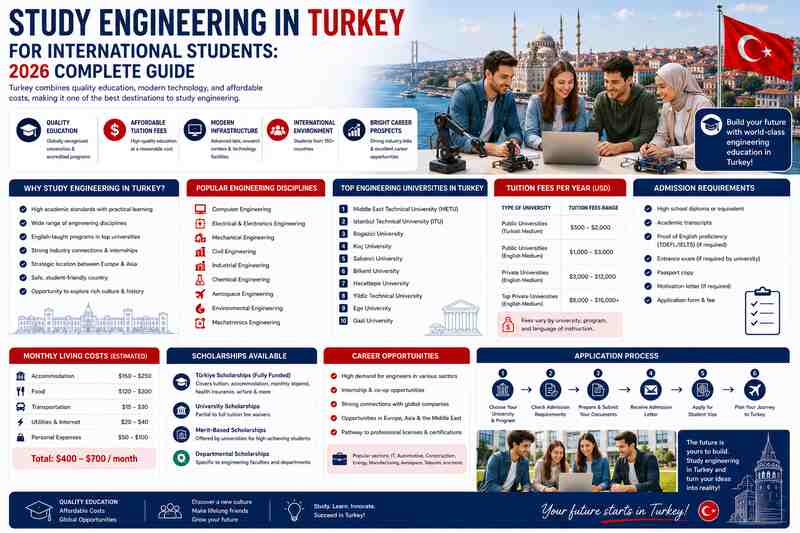
Engineering is the most searched non-medical discipline by international students considering Turkey. That's not an estimate Mastersportal enrollment data consistently places computer engineering, civil engineering, and software engineering in the top five most-searched programs across all Turkish university listings. And yet, most of what's published about engineering in Turkey online is either surface-level, outdated, or written clearly for a domestic audience. This guide is different. It covers accreditation properly, explains what MÜDEK means for your degree, compares the real tuition numbers, and gives international applicants a clear picture of what the engineering experience in Turkey actually looks like in 2026.
MÜDEK Accreditation: Why It Matters More Than Most Students Realize
When researching engineering programs in Turkey, you'll see MÜDEK mentioned frequently. It's not just a badge it has real consequences for what you can do with your degree.
MÜDEK (Mühendislik Değerlendirme Kurulu) was established in 2002 and became a full member of ENAEE (European Network for Accreditation of Engineering Education) in 2008. Programs accredited by MÜDEK carry the EUR-ACE label a European-standard engineering quality mark recognized by engineering councils in EU countries and in many countries with bilateral engineering recognition agreements.
Practically, what does this mean?
For students planning to work in Germany, Netherlands, Scandinavia, or other EU markets: a MÜDEK-accredited degree provides a recognized standard basis for professional engineering registration. The process isn't automatic you'd still need to apply to the relevant national engineering body but the accreditation substantially simplifies the recognition process compared to a non-accredited degree.
For students targeting GCC countries (UAE, Saudi Arabia, Qatar): Gulf engineering licensing boards the Society of Engineers UAE, the Saudi Council of Engineers, and equivalents generally require either an ABET, EUR-ACE, or locally-recognized engineering qualification. MÜDEK's EUR-ACE affiliation means Turkish-accredited engineering degrees are eligible for licensing consideration in these markets, which are major employment destinations for engineering graduates from Africa, South Asia, and the Middle East.
For students planning to return home: degree recognition depends on bilateral agreements between Turkey and your home country. Pakistan Engineering Council (PEC), for example, has processes for evaluating foreign engineering degrees. Nigeria's COREN (Council for the Regulation of Engineering in Nigeria) accepts foreign degrees from recognized institutions for registration purposes. Check directly with your home country's engineering council but a MÜDEK/EUR-ACE accredited degree enters that process in a much stronger position than a non-accredited one.
Which programs have MÜDEK accreditation?
MÜDEK publishes an updated list of accredited programs at mudek.org.tr. As a general reference for 2026: programs at Bahçeşehir University, Istanbul Technical University (ITU), METU, Yıldız Technical University, Istanbul Aydin University, Atılım University, and several others hold MÜDEK accreditation in one or more engineering disciplines. The accreditation is per-program, not per-university so Computer Engineering at a given university may be accredited while Mechanical Engineering at the same university is not yet. Always verify the specific program.
What the Research Says About Engineering Education Quality in Turkey
A study published in European Journal of Engineering Education examining engineering program outcomes across non-traditional study destinations found that programs carrying EUR-ACE accreditation regardless of country produced graduates with statistically comparable competency profiles to graduates of domestic accredited programs in the same countries where graduates sought employment. Turkey's MÜDEK-accredited programs fall within this EUR-ACE framework.
Research published in Higher Education analyzing international student enrollment patterns in engineering across emerging study destinations found that Turkey showed the highest growth rate in engineering international enrollment among all non-traditional destinations between 2015 and 2023 growing at over 600% in that period. The study attributed this to a combination of English-medium program expansion, EU-standard accreditation, and favorable cost-to-quality ratios.
Based on enrollment data from YÖK, engineering programs collectively represent the second-largest discipline category among international students in Turkey as of 2025, behind only health sciences. Computer and software engineering programs specifically showed the fastest year-on-year growth in international enrollments.
The Application Process for Engineering in Turkey
For private universities:
Choose your engineering discipline and target universities (apply to 2–3 simultaneously)
Prepare documents: high school diploma and transcripts (translated if not in English), passport, English proficiency evidence, photos
Submit online application, most private universities have streamlined international portals
Receive acceptance letter within 1–3 weeks for complete applications
Apply for student visa at Turkish embassy in your country (allow 3–6 weeks)
Arrive, complete in-person registration, apply for residence permit within 30 days
Minimum academic requirements:
Most private engineering programs require a high school average of 65–75%, with mathematics being the most critical subject. Some programs particularly AI Engineering look specifically at math and physics grades. No entrance exam is required for international applicants at private universities. English proficiency is tested either via IELTS/TOEFL or through the university's internal exam.
YÖS for public universities:
Applying to METU, ITU, or Yıldız Technical requires a YÖS score. The YÖS is a numerical reasoning and basic sciences test not language-based offered by individual universities at different times of year. Preparation resources are available online; the test is not as difficult as Turkey's domestic university entrance exam (YKS) but is competitive given that public engineering seats are limited.
Before You Apply
The engineering landscape in Turkey in 2026 is not what it was a decade ago. The MÜDEK accreditation push, the English-medium faculty expansion, and the investment in technology infrastructure especially in software and AI disciplines have made Turkey a legitimate engineering education destination, not just a budget fallback.
That said, the quality difference between programs is real. A MÜDEK-accredited computer engineering program at BAU or IAU is a meaningfully different educational investment than an unaccredited program at a smaller institution. Verify accreditation before committing, understand the recognition pathway for your specific target country, and choose the city and university that fit your total cost calculation.
universityapply.org maintains updated admissions and accreditation data across 2026–2027 intake cycles. Submit an inquiry for a free academic assessment we'll match your profile to the right engineering program and support the full application process at no cost.
It wasn't always obvious. Ten years ago, Turkey's engineering reputation internationally was mainly linked to its civil infrastructure and construction boom. But something has shifted over the last five or six years — private universities heavily invested in MÜDEK accreditation, English-medium engineering faculties expanded significantly, and the total cost calculation started to look genuinely compelling for students from Africa, South Asia, and the Middle East.
So what makes studying engineering in Turkey worth serious consideration in 2026?
MÜDEK accreditation aligns with EUR-ACE standards. MÜDEK — Mühendislik Değerlendirme Kurulu — is Turkey's engineering accreditation body and a full member of the European Network for Accreditation of Engineering Education (ENAEE). Programs accredited by MÜDEK carry the EUR-ACE label, which is recognized across Europe and in many countries that align with European higher education standards. This means a MÜDEK-accredited engineering degree from Turkey is not just domestically recognized — it carries genuine European-standard certification. That matters when you're planning to work in the Gulf, in Europe, or in countries that benchmark against European engineering standards.
English-medium programs have reached genuine maturity. Five years ago, "English-medium engineering" at some Turkish private universities meant the syllabus was translated but lectures were partly in Turkish. That's no longer the majority experience at established programs. Universities like Bahçeşehir (BAU), Istanbul Aydin, Yıldız Technical, and Atılım now run full English-medium engineering faculties with international faculty members, English-language exams, and course materials sourced from major global publishers. It's not perfect everywhere — some programs still have mixed-language delivery — but the best programs are genuinely English throughout.
The software and AI engineering surge. Computer Engineering, Software Engineering, and Artificial Intelligence Engineering are the three fastest-growing disciplines at Turkish universities right now. Private universities know this and have invested accordingly — GPU computing labs, dedicated AI research centers, industry partnership programs. For students targeting software careers globally, these programs are competitive at a fraction of the cost of equivalent programs in the UK or EU.
Total cost is genuinely hard to beat. A four-year computer engineering degree at a reputable private university in Istanbul, including living costs, runs between $35,000 and $65,000 total. In the UK, tuition alone for the same program runs £45,000–£80,000 over four years. That comparison doesn't need much explaining.
One area where Turkish private universities have improved significantly over the last five years is industry collaboration. Engineering programs at BAU, IAU, and Atılım now include mandatory internship semesters — typically in Year 3 or between Years 3 and 4 — as a formal part of the curriculum rather than an optional add-on.
How internships work for international students:
Turkish law allows international students to do internships as part of their academic program without requiring a separate work permit, since the internship is classified as a mandatory curriculum component. This is a meaningful practical advantage. Students in computer engineering and software engineering have found internship placements at Turkish tech companies — Getir, Trendyol, Yemeksepeti, and international companies with Turkish operations like Microsoft Turkey and SAP Turkey. Civil and mechanical engineering students intern at construction firms and manufacturing companies, some of which operate across the MENA region.
For international students planning to return home after graduation: Internship experience in Turkey adds genuine value to a CV — particularly for students targeting Gulf engineering markets, where Turkish-built infrastructure projects are prominent and familiarity with Turkish construction and engineering standards is recognized. Several Emirati and Saudi construction consortiums specifically recruit Turkish engineering graduates and graduates who trained in Turkey.
Portfolio and project work: Strong engineering programs include capstone projects in final year — typically team-based, industry-partnered design projects where students solve real engineering problems. These projects are increasingly presented at Turkish engineering conferences and form a meaningful part of the graduate's professional portfolio. Ask about capstone project structure and industry partnerships when evaluating programs.
Turkey's universities offer the full spectrum of engineering disciplines. The most popular among international students — based on our applicant data at universityapply.org — are the following:
Computer Engineering (Bilgisayar Mühendisliği): Covers algorithms, data structures, operating systems, computer networks, software development, and hardware architecture. Most programs include programming tracks in C++, Java, and Python from Year 1. Strong programs at BAU, IAU, and Bahçeşehir integrate internship semesters and industry collaboration projects.
Software Engineering (Yazılım Mühendisliği): A more application-focused alternative to computer engineering, with heavier emphasis on software development methodologies, agile practices, quality assurance, and systems architecture. Increasingly offered in English at private universities.
Artificial Intelligence Engineering: One of the newest programs in Turkey and currently among the most sought-after. BAU's AI engineering program and Istanbul Gedik's newer AI faculty both launched to high international interest. Curriculum covers machine learning, deep learning, natural language processing, computer vision, and AI ethics.
Civil Engineering (İnşaat Mühendisliği): Turkey has world-class civil engineering infrastructure and faculty. Civil engineering programs are strong at both public universities (ITU, METU) and private ones. Topics include structural engineering, geotechnics, hydraulics, transportation, and construction management.
Electrical and Electronics Engineering (Elektrik-Elektronik Mühendisliği): Combines electrical theory with electronics, signal processing, communications, and power systems. Strong programs exist at Yıldız Technical University and several private institutions.
Mechanical Engineering (Makine Mühendisliği): Classical engineering discipline covering thermodynamics, fluid mechanics, manufacturing, materials science, and machine design. Several programs are MÜDEK-accredited with well-equipped labs.
Architecture (Mimarlık): Technically distinct from engineering but often grouped with it in student searches. Architecture programs in Turkey are internationally respected — Turkey's architectural tradition is significant — and several programs carry NAAB-equivalent recognition through European frameworks.
Biomedical Engineering: Growing discipline combining engineering with health science. Several Istanbul-based universities have recently launched biomedical engineering programs targeting the intersection of technology and medical applications.
One of the most important parts of this decision is the actual cost. Here's what engineering programs realistically cost in Turkey in 2026–2027.
Program | Public Universities (English) | Private Universities (Turkish) | Private Universities (English) |
|---|---|---|---|
Computer Engineering | $1,000–$3,500/year | $2,500–$5,500/year | $4,500–$9,500/year |
Software Engineering | $1,000–$3,000/year | $2,500–$5,000/year | $4,000–$9,000/year |
Civil Engineering | $900–$2,800/year | $2,200–$5,000/year | $3,500–$8,500/year |
Electrical/Electronics Eng. | $1,000–$3,000/year | $2,200–$4,800/year | $4,000–$8,500/year |
Mechanical Engineering | $900–$2,500/year | $2,000–$4,500/year | $3,500–$8,000/year |
AI Engineering | N/A (newer program) | $3,000–$6,000/year | $5,000–$11,000/year |
Architecture | $1,200–$3,500/year | $3,000–$6,000/year | $4,500–$10,000/year |
Living costs on top of tuition:
Students in Istanbul budget $450–$750/month for accommodation, food, transport, and incidentals. In Ankara, Izmir, or Bursa, $350–$550/month covers a comfortable student lifestyle. Over four years in Istanbul, living costs total approximately $21,600–$36,000 on top of tuition.
Total four-year cost estimates (private English-medium, Istanbul):
Computer Engineering: $39,600–$73,800
Civil Engineering: $35,600–$70,000
Mechanical Engineering: $34,000–$68,000
AI Engineering: $41,600–$79,800
These figures are not aspirational — they reflect published tuition ranges plus realistic city living costs. Compare this to the UK at £55,000–£100,000 in tuition alone for a four-year engineering MEng, and Turkey's value proposition is clear.
University | City | Tuition/Year (English) | MÜDEK Accredited | Specialization Strengths | International Student Support |
|---|---|---|---|---|---|
Bahçeşehir (BAU) | Istanbul | $6,500–$9,500 | Yes (multiple depts.) | Computer, Software, AI, Civil | Excellent, dedicated international faculty |
Istanbul Aydin (IAU) | Istanbul | $5,000–$8,500 | Yes | Computer, Electrical, Mechanical | Very strong, large international community |
Yıldız Technical University | Istanbul | $1,500–$3,500 | Yes | Civil, Mechanical, Electrical | Moderate, public university |
Istanbul Technical University (ITU) | Istanbul | $2,000–$4,000 | Yes | Civil, Environmental, Naval | Limited, primarily domestic focus |
METU (Orta Doğu Teknik Üniversitesi) | Ankara | $1,500–$3,000 | Yes | All major engineering disciplines | Good, established international programs |
Atılım University | Ankara | $4,500–$8,000 | Yes | Manufacturing, Mechanical, Computer | Good, known for international student welcome |
Istanbul Gelisim | Istanbul | $3,500–$6,500 | Partial | Computer, Civil | Strong support, lower cost |
Çankaya University | Ankara | $4,000–$7,500 | Yes | Electrical, Computer | Solid mid-tier option |
Reading this table correctly:
METU and ITU are Turkey's most prestigious engineering institutions by domestic and some international rankings. Getting in requires a YÖS score and is genuinely competitive acceptance rates for international applicants in engineering are not high. For students who qualify, these are outstanding options with strong alumni networks in Turkey and the region.
For the majority of international students who want English-medium programs with strong support infrastructure and accessible admission, BAU and IAU are the most consistently recommended options. Their MÜDEK accreditations are established, their English-medium faculties are genuine, and their international offices actively support students through registration, visa, and residence permit processes.
Atılım in Ankara is worth considering for students who prefer a smaller campus environment outside Istanbul and want strong MÜDEK-accredited programs in manufacturing or mechanical engineering specifically.
Q: Is an engineering degree from Turkey recognized internationally? A: It depends on which university and program. MÜDEK-accredited programs carry the EUR-ACE label, which is recognized across Europe and in many GCC and Commonwealth countries for engineering registration purposes. Non-accredited programs are recognized domestically through YÖK but require more active verification processes abroad. Always check MÜDEK's published accreditation list at mudek.org.tr and verify with the engineering council of your target country before enrolling.
Q: Can I study computer engineering in Turkey fully in English? A: Yes, at several private universities including BAU, IAU, Gelisim, and others. Programs are delivered in English from Year 1, including all exams and course materials. Labs and software environments are English-language. The main exception is some administrative processes and student life activities, which are partly in Turkish but the academic program itself is English throughout at properly established programs.
Q: What is the minimum high school grade to get into engineering in Turkey? A: At private universities, most programs accept students with a high school average of 65–75%, with specific attention to math scores. Some more selective programs particularly at BAU or for AI Engineering may require 75–80% overall with strong math performance. Public universities like METU or ITU require much higher averages and a YÖS score on top of that.
Q: Is MÜDEK the same as ABET? A: Not the same, but equivalent in standing within their respective geographic frameworks. ABET is the US engineering accreditation standard; MÜDEK is Turkey's, aligned with European EUR-ACE standards through ENAEE. Both represent recognized international accreditation frameworks. Many countries' engineering licensing boards accept either ABET or EUR-ACE accredited degrees for professional registration eligibility.
Q: How long does an engineering degree take in Turkey? A: Bachelor's engineering programs are 4 years (8 semesters). Some universities offer a 1-year English preparatory course before Year 1 for students who need it, making the total 5 years. Master's programs in engineering are typically 1.5–2 years. PhD programs are 3–5 years.
Q: Do Turkish engineering graduates find jobs abroad? A: This varies significantly by country, discipline, and individual performance. MÜDEK-accredited program graduates pursuing professional engineering registration in GCC countries, EU countries, or Commonwealth nations have an established framework for doing so. Employment outcomes also depend on language skills, internship experience, and individual effort — Turkey's engineering programs increasingly include industry partnerships and internship semesters that strengthen employability.
Q: What engineering discipline has the best job prospects after graduating from Turkey? A: Based on global employment demand data and industry partnership activity at Turkish universities, Computer Engineering and Software Engineering currently offer the strongest international job market alignment largely because software jobs are increasingly remote and location-independent. Civil Engineering graduates have strong demand in GCC construction markets. AI Engineering is early-stage but growing rapidly in employer demand.