Ankara Ostim Technical University Ranking 2026: Turkey's First Industrial University and What It Offers

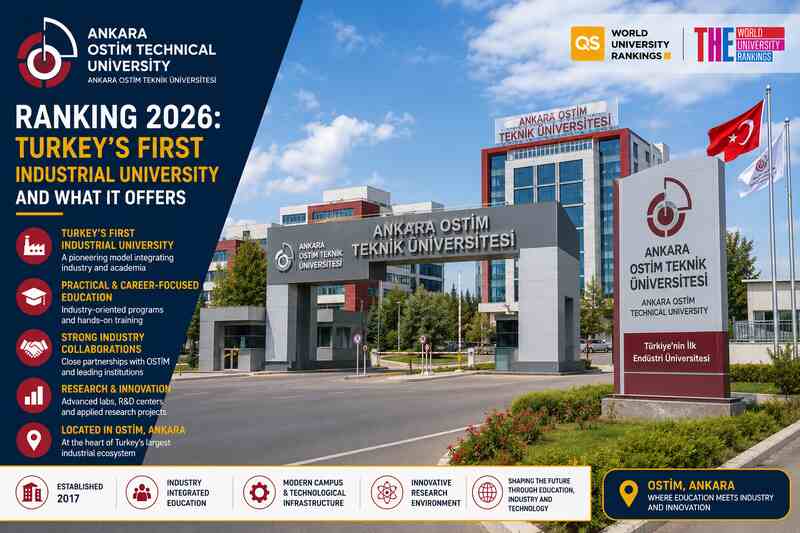
Ankara Ostim Technical University (OTÜ) holds a distinction no other Turkish university can claim: it is the first industrial university in Turkey, founded in 2017 and physically located inside the Ostim Industrial Zone the largest small and medium enterprise industrial hub in the country. That founding concept shapes everything about how this university operates, what it teaches, and how students experience their education.
The Ankara Ostim Technical University ranking in 2026 reflects the realities of a young institution still building its research publication history. Webometrics places it at approximately 2,244th globally and 145th nationally in Turkey. It is not yet listed in THE or QS main rankings. But what OTÜ lacks in ranking history it partially compensates with an unusual combination of accreditations: MÜDEK, ABET, and EUR-ACE for engineering programs a trio of engineering accreditations that very few Turkish private universities hold simultaneously.
For students targeting an engineering degree with international credential recognition and direct industry exposure, that accreditation combination changes the decision calculus considerably.
Ankara Ostim Technical University Ranking 2026: Data Overview
Webometrics 2026
Ostim Technical University holds approximately 2,244th position globally and 145th nationally in Webometrics, representing its current digital academic presence. For a university established only in 2017, this position indicates meaningful early development many universities remain unranked for their first 5–8 years.
Global Ranking Context
The turkeyuniversity.org profile tracking OTÜ data gives its global position at approximately 8,590th in some aggregated systems and 12,590th in others — variation that reflects different weighting methodologies and data collection periods. The consistent national figure is around 145th–180th in Turkey, placing it within the lower-mid tier of Turkish universities by volume-based metrics.
THE and QS Status
OTÜ is not currently listed in THE's main band rankings or QS's global or regional tables. This is expected for a university established in 2017 less than 10 years old and reflects the publication-history requirements both systems apply, not a quality assessment.
The Accreditation Advantage: ABET, MÜDEK, and EUR-ACE
This is where Ankara Ostim Technical University genuinely stands apart from most universities at its current ranking level.
MÜDEK (Mühendislik Değerlendirme Kurulu) is Turkey's national engineering accreditation board and a full member of the EUR-ACE networ the European framework for engineering degree recognition. MÜDEK/EUR-ACE accreditation means OTÜ engineering graduates can have their credentials recognized across EU countries through established equivalency procedures.
ABET accreditation is an American standard administered by ABET Inc. It is widely recognized in North America, the Middle East, and Asia as an engineering and technology quality benchmark. Holding ABET alongside EUR-ACE means OTÜ graduates have pathways to credential recognition on multiple continents — a rarity for a Turkish private university at this ranking level.
EU Accreditation: The European Union has also recognized OTÜ's programs, adding another layer of international validity.
Very few Turkish private universities hold all three simultaneously. This accreditation set effectively means that for engineering students, a degree from OTÜ carries more internationally portable value than the ranking numbers alone would suggest.
What Defines OTÜ's Academic Identity
Embedded Industrial Training
Students at OTÜ don't travel to internships in distant industrial zones the industrial zone is the campus context. Located within Ostim, students have direct access to hundreds of manufacturing, technology, and engineering companies for hands-on training, project work, and supervised professional experience. This is a structural advantage that classroom-based universities simply can't replicate.
Engineering and Applied Science Focus
OTÜ offers programs in mechanical engineering, electrical and electronics engineering, computer engineering, energy and environmental engineering, architecture and design, and economic and administrative sciences. The curriculum integrates theory with practical application from year one students work on real industrial problems alongside faculty.
Small Cohort Size - Approximately 7,000 Students
With roughly 7,000 undergraduate and graduate students and 300 faculty members, OTÜ is one of Turkey's smaller private universities. This scale translates into lower student-to-faculty ratios, more accessible supervision, and easier integration into the industrial training programs that define the university's identity.
Ankara Location
Ankara is Turkey's capital and second-largest city less chaotic than Istanbul, with a well-developed public university culture and lower cost of living. For students who find Istanbul overwhelming, Ankara offers a more structured urban environment with strong government, military, and industrial employment sectors.
Academic Reference: Industry-Embedded Universities and Graduate Employability
A 2022 paper by Tight published in Higher Education reviewed evidence on work-integrated learning models across 15 countries and found that universities with structural industry partnerships (co-location, mandatory industrial placements, industry-supervised project work) produced graduates with measurably shorter time-to-first-employment and higher first-year salaries in technical disciplines than universities with equivalent ranking positions but less integrated industry exposure. OTÜ's Ostim Industrial Zone location is the clearest example of structural industry integration available in Turkey's private university sector.
The Ostim Industrial Zone: More Than Just a Location
The Ostim Organized Industrial Zone is not a generic industrial park. It is the largest small and medium enterprise (SME) cluster in Turkey, housing more than 5,000 companies across manufacturing, technology, defense industries, aerospace components, and precision engineering. Annual turnover across the zone is measured in billions of dollars.
For students at OTÜ, this means their campus context isn't a simulated industrial environment it's one of Turkey's most economically significant production hubs, active and ongoing around them. Students in mechanical engineering, electrical engineering, and computer engineering don't need to travel for industry experience; industry is the surrounding environment from day one.
This is also why OTÜ's relationships with companies for internship placement, cooperative education programs, and graduate employment are unusually deep. Companies in the Ostim zone recruit from OTÜ specifically because the graduates have been educated in their industrial context rather than arriving from a classroom environment that has to be quickly unlearned on the job.
Ankara as a Study City
Ankara is Turkey's capital a city of approximately 5.7 million people that is less chaotic than Istanbul but no less professionally rich. The city hosts Turkey's entire government apparatus, major state enterprises, a large military sector, multiple public and private universities, and an increasingly active technology startup ecosystem.
For engineering graduates, Ankara's employment market is significantly more engineering-friendly per capita than Istanbul's, where finance, communications, and professional services dominate. Defense, aerospace, government technology contracting, and industrial manufacturing are all major Ankara employment sectors exactly the fields that OTÜ's ABET and EUR-ACE accredited engineering programs target.
Cost of living in Ankara is noticeably lower than Istanbul. Students can find shared accommodation for $150–$280/month, and monthly living costs including food, transport, and personal expenses typically run $350–$500. For international students managing budgets carefully, Ankara's lower cost profile compared to Istanbul makes OTÜ's already affordable tuition even more practically accessible.
OTÜ's Graduate Programs
At graduate level, OTÜ offers master's programs in engineering and applied sciences, with thesis and non-thesis tracks. The thesis-track programs connect directly to the industrial zone research environment graduate students can conduct thesis research on real industrial problems in cooperation with Ostim companies, producing work that is simultaneously academically publishable and practically deployable.
This model is how OTÜ builds its research publication record: not through isolated academic projects but through industry-grounded research that generates output relevant to both the academic literature and the companies that motivated the research. It's a more sustainable and faster path to ranking improvement than purely academic research programs at newly founded universities.
Scholarships and Financial Support at OTÜ
OTÜ offers merit-based scholarships for international students, with reductions available from 25% to significant tuition discounts for strong academic profiles. Given the university's baseline fees starting from approximately $2,250/year, even modest scholarships make OTÜ one of the most financially accessible engineering universities in Turkey especially for students who prioritize the ABET and EUR-ACE accreditation outcomes over institutional ranking band.
Applications through universityapply.org carry no application fee, and scholarship eligibility is assessed alongside the standard admission review. The team is familiar with OTÜ's engineering faculty requirements across different national educational systems
Read the Ultimate Guide of Studying at OSTIM University for International Students
University | Webometrics Turkey | ABET Accredited | EUR-ACE (MÜDEK) | Engineering Focus | City |
|---|---|---|---|---|---|
Ankara Ostim Technical University | ~145th | Yes | Yes | Industrial zone embedded | Ankara |
Altinbas University | - | No | Yes (MÜDEK) | General engineering | Istanbul |
Isik University | - | No | No | CS and electronics | Istanbul |
Halic University | Top 200 | No | No | Civil, computer engineering | Istanbul |
Beykoz University | Top 200 | No | No | Logistics-focused | Istanbul |
Gelisim University | ~2,745th global | No | No | Broad engineering | Istanbul |
OTÜ's ABET + EUR-ACE combination makes it uniquely positioned among Turkish private universities at its current ranking level. Altinbas also holds MÜDEK/EUR-ACE but lacks ABET. No other university in this comparison group holds all three simultaneously.
OTÜ is one of Turkey's most affordable private universities for engineering education. Based on data tracked through universityapply.org's Ostim university tuition fees guide:
Bachelor's programs: approximately $2,250–$5,500 per year
Master's programs: starting from approximately $3,000–$4,500 per year
Scholarships: available through the university and through authorized agency partnerships
The combination of ABET+EUR-ACE accreditation and starting fees from $2,250/year makes OTÜ one of the best value engineering propositions in Turkey's private university sector.
For confirmed 2026–2027 fee data and program listings, the Ankara Ostim Technical University profile on universityapply.org has current information.
Ankara Ostim Technical University's accreditation profile and industrial training model make it a genuinely distinctive option for engineering students seeking internationally portable credentials at affordable fees. universityapply.org maintains current admission and scholarship data for OTÜ and over 150 Turkish partner institutions. Submit a free inquiry no application fees. On-ground support in Ankara covers airport reception, document translation, final registration, and course selection.
Admission Requirements at Ankara Ostim Technical University
Undergraduate:
High school diploma with notarized English or Turkish translation
Official transcript
Passport copy
SAT, A-levels, IB, YÖS, or national equivalents (engineering applicants should have strong mathematics and science results)
English language proficiency for English-medium programs
Graduate:
Bachelor's transcript (notarized, engineering or related field for engineering master's programs)
ALES or equivalent graduate admissions examination
Language proficiency certificates
Statement of purpose for research-track programs
On-ground support for students arriving in Ankara includes airport transfer, accommodation guidance, document translation services, and enrollment coordination at the university.
Ankara Ostim Technical University is genuinely unique in Turkey. No other Turkish private university is physically embedded in an active industrial zone of this scale. No other private university at its current ranking level holds ABET + EUR-ACE + EU program recognition simultaneously. And no other engineering university in Turkey offers the combination of accessible starting fees, triple international accreditation, and direct industrial context that OTÜ provides. For engineering students who prioritize internationally portable credentials, practical training, and career-ready outcomes over institutional brand recognition, OTÜ is one of the most rational choices in the entire Turkish private university system.
OTÜ and Turkey's Defense and Aerospace Industry
One sector that doesn't always feature prominently in Turkish university marketing but is highly relevant for OTÜ graduates: Turkey's defense and aerospace industry. Ankara is home to the headquarters of major Turkish defense contractors including ASELSAN, ROKETSAN, and TAI (Turkish Aerospace Industries). These companies actively recruit engineering graduates from Ankara universities, and OTÜ's ABET accreditation is increasingly recognized in defense contractor recruitment processes as a quality signal.
For international students who want to build careers in Turkey's defense technology sector or in the broader Turkish manufacturing sector that supports it OTÜ's Ankara location and Ostim Industrial Zone context provide a direct pipeline that Istanbul-based universities simply cannot replicate. The combination of engineering accreditation and geographic proximity to Turkey's largest defense industrial cluster is unique in Turkey's private university landscape.
Ankara Ostim Technical University is the most compelling argument that ranking position is not the only relevant metric for engineering students. Its ABET plus EUR-ACE plus EU accreditation combination, starting fees from $2,250/year, and Ostim Industrial Zone embedded training model create a graduate-outcomes profile that should matter more to most engineering students than a THE band position. For internationally oriented engineering students who want credentials that travel, OTÜ is the most cost-effective pathway to ABET-recognized engineering education in Turkey.
The broader Ankara engineering graduate employment market reinforces OTÜ's value proposition. Ankara's concentration of defense contractors, government technology agencies, and industrial manufacturers means that ABET-recognized engineering graduates from OTÜ face a local employment market that is specifically structured around the industries that accredit their degrees. This alignment between accreditation standard and local employer expectations is more direct than at most Turkish private universities.
Q: What is Ankara Ostim Technical University's ranking in 2026? A: Webometrics 2026 places it approximately 145th–180th nationally in Turkey and around 2,244th–8,590th globally depending on the system. It is not currently listed in THE or QS main rankings, as these require longer accumulated research output histories than OTÜ has had time to build since its 2017 founding.
Q: Does OTÜ hold international engineering accreditations? A: Yes, it holds ABET (US standard), MÜDEK (Turkey, full EUR-ACE European member), and EU program recognition. This triple accreditation for engineering programs is rare among Turkish private universities and makes OTÜ degrees internationally portable for engineering graduates.
Q: What makes Ostim Technical University different from other Ankara universities? A: The Ostim Industrial Zone location is the core differentiator. Students receive industrial training embedded directly within one of Turkey's largest SME industrial hubs not simulated or distant from campus, but genuinely integrated into the physical environment where the university operates.
Q: Is Ankara a good city for international students? A: Ankara is Turkey's capital, with lower cost of living than Istanbul, well-developed public transport, and a structured university culture. International students find it quieter and more predictable than Istanbul, with good connections to Turkish government, industrial, and research sectors.
Q: What programs does OTÜ offer in English? A: Most programs at OTÜ are offered in English, making it accessible to international students who don't speak Turkish. Confirm the current language mix for your specific program when applying.