Free University Application Services - What "Zero Fees" Really Means for International Students

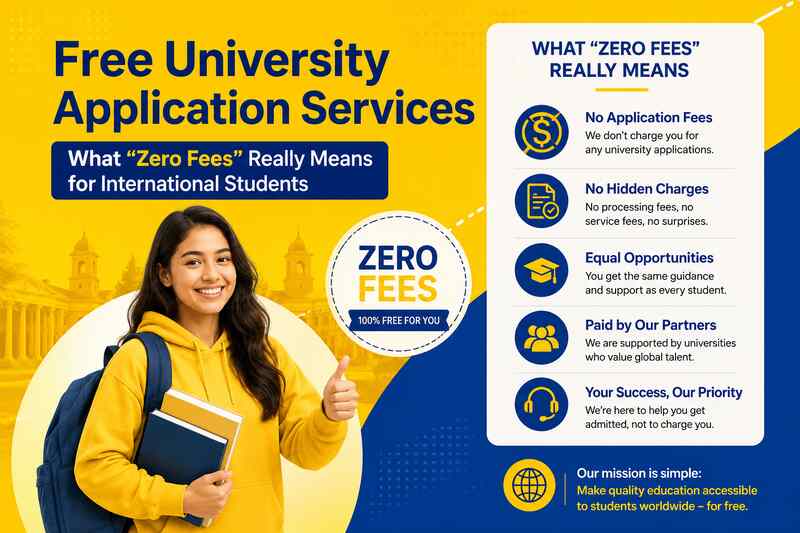
When a study abroad platform says its services are "100% free," a reasonable person's first instinct is skepticism. Free doesn't typically mean free in international education. There are application processing fees, document verification fees, consultation fees, platform access fees - the industry has developed a long list of ways to extract payment from students who don't know better.
So let's be direct about what free university application services actually mean when offered by a serious agency, how the commission model works, and why it genuinely doesn't cost you anything to use a platform like Global Degrees Network (company: Global Degrees Network Ltd, tax no: 14562389657325) for your full application and admission process.
The Business Model Behind Free Student Services
Universities pay agencies. That's the core of it. When a student enrolls at a university through a registered agency, the university pays the agency a commission - typically calculated as a percentage of the first year's tuition or as a flat placement fee. This is standard practice across international higher education globally. IDP Education, the British Council's partner network, AECC Global, and essentially every accredited education agency operates this way.
The commission model exists because universities genuinely value the work agencies do: screening applicants, verifying documents, reducing the load on university admissions teams, and delivering enrolled students who are properly prepared for the administrative requirements of international study. It's a service the university is willing to pay for because it reduces their administrative cost and increases international enrollment quality.
From the student's perspective, the key question is: does the agency pass any of this cost back to the student, directly or indirectly?
At Global Degrees Network, the answer is no. No application fees. No service fees. No document processing fees. No consultation fees. Zero.
This isn't a marketing claim that falls apart under scrutiny. The university pays the commission after enrollment. The student pays tuition directly to the university. The agency never touches student funds.
What Is Included in the Free Service?
Let's be specific, because "free application help" can mean anything from a single email to a comprehensive managed process. Here's what free actually covers through Global Degrees Network:
University Matching and Program Selection - Based on your academic background, English proficiency, budget, and program goals, the team helps identify which universities and programs in the network best match your profile. This isn't a questionnaire that spits out a generic list. It's a consultation that factors in accreditation requirements, scholarship eligibility, language of instruction, and realistic entry requirements.
Application Preparation and Document Review - Before your file is submitted, staff review your documents for completeness, formatting issues, and anything that might cause a delay. This includes checking translations, verifying that notarizations are correctly formatted for the destination country, and confirming that financial documents meet the specific university's requirements.
Portal Submission with Direct University Integration - The actual submission goes through the integrated portal, directly to the university's admission evaluation team. Not a general inbox. Not an email chain. A direct pipeline.
Admission Status Tracking - You can see where your application is in the process in real-time through your portal account. No "allow 6-8 weeks for processing" and then silence.
Offer Letter Coordination - When a provisional offer is issued, the agency coordinates the formal documentation and helps you understand the conditions attached to the offer.
Final Registration Support - After you accept an offer and arrange your visa, there's still a registration process at the university. The agency handles direct communication with the registration office to ensure this step is completed correctly.
Pre-Arrival Coordination - Accommodation search, flight assistance, short-term hotel booking, and connection to student communities - all of this is part of the free service package.
All of it. No "this part costs extra." No premium tier for post-arrival support.
No Third-Party Payments - Why This Matters
Some agencies position themselves as free service providers but then insert themselves into the tuition payment flow. A student pays "through the agency" and the agency forwards the funds to the university, potentially deducting fees, creating exchange rate margins, or simply delaying payment in ways that create financial complications.
Global Degrees Network explicitly removes itself from tuition payments. When you pay tuition, you pay directly to the university's official payment system - the same one any direct applicant would use. Your financial relationship is with the university, not with the agency.
This is worth understanding clearly for two reasons. First, it means there's no financial risk associated with using the agency - your tuition funds go directly to their destination. Second, it means the agency has no incentive to recommend specific universities based on payment margins rather than academic fit.
Free Doesn't Mean Lower Quality Admission
A reasonable concern: if the service is free to students, does the agency push students toward lower-quality universities that pay higher commissions?
This is a real issue in the international education industry, and it's worth addressing directly. Some agencies do prioritize high-commission universities over student fit. Global Degrees Network's operational model is structured specifically to prevent this.
The agency's reputation - and its ability to maintain direct integration partnerships with over 100 universities - depends on students succeeding academically and completing their programs. A student placed in the wrong program, at the wrong university, who drops out after one semester, damages the relationship between the agency and the university. Universities don't renew partnership agreements with agencies that send them ill-matched students.
So the agency's long-term interest is aligned with the student's long-term interest: finding a program the student can succeed in, at a university that meets their accreditation requirements, at a fee level the student can sustain for the full duration of the program.
This is why the consultation process asks hard questions. Can you realistically maintain the language requirements of this program? Is your academic background sufficient for the entry requirements? Does your budget cover four to six years of tuition, not just the first year? Is the accreditation of this medical degree recognized in your home country for licensing purposes?
These aren't sales questions. They're filter questions that protect both the student and the agency's reputation.
How Free Services Compare to Self-Application Costs
It's worth doing an honest calculation. What does self-application actually cost?
Time - Researching universities, understanding entry requirements, preparing and verifying documents, managing multiple application portals. For a thorough self-application, this runs to dozens of hours.
Translation fees - Professional translation of academic transcripts, birth certificates, and other documents. Notarized translations cost $30-100+ per document depending on length and country.
Notarization and apostille fees - Document authentication required by many universities. Costs vary by country but can reach several hundred dollars for a complete document set.
Application fees - Some universities charge direct application fees for international students, typically $30-100 per application.
Courier costs - Physical document submission is still required by some universities.
Mistakes - The cost of a rejected application and having to reapply, or worse, discovering after acceptance that a key document isn't in the right format.
None of these costs disappear when you use an agency. But the agency's document review reduces the risk of rejection due to formatting errors, and the direct integration removes application fees that universities often waive for agency-submitted applications.
The genuine cost comparison, for most students, is: self-application costs more in time and has higher error risk, at no savings in direct fees.
What "24/7 Support" Means in Practice
For international students, problems don't keep office hours. A visa appointment conflict discovered at midnight. A courier notification that a document package was returned. A portal error that blocks document upload the night before a deadline.
Global Degrees Network's 24/7 support structure covers genuine emergencies. Staff are distributed across time zones so that a student in Karachi contacting support at 11pm Pakistan time isn't waiting until European business hours for a response. This matters less for routine queries and enormously for time-sensitive problems.
The baseline expectation: any message sent through the support portal during any hour will receive a response from a real staff member within a few hours. For emergencies flagged as urgent, the response time is shorter.
Comparing Agency Models: What to Look For
Not all "free" agencies are equivalent. When evaluating a study abroad agency's claim of free services, check for:
Direct university relationships vs. general partnerships - Is the agency listed on the university's official website as a registered representative? Do they have technical integration with the admission system, or do they just have a contact at the admissions office?
Document pre-verification - Does the agency check your documents before submission, or do they just forward what you give them?
Post-arrival services - What actually happens after you receive your offer letter? Accommodation, registration, visa support, community connection - are these included or additional?
Payment flow - Does your tuition go directly to the university, or through the agency?
Staff transparency - Who are the people providing advice? Do they have verifiable backgrounds in international education?
Global Degrees Network meets the standard on all of these. The direct integration is verifiable through partner university portals. Document pre-verification is built into the submission workflow. Post-arrival services are documented and standard. Payment flows directly to universities. Staff backgrounds are in higher education, not sales.
The Bottom Line on Free Application Services
Free university application services through Global Degrees Network aren't a compromise. They're a structural feature of how the international education commission model works when an agency chooses to pass 100% of the benefit to students rather than extracting fees at various points in the process.
For students, the practical implication is straightforward: you get managed document review, direct admission pipeline access, scholarship identification, offer tracking, final registration support, pre-arrival coordination, and 24/7 support - all without paying a single dollar in service fees.
More than 100 universities. Zero cost to students. Same-day admission when documents are complete.
That's what free actually looks like.
Genuinely Free - And More Comprehensive Than Services That Charge
Most agencies either charge students directly or reduce service scope to sustain a free model. Global Degrees Network does neither. Zero application fees, zero consultation fees, zero documentation charges, and zero payment intermediaries - tuition goes directly to the university, always. Yet the service scope exceeds what fee-charging agencies typically offer: document pre-verification, scholarship identification, final registration support, pre-arrival accommodation coordination, and 24/7 staffing. This combination - no cost to students, comprehensive service delivery - is what no other agency in this market currently matches.
In recent years, a new category of international student service has emerged: EdTech-backed platforms that use venture capital funding to offer subsidized services while building user bases for future monetization. These platforms can appear to offer similar free services, but their business model and incentive structure are different.
A commission-based agency like Global Degrees Network earns revenue when students successfully enroll. The metric that matters is successful enrollment. The platform's incentive is therefore to help students make good choices that result in enrollment.
A VC-backed platform may be offering free services while losing money on each user, with a plan to monetize through advertising, data sales, premium upgrades, or shifting to a fee model once sufficient market share is established. The platform's incentive may be user acquisition rather than student success.
This distinction matters for students who are choosing a platform for long-term support. A commission-based agency that exists on a 20+ year track record of successful placements has demonstrated sustainability. A well-funded startup with a rapidly growing user base has demonstrated growth - which isn't the same thing.
None of this means EdTech platforms can't be useful. But students should understand the business model behind any "free" platform they use, and consider whether the incentive structure aligns with their interests.
The scale of the network matters. More than 100 universities across multiple countries means genuine choice. Students don't have to accept the one or two universities that a small agency has informal relationships with. The spread currently covers:
Turkey - Private and foundation universities in Istanbul, Ankara, Izmir, Bursa, Antalya, Konya, and other cities. Programs include medicine (Tıp), dentistry, pharmacy, engineering, business, international relations, architecture, and the full range of standard undergraduate and postgraduate programs. Fee ranges from around $3,000 per year at newer private universities to $15,000+ at well-established institutions with international rankings.
Northern Cyprus - English-medium universities in Famagusta (Gazimağusa) and Nicosia, offering strong programs in business, engineering, and architecture at fees generally lower than mainland Turkey. Popular with students who specifically want English-medium instruction without the full cost of Western European or North American universities.
Azerbaijan - Universities in Baku covering medicine, engineering, and business programs. Growing in popularity with students from the Caucasus region, Central Asia, and South Asia.
Georgia - Medical universities in Tbilisi that are listed in the World Directory of Medical Schools (WDOMS) and recognized in many countries for licensing purposes. Significantly cheaper than Western medical education while maintaining international recognition.
Malaysia - Universities in Kuala Lumpur offering English-medium programs with international accreditation, often seen as a route to degrees recognized in Commonwealth countries.
Within each country, the network includes universities at different price points and ranking levels, so students with different budgets and academic profiles have genuine options.
The scholarship search is one of the most tangible ways the free service saves students real money. Let's quantify this.
Turkish private universities typically offer international student scholarships in several forms:
Tuition Reduction Scholarships - Available to students with strong academic profiles. At many partner universities, scholarships of 25%, 50%, 75%, or 100% of tuition are available for different GPA ranges. A student with a GPA of 3.5/4.0 or equivalent might qualify for a 50% tuition scholarship that reduces annual tuition from $8,000 to $4,000.
Merit Scholarships for Specific Nationalities - Some Turkish universities run specific scholarship programs for students from partner countries, often driven by bilateral educational agreements. A Nigerian student, Pakistani student, or Indonesian student may qualify for nationality-specific scholarships that aren't widely advertised.
Early Application Scholarships - A fixed number of scholarships are reserved for early applicants each intake cycle. Students who apply within the first 30-60 days of an intake window open have access to these. After the window closes, the scholarships are allocated and subsequent applicants pay standard rates.
Presidential Scholarships - Some Turkish universities have flagship scholarship programs named after founding figures. These cover full or near-full tuition and sometimes include accommodation. They're highly competitive but genuinely available to strong international applicants.
Global Degrees Network's scholarship identification covers all four categories for each partner university. Staff know the qualification thresholds, the application windows, and the current availability. Self-applicants typically only access scholarships listed prominently on the university's English-language admissions page - which is often only the first category.
The portal is designed for international use, which means it needs to work for students across different technology contexts:
Connectivity: The portal functions on standard broadband and mobile data connections. Document upload is optimized for the file sizes typical of scanned academic documents. Students with slower connections can upload documents in stages.
Device accessibility: The portal is browser-based and works on standard laptops, tablets, and mobile phones. There's no required app download or specific operating system requirement.
Language support: The portal interface is in English. Support staff communicate in English, Arabic, Turkish, Urdu, and Azerbaijani. Students who need guidance in other languages can request support through the ticket system.
Document format: The portal accepts PDF, JPEG, and PNG file formats for all document types. Specific file size limits apply (typically 5MB per document) - staff can advise on compression if students have difficulty with larger files.
Let's make the payment security point concrete with an example.
A student in Pakistan applies to a university in Turkey through an agency that handles tuition payments through its own account. The agency tells the student to transfer $8,000 (first year tuition) to the agency's bank account, which the agency will then forward to the university after deducting its fee.
Three problems with this:
The agency could deduct a higher "fee" than disclosed
The agency could delay the payment to the university, causing the student's enrollment to be at risk
If the agency has financial problems, the student's tuition money could be lost
This isn't theoretical. Students have lost significant sums when study abroad agencies that handled their tuition payments experienced financial difficulties or operated dishonestly.
At Global Degrees Network, this scenario is architecturally impossible. The agency never asks for tuition funds. Never provides its own bank account for tuition payment. Never acts as an intermediary in the tuition payment flow. Tuition is paid directly to the university's official payment system, using the university's official bank account details, with a payment reference that goes directly into the university's student management system.
Your money goes where it's supposed to go. The agency earns its commission after enrollment is confirmed - paid by the university from its own accounts. Your financial relationship is entirely with the university, not with the agency.
Q: Why do universities pay agencies if they could just handle direct applications? A: University admissions offices, especially at private institutions that actively recruit internationally, often don't have the staffing or marketing reach to effectively recruit from dozens of countries simultaneously. Agencies pre-qualify students, handle document verification, and deliver enrolled students who are administratively prepared. This reduces the university's per-student recruitment cost and administrative burden. The commission is effectively a marketing and administrative outsourcing fee.
Q: Could using a free agency service affect my visa application negatively? A: No. Agency-supported applications are standard in international education. The offer letter you receive comes from the university - the agency is not mentioned in visa documentation. Your visa application stands on the same basis as any international student's application.
Q: What if I want to compare offers from universities inside and outside the network? A: You can apply through Global Degrees Network for partner universities and apply directly to non-partner universities simultaneously. The agency doesn't require exclusivity. Comparing offers across different pathways is a reasonable approach.
Q: Are there any strings attached to the free service? A: None. You're not committing to enroll anywhere by applying through the portal. You can receive multiple offers, compare them, and choose the best fit. The agency only receives a commission if you actually enroll. If you decide not to study abroad or choose a university outside the network, no fee applies.
Q: How do I get started? A: Create an account on the universityapply.org portal, complete your academic profile, and upload your documents. The system will guide you through the process and flag what's needed at each step.
Q: What happens if I need to defer my enrollment? A: Deferral policies are set by individual universities, not by the agency. Staff can advise on the deferral options available for your chosen university and help communicate the request to the institution.