International Student Final Registration - What Happens After You Get Your Offer Letter

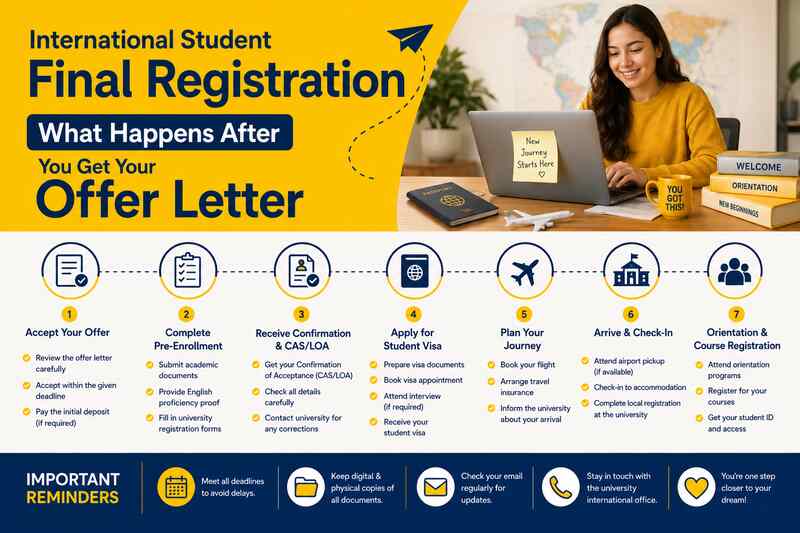
Most content about studying abroad focuses on getting the offer letter. And understandably so - it's the moment that feels like the finish line. But experienced students, and everyone who works with international students professionally, know that the offer letter is actually the starting point of a different, equally complex process.
Final university registration is the formal step that converts a provisional offer into actual enrollment. It's a process most students underestimate. And it's where a significant number of students - particularly those who handled their application independently - run into problems that delay or derail their plans.
This article covers what the final registration process actually involves, why it's more complicated than it looks, and how Global Degrees Network's post-offer support works in practice.
The Gap Between Offer Letter and Actual Enrollment
A provisional offer letter from a university says, in effect: "Based on the documents you submitted digitally, we're prepared to offer you a place in this program, subject to verification of original documents and completion of enrollment."
That last part - verification of originals and completion of enrollment - is where the work is.
The steps between receiving a provisional offer and sitting in your first class typically include:
Accepting the offer - formally, within a deadline specified in the offer
Paying the enrollment deposit - a partial tuition payment (often 25-50% of first year's tuition) that secures your place
Submitting original documents - the authenticated physical copies that correspond to what was submitted digitally
Document verification - the university's registry office verifies that originals match digital copies and meet authentication standards
Student visa application - using the offer/acceptance letter to apply for the student visa
Visa processing - 4-8 weeks typically for Turkey, varying by country
Pre-arrival coordination - accommodation, travel, airport reception
Arrival and campus check-in - physical arrival and initial campus registration
Course selection and scheduling - choosing specific courses within the program
Student ID and card issuance - health insurance enrollment, library access, dining card, etc.
First week orientation - program-specific orientation often separate from university-wide international student orientation
Residence permit application - for Turkey specifically, students need an ikamet (residence permit) within 30 days of entry
That's 12 steps after the offer letter. Each one has its own timeline, requirements, and potential complication points.
Why Final Registration Trips Up International Students
Document authentication requirements - The documents you submitted digitally for the initial application were scanned copies. For final registration, universities require originals - and those originals need specific authentication formats depending on the document type and your home country.
A high school diploma from Nigeria needs to be apostilled. A university transcript from India may need attestation by the Indian Ministry of External Affairs and then verification by the Turkish Consulate. A medical certificate needs to be from a certified institution in a format the Turkish university's health office recognizes. Getting all of this right requires understanding the specific chain of authentication required for each document type and each country combination.
Students who didn't have guidance during the initial application often discover they have documents in the wrong format only when they arrive at the university's registry office. Correcting authentication problems from abroad, while in Turkey, is slow and expensive.
Enrollment deposit deadlines - Offers come with deadlines. Miss the enrollment deposit deadline and the place can be forfeited. These deadlines are often non-negotiable, and students who don't have banking arrangements in place or who underestimate the timeline can miss them.
Course selection complexity - In Turkey, course selection for international students often involves navigating a system that's primarily designed for domestic students. Registration systems may be in Turkish. Prerequisites aren't always clearly explained for international transfer equivalencies. Students who don't have support during course selection often register for courses that don't count toward their program requirements.
The ikamet (residence permit) process in Turkey - This is a major one. International students in Turkey must apply for an ikamet within 30 days of arrival. The process requires: booking an appointment at the Göç İdaresi (Directorate General of Migration Management), submitting specific documents (passport, proof of accommodation, health insurance, proof of enrollment), paying the ikamet fee, and appearing in person at the appointment. Missing the 30-day window results in fines and complications.
Health insurance - Turkish universities and the Turkish student visa require health insurance coverage. International students can either purchase private health insurance or enroll in the state health insurance system (SGK, available to students under certain conditions). Understanding which option applies to you and how to arrange it before arrival takes navigating Turkish bureaucracy.
Global Degrees Network's Final Registration Support
Global Degrees Network's post-offer service is explicitly designed to cover all of this - not as an optional add-on, but as part of the standard free service.
Offer Response and Deposit Guidance - When a provisional offer arrives, the team reviews the conditions with the student, explains what the offer means, confirms the deposit amount and deadline, and provides the exact bank details and payment process for the enrollment deposit.
Document Authentication Checklist - Based on the student's nationality and the specific university's requirements, the team provides a complete, step-by-step authentication checklist. This covers which documents need apostilling, which need translation, which need embassy attestation, in what order the authentication steps should happen, and which services are legitimate for each step.
Direct Communication with University Registry - Where the final registration process requires information or action from the university's registry office, the agency communicates directly with the relevant staff. Students aren't left trying to navigate Turkish-language university bureaucracy alone.
Visa Letter Coordination - Most student visa applications require a specific acceptance letter formatted by the university's international office. The agency coordinates with the international office to ensure this letter is issued in the correct format and on time for the visa application.
ikamet Application Support - The agency provides the specific appointment booking process for ikamet at the Göç İdaresi, the current document list, and the fee amounts. For students in cities where the agency has ground contacts, appointment booking assistance is available.
Health Insurance Navigation - The agency advises on whether the student qualifies for SGK (state health insurance) or needs private coverage, which private insurance options are accepted by Turkish universities, and how to arrange coverage before arrival.
Course Selection Support - Where the university's course registration system is in Turkish or where the student needs guidance on which courses count toward program requirements, the agency provides support - either through direct communication with the academic department or through step-by-step guidance through the registration system.
Student Card and ID Processes - The initial administrative setup tasks at the university are explained, with the typical sequence and what to expect.
The Residence Permit Process in Turkey - A Detailed Guide
Because this is where students most often run into problems, it's worth covering in detail.
When to apply: Within 30 days of entry into Turkey. Don't wait until the last week - appointment availability can be limited, especially in Istanbul during peak student intake periods.
Where to apply: At the Göç İdaresi (Directorate General of Migration Management) office in the city where you're residing. Appointments are booked online through the official e-ikamet system.
Required documents for student ikamet:
Valid passport (original + photocopy of main page and visa)
Completed residence permit application form (downloaded and filled from the system)
Two biometric photographs (specific size requirements - 50x60mm, white background)
Proof of accommodation (rental contract, dormitory certificate, or notarized accommodation declaration)
Student certificate from the university (öğrenci belgesi, obtained from the student affairs office)
Valid health insurance covering Turkey (private insurance or SGK enrollment confirmation)
Receipt of ikamet fee payment (paid online before the appointment)
Notarized translation of your passport (required at some offices, check current requirements)
The appointment process: Book online, attend in person at the scheduled time, submit documents, have biometrics taken (fingerprints), receive a temporary permit document while the card is being processed. The ikamet card is typically issued within 30-60 days and mailed to your registered address.
Common problems:
Accommodation document not in correct format (e.g., an informal rental agreement not notarized)
Health insurance document not in Turkish or not covering required scope
Insufficient travel insurance that doesn't meet the ikamet requirements
Appointment booked in wrong city (must match your actual residence address)
Global Degrees Network's ikamet support specifically covers avoiding these problems - verifying documents before the appointment, confirming that accommodation documentation is in the correct format, and checking health insurance coverage against current ikamet requirements.
The Student Community Piece - What Arrival Support Actually Looks Like
Beyond the administrative process, the first weeks in a new country involve a different kind of challenge: social integration and building the personal infrastructure of daily life.
Students who arrive knowing other students in the same city, in the same program, or from the same home country have a significantly easier first month. They have people to ask practical questions, to explore the city with, to share initial confusion about bureaucratic requirements, and to provide the basic social support that makes a foreign city feel less foreign.
Global Degrees Network's community connection service works in advance of arrival. Based on the student's home country, program, and university, the agency connects incoming students with existing student communities - WhatsApp groups, existing networks of students from the same country, program-specific communities with students already one or two years into the same degree.
This doesn't replace the friendships students build on their own. It eliminates the period of complete isolation that some students experience in the first weeks before organic connections form. That isolation is one of the factors associated with early dropout - students who feel alone and overwhelmed in the first month are less likely to persist.
Flight Reservations and Practical Travel Coordination
Getting to a new country for a multi-year study program is more logistically complex than most students expect.
Flight booking considerations: Timing relative to enrollment deadlines. Transit visa requirements for connecting flights through third countries. Excess baggage policies and costs for students carrying personal items for multi-year stays. Travel insurance that covers medical evacuation and trip cancellation in cases of visa delay or university registration issues.
The agency doesn't book flights directly (this is done through standard booking platforms) but advises on timing, routing considerations for specific nationalities, what documentation to carry on the flight (offer letter, visa documentation, key document originals in hand luggage), and what to expect at arrival immigration.
Hotel booking for first nights: For students whose permanent accommodation isn't available from day one of arrival, the agency books appropriate short-term accommodation. This is coordinated specifically around proximity to campus and transport access, within the student's budget.
Hotel payment on arrival facilitation: This is a service worth explaining clearly. Some students arrive in a new country without local currency, without an international debit/credit card that works reliably with the local banking system, or with uncertainty about whether their card will work at the specific hotel. Global Degrees Network can pre-arrange payment on arrival through its local contacts - meaning the student arrives knowing their first-night accommodation is secured and paid for, even without local banking access. This eliminates one of the most stressful potential scenarios of arriving in a new country: finding that accommodation payment fails.
Post-Offer Support That Continues Until You're Settled in Your Program
Most study abroad agencies stop at the offer letter. Global Degrees Network's service begins there. Final registration communication, ikamet guidance, document authentication checklists by nationality, health insurance navigation, course selection support, hotel payment on arrival, and 24/7 support through the entire first month - all included, all free. The agency's ground presence in Turkey means this is genuine on-the-ground support, not a checklist emailed from a remote office. From offer letter to first lecture, no comparable agency maintains this level of structured, staffed post-admission service.
Course registration (ders seçimi) is an underestimated complexity of the first semester. In Turkish universities, course registration typically happens through a university-specific student information system (usually called OBS - Öğrenci Bilgi Sistemi).
The system is usually in Turkish. Even at universities with English-medium programs, the administrative student portal is often only partially translated. International students navigating course selection for the first time frequently encounter:
Course listings that don't clearly indicate which are required vs. elective
Prerequisite systems that aren't clearly explained for international transfer students
Time slot conflicts that require negotiation with department chairs
Credit hour systems that don't map intuitively to the student's previous experience
Global Degrees Network provides course registration support specifically for students at partner universities. This means:
A translated guide to the OBS system for the student's specific university
A pre-registration checklist of required courses for the student's program and year
Direct communication with the academic department coordinator when registration questions arise
Support in understanding how to complete the first semester's registration correctly
This support is particularly important for students entering mid-year (February intake) rather than September intake, as mid-year registration processes are sometimes less well-supported by university international offices.
Post-Offer Service | Global Degrees Network | Standard Agency | Self-Application |
|---|---|---|---|
Enrollment deposit guidance | Yes | Sometimes | Self-managed |
Document authentication checklist | Yes, nationality-specific | Generic or none | Self-researched |
University registry communication | Yes, direct | Rarely | Self-managed |
Visa letter coordination | Yes | Sometimes | Self-managed |
ikamet support | Yes, detailed | Rarely | Self-researched |
Health insurance guidance | Yes | Sometimes | Self-researched |
Course registration support | Yes | Rarely | Self-managed |
Accommodation pre-arrival | Yes | Rarely | Self-managed |
Airport reception | Yes | Rarely | Self-managed |
Community connection | Yes | Never | Self-managed |
Hotel payment on arrival | Yes | Never | Self-managed |
24/7 support during first month | Yes | Rarely | None |
The difference in the post-offer experience between using Global Degrees Network and handling everything independently is significant. Not because independent students can't figure these things out - they can. But because the time and stress involved in figuring them out independently is substantial, and because mistakes in the post-offer process (missed deposit deadlines, incorrectly formatted documents for final registration, delayed ikamet applications) have real consequences.
Document authentication requirements vary by the student's home country. Here's a summary for the major student nationalities applying to Turkish universities:
Nigeria: Nigerian secondary school and university certificates require WAEC verification, NYSC documentation where applicable, and apostille (Nigeria is a Hague Apostille Convention member since 2024). Embassy legalization may also be required for some universities.
Pakistan: Pakistani educational documents require Higher Education Commission (HEC) attestation, followed by Ministry of Foreign Affairs attestation, followed by Turkish Consulate attestation. This three-step process is essential and takes 2-4 weeks.
Egypt: Egyptian documents require Egyptian Ministry of Education authentication and then Turkish Consulate authentication. Translations into Turkish or English need to be certified.
Bangladesh: Bangladeshi documents go through the Board of Education and Ministry of Foreign Affairs attestation chain, then Turkish Consulate.
India: Indian documents require original university attestation, then state education board attestation, then Ministry of External Affairs apostille (India is a Hague Convention member). Turkish Consulate attestation may also be required for some programs.
Indonesia, Malaysia, and most Southeast Asian countries: Standard apostille chain through national education authorities and Ministry of Foreign Affairs. Turkey's reciprocal arrangements with most Southeast Asian countries simplify this somewhat.
The agency provides nationality-specific authentication guides. Starting this process early - immediately after receiving the offer letter - is critical, since multi-step authentication chains regularly take 4-6 weeks.
Health insurance is mandatory for the Turkish student ikamet, and students often find the specific requirements confusing. Here's a clear breakdown.
Option 1: SGK (Social Security Institution) - State Health Insurance
International students enrolled in Turkish universities may be eligible to register with the Turkish state health insurance system (SGK). This is only available to students under the age of 25 who are in formal university education. The cost is minimal and the coverage is comprehensive within Turkey's public health system.
The registration process requires: enrollment certificate from the university, passport, ikamet application in progress. SGK covers hospital visits, basic medical procedures, and prescription medications within the public health system.
Limitations: Coverage is only at public hospitals within Turkey's public health network. Private hospital visits aren't covered. Long waiting times at public hospitals can be frustrating. English-speaking doctors may be harder to find.
Option 2: Private Health Insurance
Several private insurance providers offer plans specifically designed for international students in Turkey:
Acibadem Health Insurance (premium option, covers private hospitals)
Allianz Turkey (international student plan)
AXA Turkey (student-specific coverage)
Mapfre Turkey
Costs range from approximately $150-400/year for student plans depending on coverage scope. Plans designed specifically for the Turkish student ikamet meet the minimum coverage requirements. Plans must cover Turkey and must have a minimum coverage amount (the specific minimum changes - always verify current requirements).
Recommendation for most students: If under 25 and enrolled in a formal degree program, applying for SGK is the most cost-effective option. For students over 25, or for those who want the flexibility of private hospital access, a private insurance plan in the $200-300/year range is the practical choice.
Global Degrees Network advises on which option is appropriate for each student's situation and provides the current document list and process for whichever option is selected.
Most English-medium university programs don't require Turkish language proficiency. Instruction, exams, and official academic communication happen in English. But daily life in Turkey is in Turkish, and the gap between academic English and daily Turkish life is real.
Students who invest even basic effort in Turkish language acquisition report significantly better daily life experiences. Practical benefits:
Reading menus at local (cheaper) restaurants vs. only eating at international places
Navigating public transport announcements and signage
Communicating with landlords and local service providers
Interacting with healthcare staff at public hospitals
Building relationships with Turkish students and locals beyond the English-speaking international bubble
TÖMER (Türkçe Öğretim Merkezi - Turkish Language Teaching Centers) operates through multiple Turkish state universities and offers Turkish language courses specifically designed for non-native speakers. Several partner universities include a Turkish language course in the first semester specifically for international students. Some private language schools in major cities offer accelerated Turkish courses.
Global Degrees Network can recommend appropriate Turkish language learning resources and, where available through partner universities, coordinates enrollment in Turkish language courses alongside academic registration.
Before settling into academic life, every international student in Turkey should establish an emergency contact structure. This is practical preparation that takes 30 minutes but matters enormously if something goes wrong.
Your university's international student emergency line: Every university with a significant international student population has an emergency contact. Get this number in the first week.
Local hospital that handles international patients: Several hospitals in major Turkish cities have international patient departments with English-speaking staff. Istanbul: Acibadem Hospital, American Hospital, Memorial Hospital. Ankara: Güven Hospital, Bayındır Hospital. Know which hospital to go to in a medical emergency.
Your home country's embassy or consulate in Turkey: Turkey is home to almost every country's diplomatic mission. Your embassy is the resource for passport emergencies, legal problems, or situations where you need consular protection. Save their emergency number.
Global Degrees Network support line: The 24/7 support line is specifically for situations where students need immediate help navigating Turkish systems in a crisis.
Local trusted contacts: Within the first weeks, identify at least one Turkish person in your network - a university staff member, a local student, a neighbor in your accommodation - who can help navigate situations where language and cultural knowledge are needed immediately.
This emergency network is the difference between an unexpected problem being a manageable inconvenience and being a crisis that derails your academic year.
Q: What if I already accepted a university offer directly and need help with final registration? A: Contact the Global Degrees Network support team. If the university is in the partner network, staff may be able to provide post-offer support even for applications that weren't initially made through the portal.
Q: How far in advance should I start the ikamet process? A: As soon as you arrive. The 30-day window starts from your entry date. Book an appointment in the first week of arrival. In Istanbul during September intake, appointment slots fill quickly.
Q: What documents should I carry in hand luggage on my flight to Turkey? A: Passport, student visa, offer/acceptance letter from university, flight tickets (return or onward for customs purposes), proof of accommodation for the first nights, health insurance documentation, and at minimum a copy of your enrollment deposit payment receipt. Don't put these in checked luggage.
Q: What happens if my original documents don't match what I submitted digitally? A: This is a serious issue. If originals don't match digital copies submitted during application, the university can withdraw the offer. This is why the document review process before submission is critical. If there's a legitimate reason for a minor discrepancy (a name variation, for example), address it proactively with the university's international office before arrival.
Q: Can the agency help with opening a bank account in Turkey? A: Staff can advise on which banks are most accessible for international students and what documents are typically required. Ziraat Bank and Vakıfbank have processes for student accounts. The agency doesn't provide banking services directly but can guide the process.
Q: Is health insurance required for the ikamet, and what level of coverage is needed? A: Yes, health insurance is required for the student ikamet in Turkey. The minimum coverage requirement changes periodically - current requirements should be verified at application time. Private insurance policies specifically marketed for Turkish student visa and ikamet purposes are available at around $150-300/year.