Cost of Studying in Turkey for International Students: Full 2026 Breakdown

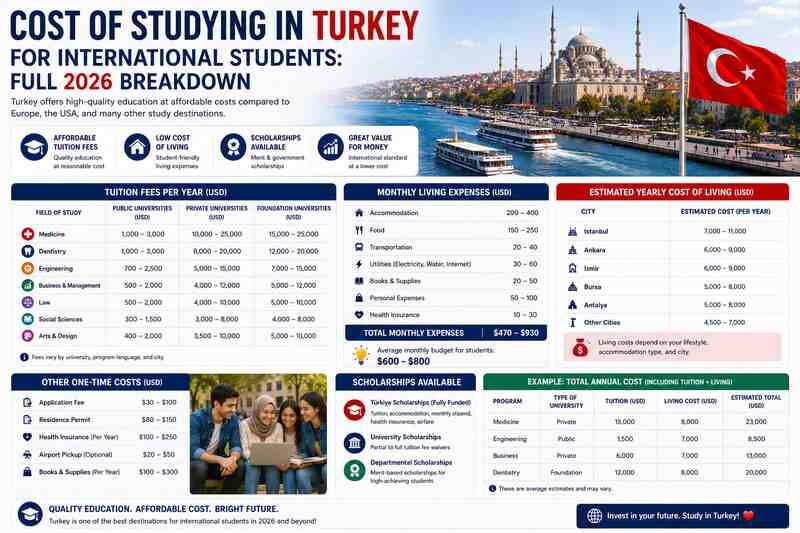
The number one question every international student asks before applying is also the most important one: how much will this actually cost me? Not the brochure number. The real number tuition, housing, food, insurance, transport, documents, visa fees, and everything else that quietly adds up over four years.
The cost of studying in Turkey is genuinely lower than most competing destinations. But "lower" is a word that needs context. Lower than the UK, yes. Lower than Malaysia or Eastern Europe in some programs? Not always. And within Turkey itself, the difference between the cheapest and most expensive options can be tenfold, depending on the university, city, and field of study.
This guide gives you the actual numbers not estimates designed to attract clicks, but ranges built from real tuition data published by Turkish universities for the 2026–2027 academic year. Where figures are approximations, we say so. Where they're confirmed from published sources, we reference them. The goal is to help you build a real budget before you apply, not after.
Why Turkey's Cost Advantage Is Real - and Why It Has Limits
Turkey's cost advantage over traditional study destinations like the UK, US, Canada, and Australia is significant and well-documented. A four-year engineering degree in the UK costs an international student £15,000–£32,000 per year in tuition alone that's $19,000–$40,000 at current exchange rates, before rent, food, or transport. In Turkey, the same program at a reputable private university runs $3,500–$9,000 per year. The math is clear.
But Turkey's cost advantage over second-tier destinations Eastern Europe, Malaysia, some parts of Southeast Asia is narrower and depends on the program. Medical education in Turkey costs $12,500–$30,000 per year at private universities, which is competitive with Georgia, Hungary, or the Philippines but not dramatically cheaper. For non-medical bachelor's programs, Turkey tends to be more affordable than Poland or Czech Republic while offering better urban infrastructure.
The other factor that often goes unmentioned: Turkey's exchange rate dynamic. University fees are denominated in US dollars or euros at most private institutions, which protects students from Turkish lira volatility. Living costs, however, are paid in lira and because the lira has depreciated significantly against hard currencies over the past several years, day-to-day living in Turkey is remarkably cheap for students earning or receiving funds in dollars or euros. A student with $600/month covers a comfortable life in most Turkish cities outside Istanbul. That's a real advantage.
The limits: Istanbul is now noticeably more expensive than it was five years ago, particularly for rent. Students targeting Istanbul on a very tight budget need to plan carefully. And any increase in Turkish tuition fees which have occurred gradually each year is worth monitoring annually.
Tuition Fees in Turkey by Program and University Type (2026–2027)
Let's go through the actual tuition ranges by program category. These figures reflect published rates for the 2026–2027 academic year. Where universities have announced confirmed figures, those are used. Where only ranges are available, the range reflects low-to-high across institutions.
Medicine and Health Sciences
Medicine is the most expensive program category in Turkey, and for good reason hospital affiliations, clinical infrastructure, and faculty costs are high. But even at the top, Turkey's medical tuition is far below Western equivalents.
Program | Public Universities | Private Universities (Turkish) | Private Universities (English) |
|---|---|---|---|
Medicine (MD / Tıp Doktoru) | $3,000–$8,000/year | $6,000–$15,000/year | $12,500–$30,000/year |
Dentistry (DDS) | $2,500–$6,000/year | $5,000–$12,000/year | $10,000–$25,000/year |
Pharmacy | $2,000–$5,000/year | $5,000–$10,000/year | $9,000–$17,000/year |
Nursing | $1,500–$4,000/year | $3,500–$7,000/year | $5,000–$10,000/year |
Physiotherapy | $1,500–$3,500/year | $3,000–$6,500/year | $5,000–$9,000/year |
For context: MBBS/MD programs in the UK cost £38,000–£58,000 per year for international students. Even the most expensive English-medium medical program in Turkey at $30,000 is still roughly half that.
Engineering and Technology
Engineering is where Turkey's private university system shines for value. Strong programs exist at competitive prices, with MÜDEK accreditation — the Turkish equivalent of ABET standards at several institutions.
Program | Public (English) | Private (Turkish) | Private (English) |
|---|---|---|---|
Computer Engineering | $1,000–$3,000/year | $2,500–$5,500/year | $4,000–$9,000/year |
Civil / Mechanical Engineering | $900–$2,500/year | $2,000–$5,000/year | $3,500–$8,000/year |
Electrical / Electronic Eng. | $1,000–$2,800/year | $2,500–$5,000/year | $4,000–$8,500/year |
Architecture | $1,200–$3,500/year | $3,000–$6,000/year | $4,500–$10,000/year |
Software Engineering | $1,000–$2,800/year | $2,500–$5,500/year | $4,000–$9,000/year |
Business, Economics, and Social Sciences
Business programs are among the most popular for international students and among the most competitively priced. Several Turkish universities have AACSB candidacy or EQUIS recognition, which carries weight for employers in the Middle East and parts of Europe.
Program | Public (English) | Private (Turkish) | Private (English) |
|---|---|---|---|
Business Administration | $800–$2,500/year | $2,000–$4,500/year | $3,500–$8,000/year |
Economics | $700–$2,000/year | $1,800–$4,000/year | $3,000–$7,000/year |
International Relations | $700–$2,000/year | $1,800–$4,000/year | $3,000–$6,500/year |
MBA (Master's) | $2,500–$6,000/year | $4,000–$8,000/year | $6,000–$14,000/year |
Postgraduate Programs (Master's and PhD)
Master's and PhD programs are generally cheaper per year than bachelor's programs, which surprises many students. Research-based master's programs at public universities can be nearly free for students who secure a research assistantship.
Level | Public Universities | Private Universities |
|---|---|---|
Master's (thesis-based) | $800–$3,000/year | $3,000–$8,000/year |
Master's (coursework-based) | $1,500–$4,500/year | $4,000–$12,000/year |
PhD | $600–$2,500/year | $2,500–$7,000/year |
How Scholarships Change the Cost Equation
The Türkiye Bursları (Turkish Government Scholarship) program is fully funded it covers tuition, accommodation, a monthly stipend (approximately $400–$650 equivalent depending on study level), health insurance, and a return flight. Applications are competitive, with over 120,000 applicants typically competing for roughly 5,000 slots each year. It's worth applying for, but it shouldn't be counted on for financial planning.
More reliably accessible are university-specific merit scholarships, which many private universities offer openly. These range from 25% to 100% tuition reduction based on academic performance. Minimum GPA requirements vary some universities offer 50% reductions to students with high school averages above 80%, others require 90%+. Several universities also offer need-based support. Students with strong academic records should always ask about scholarship availability before accepting any offer.
Based on our analysis of admissions data at universityapply.org, a significant share of international students at mid-tier private universities in Istanbul end up paying 40–60% of listed tuition due to merit discounts. The published rate is rarely what high-performing students actually pay.
What the Research Says About Cost and Quality in Turkish Higher Education
A peer-reviewed study published in the Journal of Higher Education Policy and Management examined international student satisfaction and cost-value perception across non-traditional study destinations. Findings indicated that students who chose destinations based on total cost calculations including living costs, not just tuition reported significantly higher satisfaction with their financial decisions than those who based choices on tuition alone. Turkey consistently appeared in the group of destinations where students reported lower-than-expected total costs at completion.
A separate analysis of YÖK enrollment data showed that international student numbers in Turkey grew by over 700% between 2012 and 2023 one of the fastest expansion rates of any non-traditional study destination globally. That growth correlates directly with Turkey's investment in English-medium programs and international accreditation, not just pricing.
Building Your Budget: A Practical Summary
Here's a simple framework for estimating your total cost before choosing:
Get the confirmed tuition figure, not an estimate, the published 2026–2027 rate from the university's official page or international office.
Ask about scholarship availability and the minimum GPA required. Subtract realistic discount.
Add living costs using city estimates from this guide.
Add $1,000–$1,500 for first-year administrative and travel costs.
Factor in 1–2 flights home per year.
Build a 10% buffer for unexpected costs.
The cost of studying in Turkey is genuinely competitive. But competitive doesn't mean cheap across the board it means well-priced relative to the quality delivered. Students who go in with realistic numbers, choose their city and institution deliberately, and take advantage of merit scholarships consistently report that Turkey delivered value well beyond what they expected.
universityapply.org maintains updated admissions and cost data across current intake cycles. Submit an inquiry for a free program-specific cost comparison before you decide.
Different universities hit different points on the cost-quality spectrum. Here's how some of the most popular options compare for international students specifically:
University | City | Tuition Range (English) | Value Highlights | Best Budget Type |
|---|---|---|---|---|
Istanbul Medipol | Istanbul | $12,000–$18,000 (Medicine) | WDOMS-listed, major hospital network, large international community | Medical students who prioritize clinical access |
Bahçeşehir (BAU) | Istanbul | $6,500–$11,000 | Strong Erasmus network, global accreditation process | Mid-range, career-focused students |
Istanbul Aydin (IAU) | Istanbul | $5,500–$9,000 | ADEE (dentistry), MÜDEK, wide program range | Cost-efficiency seekers, dentistry |
Istanbul Gelisim | Istanbul | $3,500–$6,500 | Affordable, applied programs, accessible admission | Budget-first, standard bachelor's |
Istinye University | Istanbul | $9,000–$16,000 | Medicine, modern hospital, growing international reputation | Health sciences students |
Ankara Yıldırım Beyazıt | Ankara | $3,000–$6,000 | State university quality at lower cost | Students comfortable in Turkish-medium |
Atatürk University | Erzurum | $2,000–$4,500 | Very low cost, established faculties | Maximum budget minimization |
The practical takeaway: for a non-medical bachelor's in English, a student can get a quality private university education in Istanbul for $5,500–$8,000/year in tuition. For medical education, the realistic minimum at a properly accredited English-medium program is around $12,500–$15,000/year in tuition. For budget-first students willing to study in Turkish with a preparatory year, costs can drop below $3,000/year in tuition.
Beyond tuition and monthly living, there are costs that don't show up in most comparison guides but are very real.
Document preparation (one-time):
Official transcript translation and notarization: $80–$200
Diploma legalization / apostille: $50–$150
YÖK equivalency assessment (if required): $40–$100
Visa and legal (recurring):
Student visa application fee: $50–$130 (varies by nationality)
Residence permit (ikametgah), annual: $70–$120
Health insurance for visa: $100–$250/year (or included in university plan)
Academic materials and tech:
Textbooks, lab materials (varies widely by faculty): $100–$300/semester
Laptop / equipment if needed: student-specific
Travel:
Return flight home (1–2 times per year): $300–$800 depending on origin country
Local travel, cultural activities: variable
A conservative but realistic estimate for total annual one-time and recurring extras: $800–$1,500 in Year 1, $400–$800 in subsequent years.
Tuition is only part of the picture. Living costs vary enormously by city and for many students on tight budgets, choosing Ankara or Trabzon over Istanbul can save $150–$250 per month, which adds up to $6,000–$12,000 over a four-year degree.
City | Accommodation | Food | Transport | Total Estimate |
|---|---|---|---|---|
Istanbul | $300–$500 | $150–$250 | $40–$70 | $500–$820/month |
Ankara | $200–$380 | $120–$200 | $30–$60 | $360–$640/month |
Izmir | $220–$400 | $130–$210 | $30–$55 | $390–$665/month |
Bursa | $180–$320 | $110–$180 | $25–$50 | $325–$550/month |
Trabzon | $150–$280 | $100–$160 | $20–$40 | $280–$480/month |
Konya | $140–$260 | $90–$150 | $20–$40 | $260–$450/month |
These estimates assume shared accommodation for rent. Students renting a private apartment will pay significantly more, particularly in Istanbul. State dormitories (KYK) can reduce accommodation costs to $30–$80 per month but are competitive and may not be available to all international students at all institutions.
Q: How much does it cost to study in Turkey per year in total? A: For a bachelor's program at a private English-medium university in Istanbul, a realistic total annual cost including tuition, accommodation, food, transport, insurance, and miscellaneous is $8,000–$18,000 depending on program and lifestyle. Medical programs push toward the higher end; engineering and business sit comfortably in the $8,000–$13,000 range. Students in Ankara or Izmir can subtract roughly $1,500–$2,500 per year from these estimates.
Q: Is studying in Turkey cheaper than in Eastern Europe? A: For most bachelor's programs, Turkey is comparable to or cheaper than Poland, Hungary, and Czech Republic. The exception is medical education in Hungary or Georgia, where some programs are priced competitively with or below Turkey's private university medical fees. For non-medical programs, Turkey generally offers better value, especially when living cost differences are included.
Q: Can I get a part-time job to help cover costs? A: Turkish law restricts international students from working during their first year. After that, limited part-time work is permitted with the appropriate authorization. Practically, language barriers make job access difficult for students who aren't Turkish-speaking. Financial planning should not rely on part-time income as a significant income source.
Q: Do Turkish universities charge fees in USD or Turkish lira? A: Most private universities targeting international students publish and collect tuition in USD or EUR. This protects students from lira exchange rate volatility on the biggest cost item. Living costs are paid in lira, which at current exchange rates is highly favorable for students receiving funds in hard currencies.
Q: Are there hidden fees I should know about? A: Yes. The most commonly overlooked are the residence permit renewal fee (annual), health insurance, document translation costs, and in Year 1, legalization of academic records. Budget $800–$1,200 extra in your first year to cover these comfortably. After Year 1, recurring non-tuition costs are lower.
Q: How do I compare total cost of studying in Turkey across universities? A: Request a full fee schedule not just tuition from each university's international admissions office. Ask specifically about mandatory student services fees, dormitory deposits, health insurance plans, and registration fees. Then add estimated living costs based on the city. universityapply.org maintains updated tuition and cost data submit an inquiry for a comparative breakdown for your specific program.