Study Abroad in Turkey, Azerbaijan, Georgia, or Malaysia - Which Country Is Right for You in 2026?

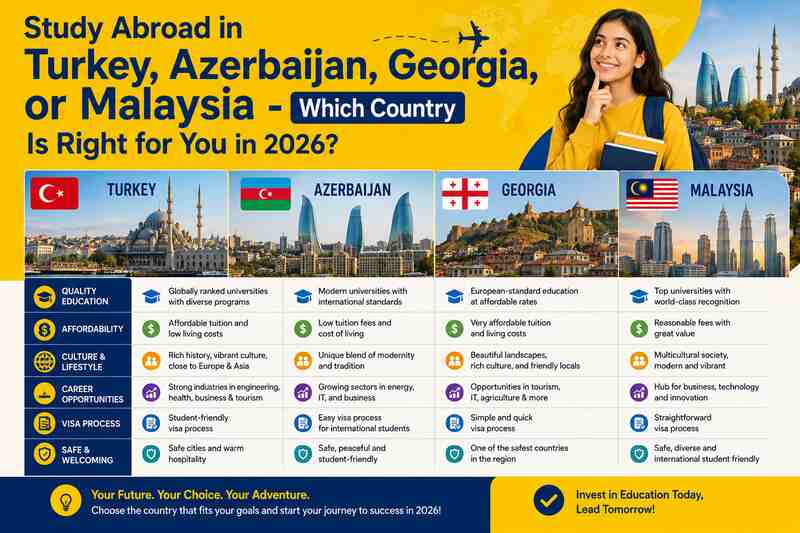
Four countries. All popular with international students in 2026. All offering English-medium programs at a fraction of Western tuition costs. All accessible through Global Degrees Network's free admission portal. But they're genuinely different in ways that matter enormously depending on who you are, what you're studying, and what you want from your time abroad.
This is an honest comparison - not a promotional summary of each country, but an analysis of who each destination actually suits, what the real tradeoffs are, and how to think through the choice if you're considering multiple options.
The Framework: What Actually Determines Which Country Fits You
Before getting into country specifics, the comparison needs a framework. The right country for you depends on:
Program - Where is the degree best recognized for your intended career? A medical degree's value depends on which international medical directories it appears in. An engineering degree's value depends on accreditation bodies.
Budget - Not just tuition, but living costs, which vary enormously between Istanbul and Baku or Tbilisi.
Language - English proficiency requirements and the actual language ratio in instruction differ.
Post-graduation plans - Do you intend to return home, work in a third country, or stay in the destination country?
Cultural fit - Islam-majority environments, language barriers, food, climate, social environment - these practical factors affect quality of life and academic performance.
With that framework in place, let's look at each destination.
Turkey - The Established Destination
Who it suits: Students with broad program needs who want a large international student community, a well-developed private university sector, and a country with strong geographic and transport connections to both Europe and the Middle East.
Universities in the network: Istanbul, Ankara, Izmir, and several other cities host partner universities. Programs span medicine, dentistry, pharmacy, engineering, business, architecture, international relations, and essentially the full range of academic disciplines.
Tuition range (2026-2027): $3,000-15,000 per year at private universities. State universities are significantly cheaper but competitive and primarily Turkish-medium. Foundation universities (private, Turkish law) vary widely in fee structure.
Living costs: Istanbul is the most expensive city - $600-1,200/month for rent, food, transport, and basic expenses combined, depending on accommodation choice. Ankara is somewhat cheaper. Smaller cities like Konya or Gaziantep can be managed on $400-700/month.
English-medium availability: Strong at established private universities. Almost all major private universities in Istanbul and Ankara offer English-medium undergraduate and postgraduate programs, particularly in medicine, engineering, and business.
Scholarship situation: The government Türkiye Scholarship (YTB) offers full-ride scholarships including tuition, accommodation, and stipend for selected students. Competition is significant. Internal university scholarships ranging from 25-75% of tuition are more accessible and often available through agency-coordinated applications.
Key consideration for medicine students: Not all Turkish medical programs are equal in terms of international recognition. Students should verify that their specific university's medicine program appears on WDOMS and is recognized by their home country's medical licensing authority. Global Degrees Network verifies this before recommending programs.
Key concern: The Istanbul housing market is tight. Students who don't secure accommodation before arrival may face difficulties. Pre-arrival coordination through the agency is particularly important for Turkey.
Azerbaijan - The Underrated Option
Who it suits: Students from Turkic-speaking backgrounds who value linguistic and cultural proximity, students from Muslim-majority countries who want a familiar environment, and students who want lower living costs than Turkey or Northern Cyprus.
Universities in the network: Primarily Baku-based institutions, covering medicine, engineering, economics, and general undergraduate programs. Azerbaijan University of Languages, Azerbaijan Medical University, and several private institutions are in the partner network.
Tuition range (2026-2027): $2,000-6,000 per year at most partner institutions. Medicine programs are at the higher end of this range.
Living costs: Baku is significantly cheaper than Istanbul. A student can manage comfortably on $400-600/month including accommodation, food, and basic expenses. This is one of Azerbaijan's strongest practical advantages.
English-medium availability: Growing but still limited compared to Turkey. Many programs in Baku are offered in Azerbaijani, Russian, or Turkish. Genuinely English-medium programs at the undergraduate level are available but fewer. Students should verify language of instruction carefully for their specific program.
Scholarship situation: Azerbaijani universities offer internal scholarships, particularly to students with strong academic profiles. The Azerbaijani government State Scholarship exists but is primarily for Azerbaijani citizens or ethnic Azerbaijanis from other countries.
Key consideration: Azerbaijan's degree recognition is strongest in neighboring countries - Russia, Central Asian states, and Turkey. For students from West Africa, South Asia, or the Arab world, verifying home-country recognition of specific Azerbaijani degrees is essential before enrollment.
Key advantage: Students who speak Turkish have a significant language advantage. Azerbaijani and Turkish are mutually comprehensible at a functional level. This makes daily life, language learning, and social integration significantly easier for Turkish-speaking international students.
Georgia - The Medical Education Destination
Who it suits: Medical students specifically. Georgia has built a niche as a recognized medical education destination, with several Tbilisi-based universities listed on WDOMS and with degrees recognized in the European Union, the United States (ECFMG-eligible for several universities), and many other countries.
Universities in the network: Medical universities in Tbilisi - Caucasus International University, David Tvildiani Medical University, and others - are in the Global Degrees Network partner list. These are specifically selected for verified WDOMS listing.
Tuition range (2026-2027): $5,000-8,000 per year for medicine programs, which is substantially cheaper than European, North American, or Middle Eastern medical education for an internationally recognized degree.
Living costs: Tbilisi is cheap by any international comparison. $400-600/month covers rent, food, transport, and reasonable lifestyle expenses. Georgia's cost of living is one of the lowest among countries with internationally recognized medical education.
English-medium availability: Medical programs at partner universities are taught in English. This is one of the core criteria for inclusion in the Global Degrees Network partner list for Georgia.
Scholarship situation: Georgian universities offer some internal scholarships, but the primary financial advantage is the low tuition itself rather than scholarship availability.
Key consideration for non-medicine students: Georgia's universities outside medicine are less internationally recognized. For students not studying medicine, Turkey, Azerbaijan, or Malaysia are generally stronger choices.
Key advantage for medicine students: A WDOMS-listed, English-medium medical degree from a Georgian university recognized in the EU is a genuinely strong qualification at a price point that makes six years of medical education financially feasible for students from middle-income family backgrounds.
Practical note: Georgia's political and security environment has been stable for international students, though the country's proximity to the Russia-Ukraine conflict region requires ongoing monitoring. The agency tracks this and advises students if conditions change.
Malaysia - The Commonwealth Option
Who it suits: Students who want English-medium instruction in a Muslim-majority country with strong Southeast Asian connections, or students who specifically want a degree with Commonwealth university recognition for careers in Commonwealth countries.
Universities in the network: Universities in Kuala Lumpur and surrounding areas, including institutions with British university affiliations and international accreditation from bodies recognized in the UK, Australia, and elsewhere.
Tuition range (2026-2027): $4,000-12,000 per year depending on institution and program. British-affiliated universities and fully private institutions are at the higher end. Local private universities with international accreditation are mid-range.
Living costs: Kuala Lumpur is more expensive than Baku or Tbilisi but cheaper than Istanbul. $600-900/month covers reasonable student living. Malaysia's strong food culture makes eating well affordable even on tight budgets.
English-medium availability: Excellent. Malaysia's higher education system operates primarily in English at the university level. Language barriers are minimal for students who are functional in English.
Scholarship situation: The Malaysian government runs several scholarship programs for international students, and private universities offer merit-based scholarships. The range is competitive for strong academic performers.
Key consideration: Malaysian degrees are well-recognized in Commonwealth countries, Southeast Asia, and the Middle East. For students intending careers in the UK, Australia, or Commonwealth-adjacent markets, Malaysian credentials are often more recognized than Turkish or Georgian equivalents.
Key advantage: Diverse, English-speaking international student community. Students from South Asia, West Africa, the Arab world, and Central Asia all have established communities in Malaysian university cities, making social integration easier than in destinations with smaller international student populations.
How Global Degrees Network Helps You Choose
The consultation process at Global Degrees Network doesn't push a single destination. It works through the student's specific situation:
What program are you studying?
What are your home country's requirements for degree recognition?
What is your budget range for tuition and living?
Do you have language proficiency requirements or preferences?
What are your post-graduation career plans?
Do you have any specific requirements around cultural environment, food, climate, or community?
Based on this conversation, the agency recommends the countries and universities in the partner network that best match the profile. Sometimes that's one clear answer. Often it's two or three options worth comparing offer letters from.
The recommendation is free. The application through the portal is free. And the student has access to 100+ universities across all four countries through a single account.
Northern Cyprus - The English-Medium Niche
Northern Cyprus deserves separate mention even though it's geographically part of the Turkey discussion. It's a distinct jurisdiction with its own university system, visa requirements, and student environment.
Status: Northern Cyprus is recognized as a separate entity (Turkish Republic of Northern Cyprus) by Turkey alone internationally. This has implications for degree recognition - Northern Cyprus university degrees are recognized through Turkey's YÖK framework and in countries that recognize Turkish-accredited institutions, but may not be independently recognized in some other countries.
Who it suits: Students who specifically want English-medium instruction in a smaller, more manageable environment than mainland Turkey. Northern Cyprus universities - Eastern Mediterranean University, Near East University, Cyprus International University - have well-developed English-medium programs with long track records. The university towns of Famagusta and Nicosia are genuinely international environments.
Tuition: Typically $2,000-7,000/year depending on institution and program. Northern Cyprus is generally cheaper than mainland Turkey for similar program quality.
Living costs: Significantly lower than Istanbul. $350-500/month covers comfortable student living.
Key consideration: Students from some countries find that Northern Cyprus degrees don't carry the same independent recognition as Turkish mainland degrees. Engineering and medicine graduates specifically should verify recognition in their target practice country before enrolling.
Why students choose it anyway: The English-medium environment, the established international student community (Near East University alone has 20,000+ international students), and the island lifestyle are genuinely appealing. For students whose career plans are oriented toward Turkey-recognized markets, it's an excellent option.
Tuition is one number. The total cost of four years of study is a different number. Here's a realistic calculation for a four-year undergraduate program:
Turkey (Istanbul)
Tuition: $8,000/year (mid-range private)
Living: $900/month - $10,800/year
Total 4 years: $32,000 tuition + $43,200 living = ~$75,200
Azerbaijan (Baku)
Tuition: $4,000/year (mid-range)
Living: $500/month - $6,000/year
Total 4 years: $16,000 tuition + $24,000 living = ~$40,000
Georgia (Tbilisi)
Tuition: $6,000/year (medicine program)
Living: $500/month - $6,000/year
Total 4 years: $24,000 tuition + $24,000 living = ~$48,000
Malaysia (Kuala Lumpur)
Tuition: $7,000/year (mid-range)
Living: $700/month - $8,400/year
Total 4 years: $28,000 tuition + $33,600 living = ~$61,600
These are estimates - actual costs vary based on accommodation choice, lifestyle, and scholarship. But the order of magnitude is clear: Azerbaijan is consistently the most affordable total, Georgia and Malaysia are mid-range, and Turkey (Istanbul specifically) is the most expensive of the four - though still a fraction of Western European or North American education costs.
Medicine is the program where destination choice matters most critically. Here's a focused comparison:
Factor | Turkey | Azerbaijan | Georgia | Malaysia |
|---|---|---|---|---|
WDOMS listing availability | Yes (select universities) | Yes (select universities) | Yes (several universities) | Yes (select universities) |
Typical annual tuition | $8,000-15,000 | $5,000-8,000 | $5,000-8,000 | $6,000-12,000 |
Language of clinical training | Mixed (Turkish clinics) | Azerbaijani/Russian clinics | English-medium | English-medium |
EU recognition | Case by case | Limited | Growing | Limited |
ECFMG eligibility | Select universities | Not generally | Select universities | Select universities |
Living cost | Medium-High | Low | Low | Medium |
For a medical student prioritizing international recognition at the lowest total cost over six years, Georgia is often the strongest option among the four - but only at the specific universities that are WDOMS-listed. For a medical student prioritizing clinical environment in a Muslim-majority country, Turkey offers the most developed clinical training infrastructure. For a student from a Turkic-speaking background, Azerbaijan's language proximity reduces the clinical training language barrier.
These are nuanced judgments that require knowing the student's profile. Global Degrees Network's consultation process works through exactly this analysis before making a program recommendation.
Beyond academics and tuition, the day-to-day quality of student life matters enormously. Students spend 4-6 years in these environments. Here's an honest comparison of what daily life looks like in each destination:
Turkey (Istanbul): Urban, intense, diverse. The food is extraordinary. Transport works reasonably well once you understand the system. The social life is rich - Istanbul has more to do per square kilometer than almost any city on earth. But it's a megacity with megacity problems: crowds, cost, complexity. Students who thrive tend to be those who lean into the urban energy rather than fighting it.
Turkey (Ankara): More structured than Istanbul, more planned, calmer. The academic environment is taken more seriously. Less international social life, but also less distraction. Good for students who want to focus primarily on their studies and don't need the stimulation of Istanbul.
Azerbaijan (Baku): Modern city, strong local culture, very affordable. The social environment is a mix of local Azerbaijani culture and a significant international student community. Food is good and cheap. The city is safe. Students often report that Baku is a very livable city that gets underestimated by students who haven't researched it.
Georgia (Tbilisi): Arguably the most charming city among the four destination capitals for student life. Old Town Tbilisi has a genuinely beautiful environment. The food culture is excellent. Cost of living is very low. The international medical student community is well-established. The primary downside is that Georgia's infrastructure outside the capital is limited, and Tbilisi itself is smaller than the other capitals.
Malaysia (Kuala Lumpur): Modern, multi-cultural, well-organized. Excellent food across multiple cuisines. Good public transport. The multinational environment means students from virtually any background can find community. Shopping malls and entertainment infrastructure are excellent. The downside for some students: KL can feel more corporate than culturally immersive - it's a Southeast Asian financial hub, not a student-focused city in the way some other capitals are.
For students from Muslim-majority backgrounds, the religious and cultural environment of the destination country matters practically, not just symbolically.
Turkey: Muslim-majority country. Halal food widely available everywhere, including at universities. Prayer facilities on university campuses and throughout cities. Ramadan is observed nationally. Turkish culture is broadly Islamic but with a Kemalist secular tradition - the social environment varies from conservative (interior cities) to quite liberal (central Istanbul neighborhoods). Students from more conservative backgrounds tend to find Ankara or smaller Turkish cities more comfortable; students who want a liberal social environment with Islamic infrastructure tend to prefer Istanbul.
Azerbaijan: Muslim-majority country, but with a Soviet legacy that created a more secular social culture than many predominantly Muslim countries. Mosques are present and active, halal food is available, but the social environment is more openly mixed than in Turkey. Students from very conservative backgrounds sometimes find Baku more secular than expected.
Georgia: Majority Orthodox Christian country. Halal food is available at restaurants catering to the large international Muslim student population, but it requires seeking out - it's not the default. The country is broadly tolerant, and the international student community in Tbilisi is used to accommodating diverse backgrounds. Students from Muslim-majority backgrounds typically adapt well, but it takes conscious effort.
Malaysia: Muslim-majority country where Islam is the official state religion. Halal food is everywhere - Malaysia arguably has one of the best halal food cultures in the world due to its ethnic Malay, Chinese, and Indian food traditions all developed under halal requirements. Prayer facilities are widely available. For students from Muslim-majority backgrounds who want the most comfortable religious environment, Malaysia compares favorably.
This comparison is exactly what the Global Degrees Network consultation process works through. Not in a surface way, but in genuine depth.
A student who mentions they're from Nigeria, studying medicine, with a budget of $8,000/year total (tuition plus living), intending to practice in the UK after graduation, will get a very specific conversation:
Georgia is strong on WDOMS listing and relatively affordable
Malaysia has some ECFMG-eligible programs but is slightly over budget
Turkey has strong programs but total cost including Istanbul living is at the upper limit of the budget
Azerbaijan has lower recognition for UK medical licensing
Based on this analysis, the recommendation is Georgia first, then Turkey (outside Istanbul), then Malaysia if specific programs there fit within budget. Azerbaijan would be flagged as less suitable for UK medical licensing goals.
This is a specific recommendation built on specific criteria. It's different from saying "all four countries are great options - here are the universities in each." The consultation earns its value by being specific.
One Portal, Four Countries, 100+ Universities - With Services That Continue After Arrival
No other study abroad platform covers Turkey, Northern Cyprus, Azerbaijan, Georgia, and Malaysia through a single integrated portal with direct university admission access, free parallel applications, and genuine post-arrival support in each destination. Global Degrees Network's consultation matches students to countries based on accreditation requirements, budget, career goals, and home-country recognition - not commission structures. The same platform that delivers your offer letter also coordinates your accommodation, airport reception, and student community connection across all four destination markets. That breadth of verified, supported coverage is available nowhere else.
Q: Can I apply to universities in multiple countries simultaneously through the portal? A: Yes. The portal supports parallel applications across all partner countries. You can compare offers from a Turkish university, a Georgian university, and a Malaysian university and then decide.
Q: Which country has the easiest visa process? A: This depends heavily on your nationality. For some nationalities, Georgia has a particularly accessible visa policy. Turkey requires a student visa which generally takes 4-8 weeks. Malaysia's student visa process is well-established. Azerbaijan has specific requirements for certain nationalities. The agency advises on visa process specifics for your nationality.
Q: Are degrees from all four countries recognized in Europe? A: This is complex and depends on the specific university, program, and EU member state. Turkish and Malaysian degrees are generally well-recognized. Georgian medical degrees are gaining recognition. Agency staff can advise on specific recognition in specific countries based on your career plans.
Q: Can I transfer between countries mid-program? A: University-to-university transfer is possible in principle but subject to each university's policies. It's complex and not something to plan for in advance. Choosing the right destination before starting is far better than planning a mid-program transfer.
Q: What if I want to study in a country not on this list? A: The agency can advise on direct applications outside the partner network, but the direct integration benefits (same-day admission, pre-verification, real-time tracking) apply only to partner universities.