How to Apply to University in Northern Cyprus in 2026 - The Fastest Route to Admission

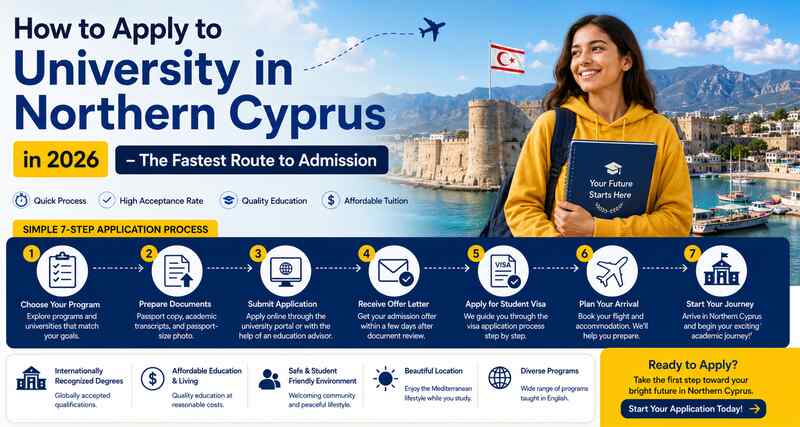
Northern Cyprus has one of the most accessible university admission systems for international students anywhere in the world. And yet most students still spend weeks on a process that should take hours - because they don't know the fastest route in.
This guide covers everything a prospective student needs to know about applying to universities in Northern Cyprus (TRNC) in 2026: the top institutions, tuition fees, YODAK accreditation, the visa process, and - critically - how the Global Degrees Network portal routes applications directly to university admission teams, with most decisions reviewed within one hour of submission.
Why Northern Cyprus Has Become a Top International Student Destination
The numbers tell a straightforward story. Northern Cyprus hosts more than 65,000 international students across its university system - a remarkable figure for an island territory with a total population of around 400,000. The ratio of international students to resident population is among the highest in the world.
Students come from Nigeria, Pakistan, Bangladesh, Egypt, Jordan, Kazakhstan, Nigeria, Indonesia, and over 100 other countries. The draw is consistent: English-medium instruction at affordable tuition, in a Mediterranean environment, with degrees recognized under Turkey's YÖK framework and by the TRNC's own Higher Education, Planning, Accreditation and Coordination Council - YODAK.
What students often don't realize until they're deep in the research is that Northern Cyprus also offers something unusual: admission decisions that can come faster than almost any other university system. Universities here are set up for high-volume international recruitment, with dedicated international admission offices. When applications arrive complete and through the right channel, the review is swift.
Through Global Degrees Network's direct integration portal, swift means within one hour.
The Major Universities - What Each One Actually Offers
Near East University (NEU) - Nicosia
Near East University is the largest university in Northern Cyprus, and by several metrics one of the largest private universities in the Eastern Mediterranean. It's located in Nicosia (Lefkosa), the capital, and hosts a sprawling campus with hospitals, research centers, and specialist institutes.
Programs: Medicine (MD), Dentistry, Pharmacy, Law, Engineering, Business, Architecture, Communications, Social Sciences, Education. More than 438 programs across undergraduate, graduate, and doctoral levels.
Fees (2026-2027): Undergraduate programs range from approximately €2,665 to €10,923 per year depending on faculty. Medicine sits at the higher end of this range. Business and social science programs are at the lower end. Scholarships are available and actively offered to strong academic performers - tuition reductions of 25%-75% are achievable for eligible applicants.
Accreditation: Recognized by YODAK, YÖK (Turkey), and by ministries of education in EU and Arab countries. NEU's medicine program has international recognition important for graduates who plan to practice in multiple regions.
Key differentiator: NEU has its own hospital network - the Near East University Hospital - where medicine and dentistry students complete clinical training. This is meaningful: clinical training at a university-affiliated hospital directly, rather than being placed in external facilities on a rotational basis, provides a more consistent training environment.
Suitable for: Students who want a large, well-resourced university experience with strong medical and engineering faculties. The campus is self-contained enough that students who want a structured, university-focused environment find NEU comfortable.
Eastern Mediterranean University (EMU) - Famagusta
Eastern Mediterranean University is Northern Cyprus's public university, established in 1979, and the institution with the strongest global ranking footprint of any university on the island. It's located in Famagusta (Gazimağusa), on the eastern coast.
Programs: Engineering, Architecture, Business, Education, Arts and Sciences, Law, Communications, and Health Sciences. Over 140 programs.
Fees (2026-2027): Among the most affordable for international students, especially in standard undergraduate programs. Civil Engineering from approximately $3,100/year. Business and social sciences from approximately $2,900/year. Medicine approximately $12,500/year. Dentistry approximately $8,750/year.
Ranking: EMU holds a position in the top 600 globally according to Times Higher Education, and is ranked first among TRNC universities on Webometrics. It's a member of the Association of European Universities, the International Association of Universities, and holds ABET engineering accreditation.
Key differentiator: EMU is public, which brings a different academic culture - more research-oriented, less commercially driven, stronger focus on engineering and applied sciences. For students who want a university that feels academically serious, EMU's environment is distinct from private institutions.
Suitable for: Engineering, architecture, and science students who want a well-ranked, affordable, research-connected environment. Also strong for students who want the social diversity of a large international student body (approximately 20,000 students).
Cyprus International University (CIU) - Nicosia
Cyprus International University is a well-established private university with a strong reputation in technology, business, law, and communications. Located in Nicosia, CIU has invested heavily in modern campus infrastructure.
Programs: IT, Computer Engineering, Business Administration, Law, Architecture, Communications, Education, Health Sciences.
Fees (2026-2027): Approximately €4,747 to €12,400 per year depending on program. Business and IT programs are at the lower end; health sciences higher.
Accreditation: CIU programs are recognized by YODAK and YÖK. Several programs hold additional international accreditations.
Key differentiator: CIU has a particularly strong IT and computer engineering faculty with connections to technology employers. Students targeting careers in software, tech, or digital communications find CIU's program structure well-aligned with industry.
Suitable for: Technology, business, and law students who want a private university with modern infrastructure and an internationally oriented student environment.
Girne American University (GAU) - Kyrenia
As the name suggests, GAU operates with an American university model - credit-hour structure, liberal arts general education requirements, smaller class sizes. Located in Kyrenia (Girne), one of the most scenic towns in Northern Cyprus.
Programs: Business, Engineering, Law, Architecture, Art and Design, Social Sciences, Health Sciences.
Fees (2026-2027): Competitive with other Northern Cyprus private universities, generally in the $4,000-8,000/year range.
Key differentiator: American-style academic structure, smaller student body than NEU or EMU (more personalized environment), and Kyrenia's location on the northern coast makes the physical environment particularly attractive.
Suitable for: Students who want a smaller university experience, American academic model, and a particularly beautiful Mediterranean campus setting.
European University of Lefke (EUL) - Lefke
European University of Lefke is one of the more affordable private universities in Northern Cyprus, with a particular strength in health sciences.
Programs: Health Sciences, Business, Engineering, Pharmacy.
Fees (2026-2027): Generally lower than the major private universities - a strong option for students with tighter budgets who still want an English-medium degree.
Suitable for: Cost-sensitive students and students specifically targeting health sciences programs outside medicine.
YODAK and YÖK - Understanding Northern Cyprus Accreditation
Before applying to any Northern Cyprus university, students need to understand how accreditation works in TRNC - because it's different from most countries and has real implications for degree recognition.
YODAK (Yükseköğretim Planlama, Denetleme, Akreditasyon ve Koordinasyon Kurulu) is Northern Cyprus's own higher education oversight body, equivalent to Turkey's YÖK for mainland institutions. All operating universities in Northern Cyprus are recognized by YODAK.
YÖK recognition: A key fact for international students is that Northern Cyprus university degrees are recognized by YÖK (Turkey's Higher Education Council) under the bilateral Turkey-TRNC educational protocol. This means a degree from Near East University or Eastern Mediterranean University carries the same YÖK recognition as a degree from a Turkish mainland university. For students who intend to work or pursue graduate studies in Turkey, this is directly significant.
International recognition: Northern Cyprus university degrees are accepted by ministries of education in more than 50 countries, including EU member states in several contexts, Arab countries, and many African and Asian states. However, recognition is not universal - students should verify their specific home country's position before enrollment.
What YODAK recognition does NOT automatically guarantee: Recognition by medical licensing bodies outside Turkey and TRNC. For medicine students specifically, WDOMS listing and home-country licensing authority recognition are the critical checks, in addition to YODAK/YÖK status.
Global Degrees Network verifies accreditation and recognition status for each program before recommending it. Students targeting specific practice countries get specific verification, not generic assurances.
One of the strongest practical arguments for Northern Cyprus is cost of living. Students consistently report lower living expenses than mainland Turkey, especially compared to Istanbul.
Accommodation: University dormitories are the most affordable option, often $150-350/month including utilities at major campuses. Private apartments near campus range $200-400/month for shared arrangements, $300-500/month for single occupancy.
Food: Northern Cyprus has a strong Mediterranean food culture. Campus cafeterias serve meals for $2-5. Local restaurants average $5-12 per meal. Cooking in your own accommodation is very affordable with local produce.
Transport: Within university cities (Nicosia, Famagusta, Kyrenia), public transport is limited but affordable. Many students rely on university shuttle services, bicycles, or shared taxis. The distances within these small cities are manageable.
Total monthly budget: A student in Northern Cyprus managing accommodation, food, transport, personal expenses, and internet can realistically live on $400-600/month - significantly less than Istanbul for comparable living quality.
For a 4-year undergraduate program, the total cost including tuition and living at a mid-range Northern Cyprus private university runs approximately $30,000-45,000 - making it one of the most affordable English-medium university environments globally.
University | Location | Type | Annual Tuition (Undergrad) | Medicine Available | ABET Engineering | Best For |
|---|---|---|---|---|---|---|
Near East University (NEU) | Nicosia | Private | €2,665-€10,923 | Yes (own hospital) | No | Medicine, dentistry, large campus |
Eastern Mediterranean (EMU) | Famagusta | Public | $2,900-$12,500 | Yes | Yes | Engineering, research, ranking |
Cyprus International (CIU) | Nicosia | Private | €4,747-€12,400 | No | No | IT, business, law |
Girne American (GAU) | Kyrenia | Private | $4,000-$8,000 | No | No | American model, smaller campus |
European University Lefke (EUL) | Lefke | Private | Lower range | No | No | Budget-conscious, health sciences |
For most international students choosing between EMU and NEU, the decision comes down to program priority. Medicine students with their own clinical training preference lean toward NEU's hospital infrastructure. Engineering students focused on international accreditation lean toward EMU's ABET recognition. Students who want the lowest total cost for non-medicine programs often find EMU's public university pricing structure the most affordable of the major institutions.
Global Degrees Network's portal processes a large volume of applications to Northern Cyprus universities - more than any individual student applying directly, and more than most agencies operating in this market. This volume matters for students in ways that aren't immediately obvious.
Priority relationship: Admission offices that work regularly with an agency portal build a processing rhythm. When a Global Degrees Network submission arrives, the evaluator knows: this is a pre-verified, complete file from a trusted integration partner. There's no reason to delay review. The relationship between the portal and the university creates an expectation of quality that means files are treated with priority.
Scholarship negotiation leverage: An agency placing significant enrollment volume at a university is in a position to advocate for scholarship terms on behalf of students. Individual applicants negotiate with no leverage. An agency with volume can often secure scholarship access for students that wouldn't be available through direct application.
Problem-solving access: When an issue arises mid-process - a document verification question, a program availability question, a scholarship condition query - an agency with volume has direct access to the right decision-maker at the university. A direct applicant has a general inquiry email.
The 1-hour review commitment is the most visible expression of this relationship. It's possible because the university trusts the completeness and quality of what the portal sends - and because the direct integration channel puts the file in front of the evaluator immediately, not in a general queue.
Getting to Northern Cyprus requires understanding a specific logistics reality: all flights to Northern Cyprus route through Turkey. Ercan Airport (ECN), near Nicosia, is only accessible via Turkey because TRNC is not internationally recognized by most countries, meaning no direct international flights operate there from outside Turkey.
Practical implications:
Students must fly to a Turkish airport (Istanbul or Ankara, typically) and take a connecting flight to Ercan.
Whether a transit visa for Turkey is required depends on the student's nationality. Many nationalities can transit Turkey without a separate Turkish visa when holding a TRNC student acceptance letter. Some nationalities do require a Turkish transit visa.
At Ercan Airport, the TRNC immigration officer issues a student entry visa (valid for 90 days) upon presentation of the university acceptance letter.
After arrival and enrollment, students apply for the TRNC student residence permit.
Entry document checklist:
Valid passport (minimum 18 months validity recommended)
University acceptance letter (from the university's international office)
Turkish transit visa if required for your nationality
Proof of accommodation for initial nights
Health insurance documentation
Global Degrees Network advises on the specific transit requirements for each student's nationality, coordinates the acceptance letter with the university's international office, and provides the specific Ercan arrival process so students know exactly what to expect.
Northern Cyprus has an unusually high return rate among international students - meaning students who studied there for one degree often return for postgraduate study. This isn't primarily about the academic experience. It's about the quality of life during the degree.
The Mediterranean climate means more than warm weather. It means a pace of life that allows students to balance academic demands with genuine downtime. The sea is accessible from most university cities within 20-30 minutes. The food culture emphasizes shared meals and social eating. The physical beauty of the island - ancient ruins, harbor towns, mountain villages - provides genuine contrast to the campus environment.
For students from busy urban centers in South Asia, West Africa, or the Arab world, Northern Cyprus often provides the first experience of a significantly different pace of daily life. Many describe it as having had a positive effect on their academic focus - less ambient stress, more physical activity, better sleep. These factors are difficult to quantify but consistently mentioned by international students reflecting on their time in TRNC.
The Global Degrees Network student community connection service specifically leverages this lifestyle dimension. Connecting incoming students with existing communities before arrival means they know from day one where to find the beach closest to campus, which local restaurants are student favorites, and what the social rhythms of the university city look like in practice. That knowledge - the practical geography of a comfortable student life - is what makes the difference between landing in an unfamiliar place and landing somewhere that quickly starts to feel like home.
Here is where the experience for students using universityapply.org diverges significantly from students applying through other channels.
Global Degrees Network has direct integration with the admission teams at all major Northern Cyprus partner universities. The portal is not a general inquiry form - it connects to the admission staff who actually evaluate and issue offers. When an application arrives through the portal, it enters the dedicated international admission workflow, not the general public queue.
The standard admission pipeline at Northern Cyprus universities without this integration:
A student uploads documents to a university's public portal. The file enters an administrative queue. A staff member logs the application. The file is routed to the international office. An evaluator checks documents. If anything is missing, a request email goes out. The student responds days later. The file goes back into the queue. Eventually a decision is issued. Total time: commonly 1-2 weeks for complete files, much longer for incomplete ones.
Through the Global Degrees Network portal:
The portal runs a completeness check before submission is allowed. Missing documents are flagged and the student resolves them before the file goes anywhere. When submission happens, it goes through the direct integration channel to the university's evaluation team - a complete file, pre-verified, landing in the right inbox. Evaluation begins immediately.
The result: most applications received through the portal are reviewed within one hour during university working hours.
This isn't hypothetical. It's the structural outcome of pre-verified completeness plus direct pipeline access. An evaluator receiving a complete file through a trusted integration channel has no reason to delay - the review takes 20-30 minutes for a standard undergraduate application, and a provisional offer is issued the same day.
Northern Cyprus Applications Through the Only Portal With Direct Institutional Access
Global Degrees Network's direct integration with Near East University, Eastern Mediterranean University, Cyprus International University, and other TRNC partner institutions means applications reach evaluation staff within minutes - not weeks. Most are reviewed within one hour. No other study abroad portal operating in the Northern Cyprus market has this level of technical access. Combined with YODAK and YÖK accreditation verification, pre-arrival accommodation in Nicosia or Famagusta, transit visa guidance, and student community introductions before arrival - the service Global Degrees Network delivers for Northern Cyprus applicants is without equivalent in the sector.
Q: Are Northern Cyprus degrees recognized in my home country? A: Recognition varies significantly by country. YODAK and YÖK recognition is universal within TRNC and Turkey. Recognition in Arab countries, most African states, and several Asian countries is well-established. EU recognition is partial - program-specific and country-specific. Medical licensing recognition requires checking WDOMS listing and home-country licensing board. The agency verifies for your specific country before making program recommendations.
Q: Can I really get an offer letter within one hour? A: For complete applications submitted through the direct integration portal during university working hours, yes - this is the typical timeline for standard undergraduate and postgraduate programs. Medicine programs with limited seats may involve slightly longer committee-level review, but still significantly faster than standard direct application pipelines.
Q: What is the academic year structure in Northern Cyprus? A: Universities in Northern Cyprus operate two primary intakes: October (fall semester) and February (spring semester). The fall intake is larger and has the widest program availability. Spring intake is available for many but not all programs. Some universities also offer a summer session.
Q: How does the Turkish Lira exchange rate affect my fees? A: Northern Cyprus universities typically invoice in EUR or USD rather than Turkish Lira, specifically to provide students with predictable costs. This insulates tuition from lira volatility. Living costs, which are in lira, do fluctuate with the exchange rate - in practice this has recently worked in students' favor as living costs in dollar terms have been lower than historical averages.
Q: Is the social environment in Northern Cyprus safe and comfortable for international students? A: Consistently rated as one of the safest environments for international students in the Mediterranean region. Crime rates are very low. The large international student population means the social environment is genuinely diverse and accustomed to students from every background. Religious observance is respected; halal food is available on campus.
Q: Can I work part-time while studying in Northern Cyprus? A: TRNC student visa conditions typically allow limited part-time work. The specific rules and restrictions should be confirmed with the university and the relevant immigration office at the time of application, as regulations can change.