How to Apply to a Turkish University as an International Student in 2026 - Step by Step

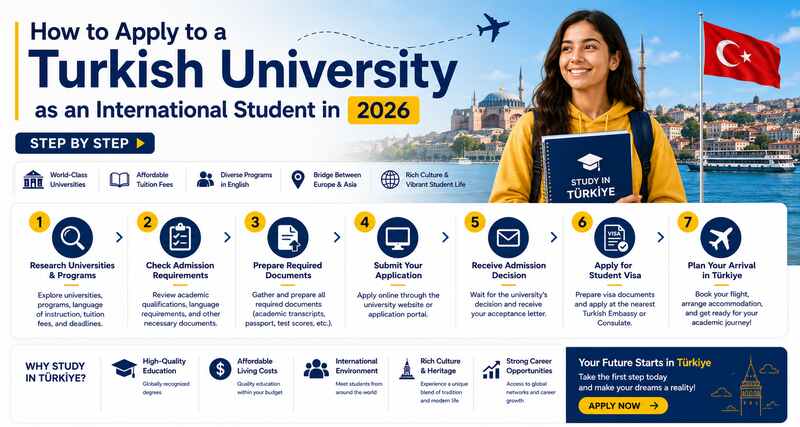
Turkey received over 240,000 international students in the 2025-2026 academic year according to YÖK data, making it the largest international student destination in the Muslim world and one of the top fifteen globally. That number is growing. So is the competition for the best-value programs, the limited scholarship places, and the affordable dormitory spots.
What hasn't kept pace with the growth is the quality of information available to students about how apply to Turkish university process actually works, what makes an application move faster, and why some students receive offer letters within hours while others wait weeks for the same type of decision at the same university.
This guide is that information. Specific, accurate, and built around how the system actually functions - not how university marketing materials describe it.
The Turkish University Landscape in 2026 - What Students Are Actually Choosing Between
Turkey has more than 200 universities operating under YÖK recognition as of 2026. For international students, the relevant universe is narrower: English-medium programs at accredited private universities, foundation universities, and select state universities that actively support international student enrollment.
Private (foundation) universities are the primary destination for most international students. These are funded privately, operate under state accreditation, and compete for international enrollment through English-medium programs, scholarship packages, and international student services. Fee structures range from approximately $3,000 per year at newer or smaller institutions to $18,000+ per year at established, well-ranked ones.
State universities (devlet üniversitesi) are much cheaper - sometimes $200-500/year for tuition - but programs are predominantly in Turkish. English-medium options at state universities exist but are limited and often require YÖS (Yabancı Uyruklu Öğrenci Sınavı) or equivalent exam results for admission.
For international students planning English-medium study, the private university sector is where the genuine options sit.
The Top Turkish Universities for International Students - Detailed Profiles
Istanbul Medipol University
One of the strongest private medical universities in Turkey. Located in Istanbul with multiple campuses and a network of affiliated hospitals.
Programs: Medicine (Tıp Doktoru), Dentistry, Pharmacy, Nursing, Health Management, Engineering, Business.
Fees (2026-2027): Medicine approximately $15,000-$18,000/year. Other health programs $8,000-$12,000/year. Engineering and business $6,000-$10,000/year.
Accreditation: YÖK-recognized. Medicine program listed on WDOMS. Affiliated hospitals provide direct clinical training environment for medicine and dentistry students.
Key strength: The hospital network is the differentiator. Medipol's affiliated hospitals serve a large patient population, giving medicine students genuine clinical volume and case variety during training.
Scholarship availability: Merit scholarships of 25%-75% of tuition available for students with strong academic profiles. Early apply to Turkish universityincreases scholarship access.
Bahcesehir University (BAU) - Istanbul
BAU is one of Turkey's most internationally oriented private universities, with campuses extending to Berlin, Washington DC, and other cities through the BAU Global network.
Programs: Engineering, Business, Architecture, Design, Communications, Law, Medicine.
Fees (2026-2027): $10,000-$15,000/year for most programs. Medicine higher.
Accreditation: AACSB-accredited Business school - one of relatively few Turkish universities with this international business accreditation. Engineering programs with international recognition.
Key strength: The international network makes BAU particularly attractive for students who see their degree as a step toward careers or further study in multiple countries. The BAU Global partnerships provide exchange and cross-enrollment opportunities not available at most Turkish universities.
Istanbul Aydin University (IAU)
Istanbul Aydin is a large private university with one of the highest international student counts among Turkish institutions, known for accessible entry requirements and broad program availability.
Programs: Engineering, Business, Architecture, Law, Health Sciences, Education, Fine Arts. More than 130 programs.
Fees (2026-2027): $5,000-$12,000/year depending on faculty. One of the more cost-accessible options among Istanbul private universities.
Key strength: Accessibility. IAU accepts students with a wider range of academic profiles than more selective institutions. For students who don't meet the GPA thresholds of Medipol or BAU, IAU provides a path to an Istanbul education with real accreditation and a recognized degree.
Ankara Yildirim Beyazit University
State university in the Turkish capital, with strong international student programs particularly in health sciences and social sciences.
Programs: Medicine, Health Sciences, Engineering, Social Sciences, Humanities.
Fees: State university pricing - significantly lower than private universities.
Key strength: State university academic culture with Ankara's structured environment. For students who qualify for YÖK-recognized state universities and want significantly lower tuition than private alternatives, Ankara Yildirim Beyazit is a serious option.
Istanbul Gelisim University
Growing private university in Istanbul with a practical focus on professional programs and one of the more competitive tuition rates among Istanbul institutions.
Programs: Business, Engineering, Health Sciences, Sports Sciences, Fine Arts.
Fees (2026-2027): $4,000-$8,000/year - among the more affordable Istanbul private universities.
Key strength: Value. Students who want an Istanbul address at a price point significantly below Medipol or BAU find Gelisim a competitive option.
University Comparison Table - Turkey 2026
University | City | Annual Tuition | Medicine | AACSB Business | Language | Best For |
|---|---|---|---|---|---|---|
Istanbul Medipol | Istanbul | $15,000-$18,000 (med) | Yes - hospital network | No | English | Medicine, dentistry |
Bahcesehir (BAU) | Istanbul | $10,000-$15,000 | Yes | Yes | English | Business, international careers |
Istanbul Aydin (IAU) | Istanbul | $5,000-$12,000 | No | No | English/Turkish | Wide access, affordable Istanbul |
Istanbul Gelisim | Istanbul | $4,000-$8,000 | No | No | English/Turkish | Budget-conscious Istanbul programs |
Ankara Yildirim Beyazit | Ankara | State pricing | Yes | No | Turkish-primary | Lower cost, Ankara environment |
The choice between these institutions isn't primarily about which is "best" in abstract terms. It's about matching the student's profile - academic, financial, and program-specific - to the right institution. A student with a strong academic profile, a medicine goal, and a budget that can sustain $17,000/year should be looking at Medipol. A student targeting international business with strong GPA should consider BAU's AACSB accreditation seriously. A student who needs Istanbul-based education at closer to $6,000/year has real options at Aydin or Gelisim.
The Admission Pipeline - Why Most Direct Applications Take So Long
When international students apply directly through a Turkish private university's public portal, they enter a processing pipeline with several stages:
Intake and logging - Applications are received, logged, and assigned a reference number. At major Istanbul universities during peak August-September periods, this alone can take several days.
Document screening - Administrative staff check for completeness. If anything is missing - a translated transcript, an apostilled diploma, a financial guarantee letter - a request email goes out. The student may not respond for days.
Faculty routing - Complete files move to the relevant faculty or program department for academic evaluation.
Academic evaluation - The actual review of academic credentials. For a standard undergraduate application, this takes an experienced evaluator 20-30 minutes.
Offer generation - The decision is documented and an offer letter is generated.
The total time for this pipeline at a busy university: typically 2-6 weeks. The evaluation itself is less than an hour. The queue, routing, and document-chasing is everything else.
More Turkish University Applications, Faster Decisions, Deeper Scholarship Access
Global Degrees Network processes more applications to Turkish partner universities than any comparable study abroad portal, and the volume creates a service advantage that compounds throughout the process - priority evaluation within one hour, real-time scholarship window intelligence, institutional leverage for tuition negotiation, and ground-level support that only a genuinely Turkey-present agency can provide. From Istanbul Medipol to Bahcesehir to Istanbul Aydin and beyond, the portal's integration covers the full Turkish private university landscape. Zero fees, same-day offers, and post-arrival support that no competitor matches. That is the measurable difference.
For students who are considering both mainland Turkey and Northern Cyprus, the choice comes down to a few consistent variables:
Cost: Northern Cyprus is generally cheaper than Istanbul for comparable programs. Ankara and smaller Turkish cities close the gap significantly. If budget is the primary constraint, Northern Cyprus private universities and state Turkish universities are both worth evaluating.
Program availability: Turkey has a much larger university system - more programs, more specializations, more options at every price point. Northern Cyprus is particularly strong for English-medium programs in medicine, engineering, and business, but the total program breadth is narrower.
Campus environment: Northern Cyprus university campuses are more self-contained and the cities are smaller - a different lifestyle than Istanbul's megacity dynamic. Students who want urban energy and maximum social variety prefer Istanbul. Students who want a more focused, campus-centered experience often prefer Northern Cyprus.
Accreditation for specific careers: Medicine students need to check WDOMS listing and home-country licensing recognition for both Turkish and TRNC institutions. Engineering students should check ABET or MÜDEK accreditation against their target practice country requirements.
Visa logistics: Both require Turkish visa processing; Northern Cyprus adds the TRNC entry layer and the transit-through-Turkey flight requirement.
Global Degrees Network covers both markets through the same portal. Students can apply to universities in both Turkey and Northern Cyprus simultaneously and compare offer letters side by side.
Beyond academics and administrative process, students choosing Turkey need honest expectations about daily life.
Language in daily life: Turkish private universities teach in English. But Turkey is a Turkish-speaking country. Grocery stores, local restaurants, pharmacies, landlords, transport staff - Turkish is what you'll encounter. Students who make even modest effort to learn practical Turkish (100-200 words and basic phrases) report a significantly better daily life experience. TÖMER language centers operate at many partner universities and offer beginner Turkish courses alongside the academic schedule.
Exchange rate dynamics: Turkey has experienced significant lira volatility in recent years. For students paying tuition in USD or EUR (as most private universities require from international students), this doesn't directly affect their fee. But living costs - accommodation, food, transport - are in Turkish lira. Lira weakness has in practice meant that daily living costs in dollar terms have been very affordable. This could change; students with multi-year program commitments should factor currency risk into their financial planning.
Healthcare access: Istanbul and Ankara have world-class private hospital networks. Public healthcare is accessible through SGK enrollment. Students who need medical attention have good options - the practical challenge is language (finding English-speaking doctors) rather than quality of care. Several hospitals in both Istanbul and Ankara specifically serve international patients with English-speaking staff.
Safety: Turkey is generally safe for international students, with standard urban precautions applying. The international student population in major Turkish cities is large and well-established, and students from most countries have existing communities in Istanbul and Ankara. The political environment has been stable for international students, though staying informed about domestic political developments is sensible.
Global Degrees Network's student community connection service means incoming students arrive with contacts who can give genuinely current, ground-level advice on all of these practical realities - not information from a website, but from students who lived it last semester.
Receiving a Turkish university offer letter triggers a specific sequence that most students aren't briefed on:
Accepting the offer: Offers come with a deadline. Accepting formally (usually a signed acceptance form through the university portal or by email) and paying the enrollment deposit secures the place.
Enrollment deposit: Typically 25-50% of first-year tuition. Paid directly to the university's bank account. Global Degrees Network never handles student tuition funds - payment goes directly to the institution.
Visa application: With the formal acceptance letter from the university's international office (different from the provisional offer - the final acceptance letter is the official document for visa purposes), the student applies for the Turkish student visa at the nearest Turkish consulate.
Visa processing: 4-8 weeks for most nationalities. Some consulates process faster. The agency advises on realistic timelines for specific nationalities.
Final registration at the university: After arriving in Turkey, students complete physical registration at the university's student affairs office (öğrenci işleri). This involves submitting original documents for verification and completing enrollment paperwork.
ikamet application: Within 30 days of entry, students apply for the Turkish student residence permit (ikamet) at the Göç İdaresi (Directorate General of Migration Management). This is a mandatory legal requirement.
Course selection: Registration in specific courses for the semester, typically done through the university's student information system (OBS).
Global Degrees Network's post-offer support covers every step in this sequence - document checklists, visa guidance, ikamet process, registration support, and 24/7 availability during the arrival period.
Document requirements vary by university, program, and student nationality. This is the general baseline for most Turkish private university undergraduate applications:
Academic documents:
High school diploma (original or certified copy)
Apostille or authentication chain appropriate for your country
Academic transcript for all years of secondary education
Certified translation into Turkish or English (university-specific - some accept English-only)
Identity documents:
Passport (main photo page) - minimum 18 months validity recommended
Passport-size photographs (4-6 photos, specific dimensions - check university requirements)
Language:
TOEFL, IELTS, or university English placement result (for English-medium programs)
Some universities accept secondary education completed in English as language evidence
Financial:
Bank statement or financial guarantee showing ability to fund tuition (specific minimum balance requirements vary)
Scholarship or sponsorship letter if applicable
Program-specific (examples):
Medicine applicants: biology and chemistry transcript verification
Architecture applicants: portfolio may be required
Postgraduate applicants: undergraduate degree certificate, transcripts, and often a statement of purpose
The Global Degrees Network portal's completeness engine checks all of this against the specific university's requirements before allowing submission - so students know exactly what's needed before the file goes anywhere.
Global Degrees Network processes more applications to Turkish partner universities than almost any other agency in the sector. This volume has concrete benefits beyond just the speed of review:
Institutional priority: Universities maintain processing relationships with their most active integration partners. When a high-volume partner portal submits a file, the university knows the volume of relationship is significant. This reinforces the priority treatment of submitted files.
Real-time program availability intelligence: With applications flowing across 100+ universities simultaneously, the agency's team has real-time visibility into which programs have remaining places, which scholarship pools are still open, and which universities are processing faster than others in the current cycle. Individual applicants have none of this intelligence.
Negotiated scholarship access: An agency placing significant enrollment volume at a university is in a different negotiating position than an individual student. Global Degrees Network's volume enables scholarship advocacy that results in students accessing better terms than direct applications typically achieve.
Error pattern recognition: Processing large volumes of applications means the team recognizes which document formatting errors cause delays at specific universities, which authentication chains are currently running slow at specific embassies, and which common mistakes trip up students from specific countries. This pattern recognition makes the document review genuinely useful, not just a checkbox exercise
Global Degrees Network's portal has direct integration with the admission evaluation workflows of Turkish partner universities. This integration removes most of the pipeline stages described above.
Before submission, the portal's completeness engine checks the student's uploaded documents against the specific requirements of the chosen Turkish university and program. Missing documents are flagged and the student resolves them. By the time submission happens, the file is complete and pre-verified.
At submission, the file goes through the direct integration channel - not to a general inbox, not to a logging queue, but directly to the university evaluation team as a complete, trusted submission from a formally integrated partner portal.
The result: applications received through the Global Degrees Network portal are typically reviewed within one hour during university working hours.
One hour. Not one week. Not one month. The same 20-30 minute evaluation that happens at any stage of the standard pipeline - but it happens immediately, because the administrative stages before it have been removed by the integration.
This speed has real consequences for students:
Scholarship access: Many Turkish universities allocate merit scholarships on a rolling basis from a fixed annual budget. Students who receive offers quickly and respond quickly secure scholarship consideration before allocations exhaust. A student who waits three weeks for a standard pipeline decision may find that the scholarship available to January applicants is gone by the time their offer arrives.
Visa timeline: A student who receives an offer letter in March for a September intake has a comfortable 5-6 months for visa processing, accommodation arrangement, and travel preparation. A student who receives their offer in late July is rushing to make the September start date with a visa process that takes 4-8 weeks.
Program availability: Popular programs at well-regarded Istanbul universities fill up. Medicine seats, in particular, are limited. Early offers to early applicants convert to enrollment. Late-applying students, even qualified ones, sometimes find their preferred program's available places already allocated.
The 1-hour review isn't just a feature - it's a structural advantage that compounds into better scholarship terms, better program availability, and more comfortable timeline management.
Q: What is the YÖS exam and do I need it for private Turkish universities? A: YÖS (Yabancı Uyruklu Öğrenci Sınavı) is a Turkish university entrance exam for international students. It's primarily required for state university admission. Most private Turkish universities accept SAT scores, national exam results from the student's home country, or their own internal assessment instead of YÖS. The specific requirements depend on the university and program.
Q: Can I apply for a Turkish university mid-year, for February intake? A: Yes. Most Turkish private universities offer both September and February intakes for most programs. The February intake has slightly fewer program options but is fully valid and the degree timeline is equivalent. Through the Global Degrees Network portal, February intake applications follow the same process and the same 1-hour review standard.
Q: How does the Türkiye Scholarship (YTB) interact with private university applications? A: The Türkiye Scholarship is a separate government program with its own application portal and process. It's independent of the private university application process. Students can apply for Türkiye Scholarship separately while also applying through the Global Degrees Network portal - if Türkiye Scholarship is awarded, it covers the private university tuition. If not, the private university's own internal scholarship (often accessible through the agency) applies.
Q: What happens if I receive an offer from a Turkish university and then decide not to go? A: You can decline any offer without obligation. The agency's service doesn't require you to enroll anywhere. Enrollment deposits paid to universities have their own refund policies (specified in each university's offer terms), which the agency explains before you pay anything.
Q: Is it possible to get a 100% scholarship through Global Degrees Network? A: Full scholarships are available at some partner universities for students with exceptionally strong academic profiles (typically 3.7+ GPA on 4.0 scale or equivalent). These are competitive. More commonly, partial scholarships of 25%-75% are achievable for strong applicants. The consultation identifies which universities have scholarship windows open and what academic profile is required.
Q: Do Turkish universities accept students from all countries? A: Virtually all nationalities are accepted at Turkish private universities. Some nationalities require additional documentation or have specific recognition agreements. A small number of state programs have per-nationality quota limits. The portal's eligibility screening identifies any nationality-specific constraints for each program.