Turkey Student Visa for International Students: Complete 2026 Step-by-Step Guide

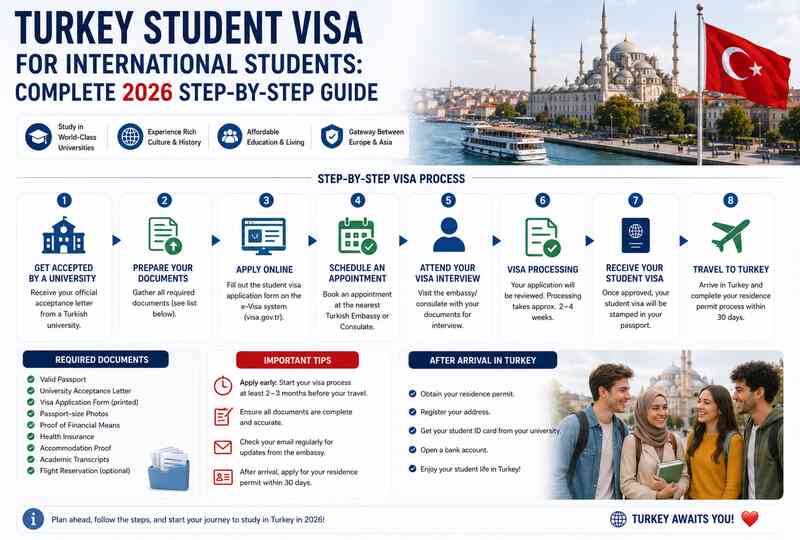
Getting accepted to a Turkish university is the exciting part. What comes after the visa, the residence permit, the documents is where students hit unexpected delays, make avoidable mistakes, and sometimes miss their intake deadline because of paperwork problems that could have been handled in week one.
The Turkey student visa process is not complicated if you understand it properly. But it has specific document requirements, embassy-level differences in processing times, and a post-arrival step the residence permit that most guides don't cover in enough detail. This article covers the full process from pre-departure to your first month in Turkey, with real timelines, real document lists, and honest notes on where things tend to go wrong.
Understanding the Two-Stage Process: Visa + Residence Permit
Most students think of the student visa as the only hurdle. It isn't. There are two distinct legal steps, and both are required.
Stage 1, Student Visa (before departure): Applied for at the Turkish embassy or consulate in your home country. This gets you into Turkey legally as a student. It is typically a single-entry or multiple-entry visa valid for 90 days of initial stay.
Stage 2, Student Residence Permit / İkamet Tezkeresi (after arrival): Applied for inside Turkey within 30 days of arrival. This is the document that legally authorizes your stay for the full academic year and beyond. Without it, your presence in Turkey is technically unauthorized after your visa's permitted stay period ends. The residence permit is renewed annually throughout your studies.
Both stages are required. Both require documentation. Both have processing timelines. Plan for both from the beginning.
Who Needs a Turkey Student Visa?
Not all international students need a visa before arriving. It depends on nationality.
Students who can enter visa-free and apply for residence permit directly: Citizens of some countries including certain EU member states, Georgia, Ukraine, and others — can enter Turkey visa-free for up to 90 days and then apply directly for a residence permit without obtaining a student visa first. The list of visa-exempt countries is maintained by the Turkish Ministry of Foreign Affairs and changes periodically. Always verify current status at mfa.gov.tr before assuming you qualify.
Students who need a student visa: Citizens of most African, Asian, South Asian, and Middle Eastern countries need a student visa before entering Turkey. This includes Nigeria, Ghana, Pakistan, Bangladesh, Indonesia, Egypt, Morocco, Jordan, Iraq, Sudan, and many others. If you're unsure, check the Ministry of Foreign Affairs website or contact the Turkish embassy in your country directly.
Students from some countries who can obtain a visa on arrival or e-visa: Turkey's e-visa system (evisa.gov.tr) covers tourism purposes but is generally not valid for student stays longer than 90 days. Do not use a tourist e-visa as your legal basis for studying in Turkey it does not qualify you for a student residence permit.
Common Mistakes That Delay or Derail Applications
Based on the applications we've processed at universityapply.org, these are the most frequent problems:
Inconsistent name on documents. Your name must appear identically on your passport, acceptance letter, bank statement, health insurance, and application form. Even minor differences a middle name included on one document and not another, or a surname spelled differently can trigger delays or rejection. Check every document before submission.
Acceptance letter missing required information. Some universities issue acceptance letters that are brief or missing key details. The letter must state your full name, program name, academic year, duration, and carry an official stamp and authorized signature. If your letter is vague, request a more detailed version from the international office.
Bank statement too recent or too thin. A statement printed and submitted on the same day as the appointment, showing a single large deposit made within the last 48 hours, is a red flag for embassy staff. Ideally, the statement shows a sustained balance over 1–3 months. If funding was recently transferred from abroad, include a remittance receipt to document the source.
Booking flights before visa approval. Some students book non-refundable flights based on expected visa timelines. Embassy processing delays are real and unpredictable. Book refundable tickets or wait until the visa is in hand before committing to travel dates.
Missing the 30-day residence permit window. This is the most consequential mistake. Students who arrive in Turkey, get busy with orientation, moving in, and registration, and forget to apply for the residence permit within 30 days face fines and administrative complications. Put the deadline in your calendar on arrival day.
Registering at the wrong migration office. In Istanbul especially, students sometimes book appointments at the wrong district office. Your appointment must be at the office that covers the district where your accommodation is located not the district where your university campus is.
University Comparison: International Student Support for Visa and Residence Permit
One underappreciated factor in choosing a university is how well the international office supports students through the visa and residence permit process. This is a real differentiator.
University | City | Dedicated Visa Support | Residence Permit Assistance | Group Health Insurance | Airport Transfer |
|---|---|---|---|---|---|
Istanbul Medipol | Istanbul | Yes - dedicated international office | Yes - guided process | Yes - included in enrollment | Yes |
Bahçeşehir (BAU) | Istanbul | Yes | Yes - group appointment system | Yes | Yes |
Istanbul Aydin (IAU) | Istanbul | Yes | Yes | Yes | Some campuses |
Biruni University | Istanbul | Yes | Yes - group sessions | Yes | On request |
Istinye University | Istanbul | Yes | Partial support | Yes | On request |
Ankara Yıldırım Beyazıt | Ankara | Limited | Limited | No - student arranges separately | No |
Atatürk University | Erzurum | Limited | Limited | No | No |
Private universities have clearly invested more in international student services infrastructure than public universities, which largely leave students to navigate the residence permit and insurance process independently. For first-time international students arriving in Turkey particularly those who don't speak Turkish this support difference is meaningful. Group residence permit application sessions, where the university's international office accompanies students to the migration office and handles document checking, can save significant time and stress.
Step 1; Get your university acceptance letter. Everything else follows from this document. Apply to your university first, secure admission, and request the official acceptance letter from the international admissions office. Make sure it clearly states: your full name (exactly as in your passport), your program name, the academic year start date, the duration of the program, and the university's official stamp and signature.
Step 2; Get your health insurance. If your university provides a group insurance certificate, request it from the international office before your embassy appointment. If purchasing independently, make sure the policy is valid from your entry date and covers Turkey specifically.
Step 3; Prepare your financial proof. Get a bank statement dated within 30 days of your application. If your parents or a sponsor are funding your studies, prepare a sponsor declaration letter along with their bank statement. Some embassies want the statement to show a minimum of 3 months of consistent balance — not a one-time deposit made the day before.
Step 4; Book your embassy appointment. Most Turkish embassies require appointments — walk-in applications are not accepted at the majority of locations. Book through the embassy's official scheduling system as early as possible. In countries with large applicant volumes (Nigeria, Pakistan, Indonesia), appointments may be scheduled weeks in advance. Do not book your university start date without accounting for embassy appointment wait times.
Step 5; Attend your appointment and submit documents. Bring originals and copies of all documents. Embassy staff will review the file, take biometrics in some cases, and issue a receipt. Do not submit documents with expired dates, inconsistent names, or missing translations.
Step 6; Wait for visa processing. Standard processing is 10–21 business days at most embassies. Some embassies in high-volume countries take 4–6 weeks. Urgent processing is sometimes available for an additional fee but is not guaranteed. Build this timeline into your pre-departure planning.
Step 7; Collect your visa and travel. Once the visa is ready, you collect your passport from the embassy (or it may be returned by mail in some countries). Book your travel to arrive before your university's registration deadline ideally 1–2 weeks before to allow time for registration and administrative processes on arrival
Document requirements are set by Turkey's Ministry of Foreign Affairs, but individual embassies sometimes add requirements or request additional items. The list below covers the standard requirements verify with your specific embassy before submitting.
Core documents required at most Turkish embassies:
Valid passport - must be valid for at least 6 months beyond your planned entry date, with at least 2 blank pages
Completed visa application form - available through the Turkish embassy website in your country or through the e-konsulat system
Passport-size biometric photos - typically 2-4 photos, white background, recent (taken within 6 months)
University acceptance letter - official, on university letterhead, signed and stamped, clearly stating your name, program, start date, and duration of study. This is the single most important document in the file.
Proof of financial means - bank statement showing sufficient funds to cover tuition and living costs. Most embassies look for evidence of $500–$800 per month minimum. Some specify a minimum total balance. A sponsor letter with accompanying bank statement is acceptable if a family member is funding the studies.
Health insurance - valid for the full duration of your intended stay in Turkey. Must cover medical expenses including hospitalization. Many Turkish universities offer group health insurance plans for enrolled international students ask your university's international office for the insurance certificate before your embassy appointment.
Proof of accommodation - dormitory reservation letter from the university, a rental agreement, or a letter from a host if staying with a contact in Turkey initially
Tuition payment receipt or scholarship letter - evidence that tuition for at least the first semester has been paid, or that a scholarship covers tuition and/or living costs
Academic transcripts - from your most recent institution (high school for undergraduate applicants, university for postgraduate applicants)
Visa application fee payment - amount varies by nationality; check current fee schedule at your embassy
Additional documents some embassies request:
Police clearance certificate / criminal record check from your home country
Medical certificate confirming you are free of infectious diseases
Proof of ties to home country (property documents, family documents) less common but sometimes requested
This is the step most guides underexplain. The residence permit (İkamet Tezkeresi) is what legally authorizes your extended stay in Turkey. You must apply within 30 days of your first entry not 30 days from registration, 30 days from the date of your passport's entry stamp.
Who processes it: The İl Göç İdaresi Müdürlüğü the Provincial Directorate of Migration Management in whichever city your university is located. Istanbul, Ankara, and Izmir each have multiple offices. In Istanbul, the system is appointment-based through the e-ikamet system (e-ikamet.goc.gov.tr).
Documents needed for the residence permit application:
Completed residence permit application form (from e-ikamet system)
Valid passport (original + photocopy of all stamped pages)
4 biometric passport photos (white background, recent)
University enrollment certificate (öğrenci belgesi), obtained from your university's registrar after completing in-person registration
Valid health insurance covering Turkey (same policy used for the visa, or a new one)
Proof of accommodation (dormitory agreement or rental contract)
Residence permit fee payment receipt, approximately $70–$120, paid at designated banks or PTT offices (not at the migration office itself)
Tax ID number (Vergi Kimlik Numarası), a simple document obtained free of charge at any tax office (Vergi Dairesi); takes about 10 minutes
Process timeline: After submitting your application, the residence permit card is typically mailed to your registered address within 3–8 weeks. You'll receive a temporary approval document in the meantime, which serves as proof of legal status while the card is being processed. Keep this document safe you may need to show it if asked for ID by authorities.
Renewal: The student residence permit is valid for 1 year and must be renewed annually. Renewal applications should be submitted 60 days before the current permit's expiry date. The renewal process requires updated enrollment documentation from the university, updated health insurance, and updated accommodation proof.
Here is a realistic timeline working backward from your university registration date:
Stage | Realistic Timeline |
|---|---|
Get acceptance letter from university | 1–2 weeks after submitting a complete application |
Prepare all visa documents | 1–3 weeks (longer if apostille or police clearance required) |
Book embassy appointment | Immediately — don't wait, appointments fill fast |
Embassy appointment to visa issuance | 10–30 business days depending on country |
Travel and arrival in Turkey | At least 1 week before registration deadline |
University in-person registration | First 1–2 weeks of arrival |
Residence permit application deadline | Within 30 days of passport entry stamp |
Residence permit card delivery | 3–8 weeks after application submission |
Total lead time from decision to arrival: 8–14 weeks in most cases. Students who start the process 10–12 weeks before their intended intake date rarely face problems. Students who start 4 weeks out frequently do.
The Turkey student visa process is genuinely manageable. It requires attention to detail, correct documentation, and realistic timeline planning nothing more. The students who struggle are almost always those who underestimated how long document preparation takes, or who left the embassy appointment booking too late, or who arrived in Turkey and forgot about the 30-day residence permit deadline.
Three things that make the biggest difference:
First, start your document preparation the same week you decide to apply to a university, not after you receive the acceptance letter.
Second, verify requirements directly with the Turkish embassy in your country, since individual embassies sometimes add requirements beyond the standard list.
Third, use your university's international office aggressively. The best private universities in Turkey employ staff specifically to guide international students through this process. Use them.
universityapply.org supports students through the full process, from university selection and application to visa document preparation and post-arrival guidance. Submit an inquiry for a free consultation before you start your application.
Q: Can I enter Turkey on a tourist visa and then change to a student visa? A: No. Turkish immigration law does not permit status change from tourist to student inside Turkey. You must obtain a student visa from a Turkish embassy or consulate in your home country before arriving on a student basis. Attempting to apply for a residence permit on a tourist visa will result in rejection.
Q: My country doesn't have a Turkish embassy what do I do? A: Turkey has consular representation in most countries either directly or through honorary consulates. If there is no embassy in your country, you may need to apply at a Turkish embassy in a neighboring country. Contact the Turkish Ministry of Foreign Affairs (mfa.gov.tr) for guidance on which embassy handles your nationality.
Q: How much money do I need to show in my bank account? A: There is no single official minimum, but embassies typically look for enough to cover tuition plus living costs for at least the first year. A practical benchmark: $8,000–$15,000 depending on your program. If your tuition is already paid and you have evidence of that, living costs evidence may suffice for the balance.
Q: Can my parents' bank statement be used instead of mine? A: Yes, if accompanied by a notarized sponsor/guarantee letter from your parents declaring they will fund your studies. This is a standard and commonly accepted approach.
Q: What happens if I miss the 30-day residence permit window? A: You face an administrative fine and a mandatory exit from Turkey to re-enter legally. The fine amount depends on how long you overstayed. It's an avoidable problem mark the 30-day deadline on arrival day and start the online appointment booking process for the migration office within your first week.
Q: Is Turkish health insurance mandatory for the visa? A: Yes. Health insurance valid in Turkey is required for both the student visa application and the residence permit application. If your university offers a group plan (most private universities do), get the insurance certificate from the international office before your embassy appointment.
Q: Do I need to renew my student visa every year? A: No. Your student residence permit replaces the student visa as your legal authorization to stay. You renew the residence permit annually — not the visa. The original student visa is used only once to enter Turkey.