Study in Turkey for International Students: The Complete 2026 Guide

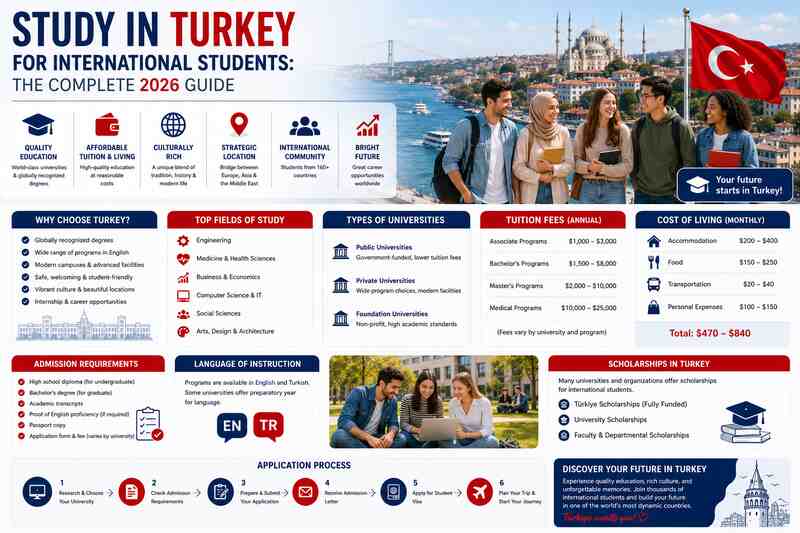
Over 300,000 international students are currently enrolled in Turkish universities. That number was under 30,000 just fifteen years ago. Something clearly changed and it wasn't just the marketing. Turkey built real infrastructure, real English-medium programs, and real pathways for students from Asia, Africa, the Middle East, and Europe to earn globally recognized degrees without spending a fortune doing it.
But choosing to study in Turkey for international students is a decision that needs proper data, not just enthusiasm. Tuition ranges vary wildly. Admission requirements differ between public and private institutions. And the experience of an African student applying from Lagos is going to be different from a Pakistani student already familiar with Turkish academic culture. This guide covers all of it the real numbers, the real process, and the things most university websites won't tell you upfront.
Why Turkey Has Become a Top Study Destination in 2026
There are a few destinations that have seen genuine structural growth in international enrollments over the last decade. Turkey is one of them. It's not just price though price matters. It's the combination of factors that students are actually prioritizing right now.
Affordability that holds up when you do the math. At most private universities in Turkey, annual tuition for bachelor's programs in English ranges from $3,000 to $12,000. Living costs in cities like Ankara or Trabzon run $300–$450 per month for a student who manages a modest budget. Istanbul is higher $500–$700 a month is realistic but still a fraction of London, Toronto, or Sydney. When students from Nigeria, Egypt, or Indonesia calculate total four-year costs including accommodation, they often find Turkey comes in at roughly a third of equivalent programs in the UK.
Degree recognition that actually works internationally. This is the question every serious student asks, and it deserves a real answer. Turkish university degrees are recognized by YÖK (the Turkish Council of Higher Education), and many programs carry accreditations from MÜDEK (engineering), AACSB or EQUIS (business), and ADEE (dentistry). Medical degrees from recognized universities are listed in the World Directory of Medical Schools (WDOMS), which means graduates can sit for USMLE, PLAB, and equivalent licensing exams. That's not a small thing.
English-medium programs that don't require Turkish. Many students worry they'll need to learn Turkish before they can study. At most private universities, that's not the case. Programs in medicine, engineering, business, and architecture are offered fully in English. Some universities also offer Arabic-medium or mixed-language tracks, which has pulled significant numbers of Arab-speaking students to Istanbul and Ankara in particular.
A geography that makes logistics easier. Turkey sits at the intersection of Europe, Asia, and the Middle East. Direct flights from West Africa, South Asia, and the Arab world are frequent. Istanbul's Atatürk and Sabiha Gökçen airports are major hubs. Students from countries that struggle with expensive transit routes to the US or UK find Turkey genuinely accessible.
So, still is it the right choice for everyone? No. Students who want strong postgrad ties to North America or Australia specifically may face a longer recognition process. But for the majority of international students seeking quality, affordability, and a degree recognized across multiple regions, Turkey is a genuinely competitive option.
University Comparison: Top Options for International Students in 2026
University | City | Annual Tuition (English) | Accreditation Highlights | Best For |
|---|---|---|---|---|
Istanbul Medipol | Istanbul | $12,000–$18,000 (Medicine) | WDOMS, hospital network | Medicine, health sciences |
Bahçeşehir (BAU) | Istanbul | $6,000–$11,000 | AACSB candidate, MÜDEK | Business, engineering, architecture |
Istanbul Aydin (IAU) | Istanbul | $5,500–$9,000 | ADEE (dentistry), MÜDEK | Wide range, cost-efficiency |
Biruni University | Istanbul | $10,000–$20,000 | WDOMS, pharmacy labs | Medicine, dentistry, pharmacy |
Istinye University | Istanbul | $9,000–$16,000 | WDOMS, modern hospital affiliation | Medicine, nursing |
Ankara Yıldırım Beyazıt | Ankara | $3,000–$7,000 | State university, YÖK | Competitive budget option |
Atatürk University | Erzurum | $2,000–$5,000 | YÖK, established faculty | Budget-conscious students |
Choosing between them: BAU and IAU are the most popular with MENA and West African students because of their large international student communities and English-medium programs across faculties. Medipol and Biruni are the first choices for medicine and dentistry applicants who want clinical hospital exposure. If budget is the main constraint and the student can manage a Turkish-medium program, Atatürk or Ankara Yıldırım Beyazıt offer remarkable value.
One practical note: university reputation matters most in the region where you plan to work after graduation. A degree from METU opens certain doors in Turkey itself. A degree from BAU or Medipol recognized by WDOMS or accredited under European standards opens doors across the Middle East, parts of Africa, and within EU licensing frameworks. Know your end goal before you choose.
Living in Turkey as an International Student
The practical experience of living in Turkey matters as much as the academic one so it's worth covering honestly.
Accommodation options: Most universities offer student dormitories, either on-campus or affiliated off-campus housing. State dormitories (KYK) are extremely affordable sometimes as low as $30–$80 per month but demand is high and availability for international students varies. Private dormitories are more accessible and typically cost $150–$350 per month. Renting an apartment is common among second and third-year students, with shared flats in Istanbul running $200–$350 per person per month depending on the district.
Healthcare: International students with a valid residence permit can access public healthcare at subsidized rates. Private health insurance is required for the visa application most universities offer group insurance plans at $100–$200 per year.
Safety and culture: Turkey is generally safe for international students, and Turkish cities have large, established international student communities. Universities in Istanbul, Ankara, and Izmir all have student associations organized by nationality Nigerian, Pakistani, Egyptian, Indonesian, and many others have active campus communities. Students regularly report that the adjustment is easier than expected, partly because the international student community is so large.
Part-time work: Turkish law does not generally permit international students to work during their first year of study. After that, students may work limited hours with appropriate permits, but this shouldn't be factored into financial planning as a reliable income source.
A Final Word Before You Apply
Deciding to study abroad is not a small thing. It's years of your life, real money, and a bet on your future. Turkey, in 2026, is a genuinely solid bet for the right student one who has researched their program properly, verified accreditation for their field, and has a clear idea of where they want to work after graduation.
The data supports it: over 300,000 international students can't all be wrong. But data isn't personal advice. Every student's situation is different grades, budget, target country for employment, family expectations. That's why at universityapply.org, we don't push one university over another. We analyze your profile, match it to the right institution, and support the process from application to arrival, at no cost to the student.
Submit your inquiry today for a free academic assessment.
Requirements to study in Turkey differ depending on whether you're applying to a public or private university, and what level of study you're targeting.
For undergraduate programs at private universities: Most private Turkish universities have relatively open admissions. You need a completed high school diploma with a minimum average often 60–70% depending on the university and program. Medicine and dentistry typically require 75–85% or above. No entrance exam is required at most private institutions for international applicants, which is one reason they've grown so popular. You'll need:
High school diploma and transcripts (officially translated if not in English or Turkish)
A valid passport
Passport-size photos
Proof of English proficiency if applying to an English-medium program (IELTS, TOEFL, or an internal English exam administered by the university)
Completed application form (usually submitted online)
For undergraduate programs at public universities: Public universities are significantly more competitive. Most require a valid YÖS score (the Foreign Student Exam administered by individual universities), and some also accept SAT scores. The YÖS tests numerical reasoning and basic sciences it's not language-based, which makes it accessible to international students from diverse academic backgrounds. Acceptance rates at top public universities like METU or Boğaziçi are quite low for international applicants.
For postgraduate programs: Master's and PhD applicants need a recognized bachelor's degree, transcripts, letters of recommendation (usually 2), a statement of purpose, and in many cases English proficiency scores. Research-based programs may also require a research proposal.
One thing worth knowing: Turkey does not recognize high school diplomas from all countries automatically. Students from certain regions may need a document equivalency evaluation (denklik) through YÖK before their application is accepted. This doesn't disqualify students it just adds a processing step. Based on our applicant database at universityapply.org, students who prepare this documentation early rarely encounter delays.
This is probably the most important decision international students face, and it's worth examining carefully rather than defaulting to the assumption that public is always better.
Public universities carry strong brand recognition domestically and in some regions internationally. METU, Boğaziçi, Istanbul Technical University, and Ankara University appear in QS World University Rankings. They offer lower tuition sometimes dramatically lower. But the trade-offs are real: admission is competitive, English-medium programs are fewer, and support services for international students are less developed at most public institutions compared to private ones.
Private universities have invested heavily in international student infrastructure over the last decade. Universities like Istanbul Medipol, Bahçeşehir (BAU), Istanbul Aydin, Istinye, and Biruni have dedicated international offices, English-medium faculties, English-speaking support staff, modern campuses, and in some cases hospital networks for clinical training. The experience for an international student landing in Turkey navigating documents, registration, accommodation, course selection is considerably smoother at most private universities than at most public ones.
The honest assessment: for students who qualify for top public universities and want maximum prestige, pursuing the YÖS and targeting METU or Boğaziçi makes sense. For the majority of international students especially those from countries where the equivalency process is complex, or those who want English-medium programs with strong support a reputable private university often delivers a better total experience.
Let's put numbers to it properly, because vague language like "affordable" helps no one plan a budget.
Tuition fees by institution type (2026–2027 academic year):
Program Type | Public Universities | Private Universities |
|---|---|---|
Bachelor's (Turkish-medium) | $500–$3,000/year | $1,800–$5,000/year |
Bachelor's (English-medium) | $1,000–$5,000/year | $3,500–$12,000/year |
Medicine (English) | $3,000–$8,000/year | $12,500–$30,000/year |
Dentistry (English) | $2,500–$6,000/year | $10,000–$25,000/year |
Engineering (English) | $1,000–$3,000/year | $3,500–$9,000/year |
Master's programs | $800–$4,000/year | $3,000–$10,000/year |
Living costs by city:
Istanbul is the most expensive city but also the most internationally connected and the most competitive for internships and career networks. Ankara, Bursa, and Izmir are significantly more affordable. Trabzon and Konya are the budget-friendly options for students who want low living costs. A realistic monthly budget for Istanbul students is $500–$750 including rent, food, transport, and utilities. Outside Istanbul, $350–$550 covers most students comfortably.
Other costs to factor in:
Student residence permit (ikametgah): approximately $70–$100 per year
Health insurance (if not covered by scholarship): $100–$250 per year
Document translation and notarization: $100–$300 one-time cost
Visa application fee: varies by nationality, typically $50–$150
The total four-year cost for a business or engineering degree at a mid-tier private university in Istanbul, including all living expenses, realistically lands between $28,000 and $45,000. Compare that to the UK at $120,000+ or Canada at $90,000+ for a similar program, and the math makes sense.
The process is simpler than most students expect, especially for private universities.
Step 1; Choose your universities and programs. Apply to 2–3 options, not just one. This protects you if one application gets delayed or a seat fills.
Step 2; Prepare your documents. This is where most delays happen. Official transcripts need translation into Turkish or English. In countries where documents must be notarized or apostilled, that takes time. Start this 8–12 weeks before your target intake.
Step 3; Submit your application. Most private universities accept applications online through their international admissions portals. Some use third-party agents. No entrance exam is required at most private institutions for standard programs your high school GPA and English proficiency score are the primary criteria.
Step 4; Receive your acceptance letter. Once accepted, you'll get an official acceptance letter. Keep multiple copies you'll need it for your student visa, for your residence permit, and for university registration.
Step 5; Apply for your student visa. With the acceptance letter in hand, apply at the Turkish embassy or consulate in your country. Bring passport, photos, proof of funds, health insurance, and accommodation details. Most embassies process student visas within 2–6 weeks.
Step 6; Arrive and complete registration. After arriving in Turkey, you complete final university registration in person, select your courses, and apply for your ikametgah (residence permit) within 30 days of arrival. This step is often where students feel overwhelmed navigating Turkish bureaucracy in a new city is stressful.
This is exactly where working with an authorized agency helps. universityapply.org maintains updated admissions data across current intake cycles. Submit an inquiry for a free academic assessment, we'll match your grades, budget, and program goals to the right university and guide the full application process at no cost.
Q: Can I study in Turkey without IELTS? A: Yes. Many private universities either accept internal English proficiency tests administered by the university itself, or offer an English preparatory year for students who need it. Students who completed their previous education entirely in English (high school or university) may also submit proof of that as an alternative. Always check the specific requirements of each university, since policies vary.
Q: Is a degree from Turkey recognized in my country? A: It depends on your country and field. Medical degrees from WDOMS-listed universities are recognized in most countries for licensing exam eligibility. Engineering degrees from MÜDEK-accredited programs are aligned with European standards. Business degrees from AACSB-affiliated or EQUIS-recognized institutions carry international weight. For non-accredited programs, recognition depends on bilateral agreements between Turkey and your home country — check with your home country's education authority before enrolling.
Q: How long does the university application process take? A: For private universities, the academic review and acceptance can happen within 1–2 weeks of submitting a complete application. Including document preparation, visa processing, and travel, most students complete the full process in 8–14 weeks from decision to arrival. Public universities follow fixed admission cycles with specific deadlines.
Q: What is the language of instruction at Turkish universities? A: It varies by institution and program. Most private universities offer English-medium programs for their main faculties — engineering, medicine, business, and health sciences. Some programs are Turkish-medium with an obligatory one-year Turkish preparatory course. A small number of universities also offer Arabic-medium instruction. Check the specific program page, not just the university's general information.
Q: Do Turkish universities offer scholarships for international students? A: Yes, through two main channels. The Turkish government's Türkiye Bursları (YTB) program offers fully funded scholarships covering tuition, accommodation, a monthly stipend, and a return flight — applications open in January each year. Private universities also offer merit-based tuition discounts of 25–75%, sometimes up to 100% for exceptional academic records. These are worth applying for even if the Türkiye Bursları isn't a fit.
Q: What happens after I get my acceptance letter? A: You apply for your student visa at the Turkish embassy in your country, then travel to Turkey, complete in-person university registration, select your courses, and apply for your residence permit (ikametgah) within 30 days of arrival. First-year students often find the residence permit and document registration steps most confusing — having support from an authorized agency makes this significantly smoother.