Study Dentistry in Turkey for International Students: 2026 Complete Guide

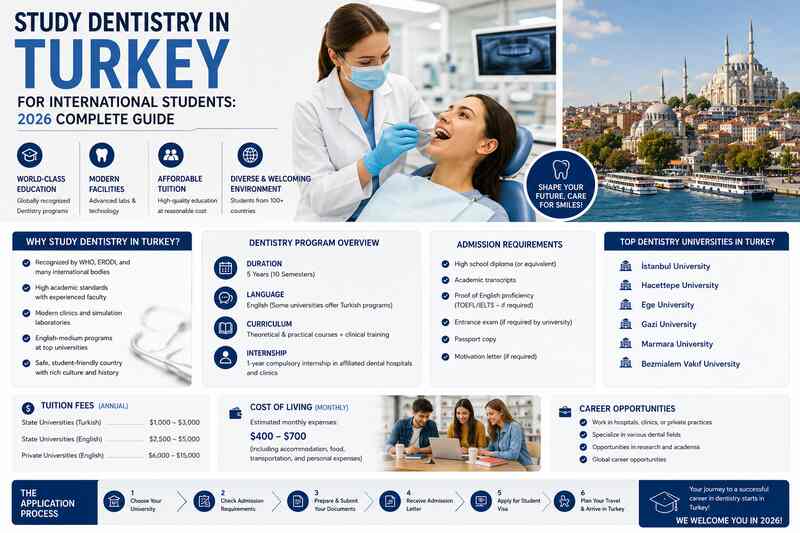
Dentistry is one of the most consistently high-demand professions across the world, and one of the most expensive to train for. In the UK, dental school costs an international student £35,000–£45,000 per year in tuition. In the US, it's worse $65,000–$85,000 per year at many schools. Even countries that positioned themselves as affordable alternatives have seen tuition climb sharply over the last five years.
Turkey entered the picture differently. Over the last decade, Turkish dental faculties have invested in clinical infrastructure, international accreditation, and English-medium instruction to become a serious destination for international dental students not just a budget option, but a genuinely accredited pathway to a recognized DDS degree. Students who study dentistry in Turkey graduate with a Diş Hekimliği Doktoru (DDS) degree, recognized by YÖK, listed under relevant international directories, and aligned with European dental education standards through ADEE membership.
This guide covers what dental training in Turkey actually looks like, which universities offer the strongest programs, what the real costs are, how accreditation works, and what international students need to do to apply in 2026.
University Comparison: Best Dental Schools in Turkey for International Students
University | City | Annual Tuition (English DDS) | Accreditation | Clinical Facility | International Student Volume |
|---|---|---|---|---|---|
Istanbul Aydin (IAU) | Istanbul | $10,000–$15,000 | ADEE member, YÖK | Large dental clinic, modern simulation labs | Very large — one of Turkey's biggest international intakes |
Acıbadem University | Istanbul | $18,000–$25,000 | ADEE member, YÖK | Acıbadem hospital network, high patient volume | Smaller cohort, high clinical quality |
Istanbul Medipol | Istanbul | $13,000–$18,000 | YÖK, hospital affiliation | Medipol dental clinics + hospital | Large international community |
Biruni University | Istanbul | $12,000–$17,000 | YÖK, growing accreditation | Biruni dental faculty clinic | Mid-size, health sciences focus |
Istanbul Gelisim | Istanbul | $8,000–$12,000 | YÖK | Standard dental clinic | Large general university, budget-accessible |
Near East University (North Cyprus/Turkey) | Nicosia (Turkish side) | $9,000–$14,000 | Internationally active, ADEE-adjacent | Large dental faculty | Very large international intake |
Ankara Yıldırım Beyazıt | Ankara | $3,000–$6,000 (Turkish-medium) | YÖK, state university | University hospital dental clinic | Small international intake |
Choosing between them:
IAU is the most popular dentistry destination for international students in Turkey, it combines reasonable pricing, ADEE membership, a large English-medium cohort, and an established international student community. For students who want the balance of cost, accreditation, and community, it's the most straightforward recommendation.
Acıbadem is the quality-ceiling option. The clinical environment, through the Acıbadem hospital network, is among the best available in Turkey. Tuition is higher, cohort is smaller, but graduates consistently describe clinical training quality as excellent. For students who prioritize clinical depth and can manage the higher cost, Acıbadem is worth the premium.
Istanbul Gelisim is for genuinely budget-constrained students who still want Istanbul, English instruction, and an accredited degree. The clinical setup is standard not exceptional but the degree is YÖK-recognized and the program is properly structured.
For students open to North Cyprus which operates under Turkish educational oversight through YÖDAK and is geographically and administratively linked to Turkish higher education, Near East University's dental program is enormous, internationally diverse, and offers competitive pricing. Graduates' degree recognition follows YÖDAK/YÖK pathways and must be verified in the target country.
Special Considerations for Dental Students
Dental lab materials and instruments: Clinical years require investment in personal dental instruments and lab materials beyond what the university provides. Budget $500–$800 per year during clinical years (Years 4 and 5 primarily) for consumables, gloves, protective equipment, and any required personal instrumentation.
Clinical language barrier: Like medical education, dental clinical years involve real patients in a Turkish-speaking environment. Faculty instruction in English-medium programs is in English, but patient interaction is in Turkish. Universities provide Turkish language courses, and many students find they develop enough functional Turkish for clinical communication within 1–2 years. It's a real challenge worth planning for.
International licensing exams: Several dental licensing bodies particularly those using Prometric include practical components. Students planning to practice in GCC countries should inquire specifically about whether their target university's degree is accepted by the relevant dental licensing authority (DHA, HAAD, SCFHS, etc.) before enrolling.
Specialization pathways: Graduates wishing to specialize in Turkey sit the DUS exam (in Turkish). Those seeking specialization in EU countries typically need to complete specialty training in the target country regardless of their undergraduate degree origin. This is standard for foreign dental graduates seeking EU specialist status.
What Research Says About Dental Education Quality in Turkey
A study published in the European Journal of Dental Education examined simulation-based preclinical training outcomes in Turkish dental schools and found that programs using standardized phantom head curricula produced measurably better baseline procedural competencies in entering clinical students compared to programs with less structured preclinical lab sequences. Several Turkish dental schools that have updated their simulation curricula in recent years align with these findings.
Research published in the Journal of Dental Education on international dental graduates' clinical performance found that early and frequent patient contact during dental training was the strongest predictor of clinical competency at graduation ahead of research output of the faculty or national ranking of the institution. This finding supports the case for Turkish dental schools with high patient volumes and early clinical entry, particularly those associated with large hospital or clinic networks.
Is Dentistry in Turkey the Right Choice for You?
For international students who want an accredited DDS degree, real clinical training, and a cost structure that doesn't result in $300,000+ in debt, Turkey is a serious and increasingly proven option. The clinical infrastructure at the better-established schools is genuinely strong. The ADEE accreditation at several institutions creates a real pathway for European licensing. And the community of international dental graduates from Turkish universities practicing across Africa, the Middle East, and Europe proves the degree works in the real world.
The honest caveats remain the same as for medicine: the clinical language environment is in Turkish, degree recognition requires active verification per target country, and the name recognition of Turkish dental schools in North American markets is limited. These are real factors.
But for students from Nigeria, Pakistan, Egypt, Indonesia, and dozens of other countries where domestic dental school admission is intensely competitive or prohibitively expensive, and who are willing to spend five years building real skills in a real clinical environment dentistry in Turkey represents one of the better value propositions in global dental education today.
universityapply.org maintains real-time admissions data for dental programs across current intake cycles. Submit an inquiry for a free assessment we'll match your academic profile and budget to the right dental school and support your application from submission to arrival.
Turkey's dentistry degree is a 5-year program (6 years if a 1-year English preparatory course is needed). The degree awarded is Diş Hekimliği Doktoru (DDS).
Year 1; Biomedical Sciences: Anatomy, Histology, Embryology, Biochemistry, Physiology, Medical Biology. Students also begin introduction to dentistry courses dental anatomy, oral biology, and basic occlusion principles. The goal of Year 1 is to build the biomedical foundation that clinical years depend on.
Year 2; Dental Sciences: Microbiology, Pathology, Pharmacology, Radiology introduction, Dental Materials Science, Oral Medicine, and Periodontology basics. Students also complete simulation lab work learning proper instrumentation use, dental material handling, and basic restorative techniques on models before touching patients.
Year 3; Preclinical Training: Full preclinical practical skills training in simulation labs. Students complete cavity preparations, crown wax-ups, partial denture frameworks, and full denture fabrication on phantom heads. By the end of Year 3, students have demonstrated baseline competency in all major procedural areas before moving to clinical work.
Year 4; Clinical Entry: First clinical year. Students begin treating real patients under direct faculty supervision. Rotations cover: Restorative Dentistry (fillings, indirect restorations), Periodontology (scaling, root planning, surgical techniques), Oral Surgery (extractions, surgical procedures), Prosthodontics (removable and fixed prosthetics), and Endodontics (root canal treatment).
Year 5; Advanced Clinical Training: Expanded clinical year with increased caseload and reduced direct supervision. Students manage more complex cases, including multi-unit restorative work, complex surgical extractions, pediatric dentistry (pedodontics), and orthodontic basics. The year concludes with comprehensive final clinical and theoretical examinations.
After graduation: Graduates earn the DDS degree. Those wishing to specialize in Turkey sit the DUS (Diş Hekimliği Uzmanlık Sınavı). Those practicing abroad must pass the licensing requirements of their target country which varies significantly by destination.
There are a few ways to evaluate whether a study destination is genuinely good for a particular program, or just affordable. For dentistry specifically, the relevant factors are: accreditation and degree recognition, clinical training quality, patient volume during training, and the total cost over the program duration. Turkey holds up well on all four.
Accreditation through ADEE. The Association for Dental Education in Europe (ADEE) is the benchmark organization for dental education standards across the European region. Turkish dental faculties that are ADEE members and several are operate within a curriculum framework aligned with European standards. This matters for graduates who plan to seek licensing in EU countries, the Middle East, or in countries that use European dental education standards as their benchmark.
Patient volume in clinical training. This is an often-overlooked factor that Turkey does particularly well on. Turkish dental schools especially public ones and those affiliated with large urban hospitals, see high patient volumes. Dental clinics at universities like Istanbul Aydin, Acıbadem, and Istanbul Medipol treat significant numbers of patients per year, giving students genuine hands-on exposure across a range of cases. Dental education is fundamentally skills-based, so the number of real cases a student manages during training has a direct impact on graduate competence.
5-year program structure with early clinical entry. Turkish dental programs are 5 years long. Years 1–2 cover foundational biomedical and dental sciences. Year 3 transitions to preclinical practical skills in simulation labs wax work, phantom head exercises, cavity preparation. Years 4–5 are clinical years spent treating real patients under faculty supervision across all dental disciplines. The clinical entry point in Year 3/4 is earlier than in some comparable programs, which benefits students who want practical training integrated early.
Cost that is genuinely competitive. At English-medium private universities, dentistry tuition ranges from $10,000 to $25,000 per year significantly lower than Western equivalents and competitive with other non-traditional destinations. Combined with low living costs, the total 5-year investment at a reputable Turkish dental school is dramatically lower than training in the UK, Australia, or North America.
Degree recognition is where students need to be most careful and most specific. "Recognized internationally" is a phrase that sounds reassuring but means very little without context. Here is what actually applies:
YÖK recognition: All accredited Turkish dental programs carry YÖK recognition this is the domestic legal baseline. Without it, the degree is not valid in Turkey. All universities on this list carry YÖK recognition.
ADEE membership: The Association for Dental Education in Europe sets curriculum and quality standards for dental education across Europe and beyond. Several Turkish dental faculties are ADEE members, which means their programs align with European dental education frameworks. This is relevant for graduates pursuing recognition in EU countries, though it is not a guarantee of automatic recognition it facilitates the process.
EU recognition what it actually involves: Graduates from ADEE-aligned Turkish dental schools can apply for professional qualification recognition in EU countries under the EU Directive on Professional Qualifications (2005/36/EC as amended). The process involves submitting degree documentation to the target country's dental regulatory authority. Some countries process recognition smoothly; others require a compensation test or adaptation period. The process is not automatic and takes time but it is a real and used pathway.
Gulf Cooperation Council (GCC) countries: Gulf countries UAE, Saudi Arabia, Kuwait, Qatar, Bahrain, Oman have specific licensing exam requirements for dental graduates. The Prometric dental exam (DHA in Dubai, HAAD in Abu Dhabi, SCFHS in Saudi Arabia, and so on) is typically required regardless of where the degree was obtained. WDOMS-adjacent and YÖK-recognized degrees are generally eligible for examination. Students targeting GCC employment should verify current Prometric exam eligibility for their specific target country's dental authority.
Nigeria, MDCN: Nigerian graduates of foreign dental schools must register with the Medical and Dental Council of Nigeria (MDCN) to practice. MDCN requires completion of a screening process and typically a qualifying examination. YÖK-recognized Turkish dental degrees are eligible for this process, but graduates should verify current MDCN requirements before enrolling.
Pakistan, PMDC: Similar to medicine, the Pakistan Medical Commission requires a screening examination for graduates of foreign dental schools. YÖK-recognized programs are eligible.
Let's put real numbers to the total investment.
Scenario A: Mid-tier private university, Istanbul, English-medium (e.g., IAU)
Cost Item | Year 1 | Years 2–5 (each) |
|---|---|---|
Tuition | $12,000 | $12,000 |
Accommodation (private dorm) | $3,600 | $3,600 |
Food and daily expenses | $2,400 | $2,400 |
Health insurance | $200 | $180 |
Residence permit | $100 | $100 |
Documents / one-time setup | $400 | - |
Dental lab materials (clinical years) | $300 | $500–$800 |
Transport | $600 | $600 |
Annual total | $19,600 | $19,380–$19,680 |
5-year total | ~$97,000–$99,000 |
Scenario B: High-end private university, Istanbul (e.g., Acıbadem)
Total 5-year cost including living: approximately $130,000–$150,000.
Scenario C: Budget private university, Istanbul (e.g., Gelisim)
Total 5-year cost including living: approximately $75,000–$85,000.
For comparison: A 5-year dental program in the UK costs an international student approximately £190,000–£230,000 in tuition alone. Total 5-year cost with London living: easily £280,000–£350,000 ($360,000–$450,000). Even the most expensive Turkish dental school is a fraction of that.
Private universities - English-medium DDS:
High school diploma with strong science background (biology, chemistry)
Minimum average: typically 70–80% with specific minimum in biology and chemistry (varies by university some require 75% in sciences specifically)
English proficiency: IELTS 5.5–6.5 or TOEFL iBT 60–80, or internal university English proficiency exam
Official transcripts (translated into English if required)
Valid passport
No Turkish entrance exam for international applicants
Motivation letter (required at some institutions)
Public universities - Turkish-medium:
YÖS score
High school diploma with high science averages
Turkish language proficiency
For students who don't meet English requirements: Most universities offer a 1-year English preparatory program before Year 1 begins. This extends the total program to 6 years but allows entry for students who are academically strong but need English development. Some universities also offer Arabic-medium tracks in dentistry for Arab-speaking students.
The application process for the September 2026 intake opened at most universities in November 2025, with rolling admissions continuing through June–July 2026. Apply early ,dentistry seats in English-medium programs fill faster than most other programs, and early applicants have better access to merit scholarships.
Q: Is dentistry in Turkey accredited? A: YÖK-accredited Turkish dental programs meet Turkish national standards, and those holding ADEE membership align with European dental education standards. Specific international recognition depends on the target country always verify with the dental regulatory body of the country where you plan to practice.
Q: Can I practice dentistry in Europe after graduating from Turkey? A: EU recognition is possible through the EU Professional Qualifications Directive for ADEE-aligned programs, but it is not automatic. The process involves applying to the dental council of the target EU country, submitting documentation, and in some cases completing a compensation test or adaptation period. IAU and Acıbadem graduates have pursued this pathway it exists and is used.
Q: Is the DDS from Turkey the same as MBBS in dentistry? A: The Diş Hekimliği Doktoru is equivalent to a DDS (Doctor of Dental Surgery) in the US and Canadian systems, and to a BDS (Bachelor of Dental Surgery) in the UK/Commonwealth system. The naming convention differs by country but the scope of qualification is equivalent.
Q: How many patients do students treat during training? A: This varies by university. At high-volume programs like IAU and Acıbadem, students in clinical years may complete 200–400+ clinical procedures across all disciplines during Years 4–5. The target caseload is typically set by the faculty and monitored through clinical logbooks. Ask for the minimum required case numbers when evaluating universities this is one of the most important questions to ask.
Q: Can I get a scholarship for dentistry in Turkey? A: Yes. Government scholarships through Türkiye Bursları cover dentistry. Private universities also offer merit-based tuition reductions of 25–75% for academically strong applicants. Students with science averages above 80–85% regularly receive partial scholarships without needing to apply separately, it's offered during the admissions process.
Q: Is it hard to get into dental school in Turkey as an international student? A: At private universities, admission is significantly more accessible than in most students' home countries. The primary requirements are a solid science GPA and English proficiency, no BMAT, no DAT equivalent, no Turkish entrance exam. For public universities, competition is higher and a YÖS score is required.